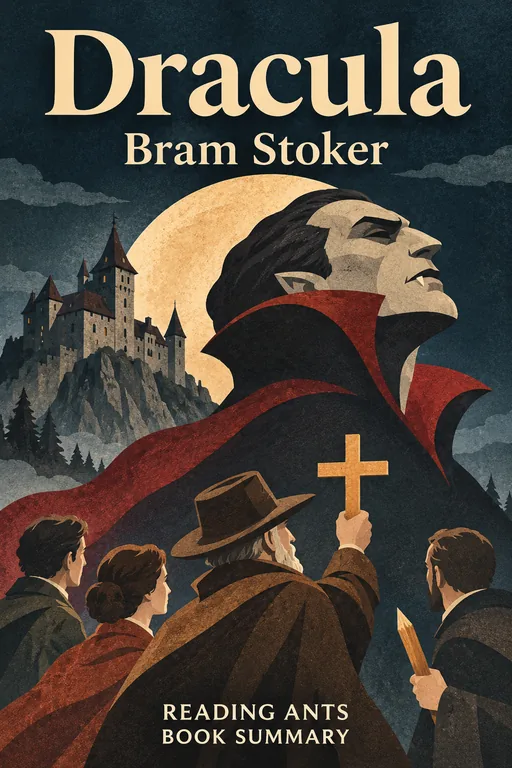
Dracula: the longer summary
Before You Start (No Spoilers)
Dracula is the book that created the modern vampire, and it is very different from most vampire stories that came after. Count Dracula is an ancient nobleman from Transylvania who moves to England to find new victims, and the people who stand against him are an ordinary group of friends: a lawyer, a doctor, a young woman, a rich young man, an American adventurer and a Dutch professor who knows about old superstitions. The book is told entirely through diary entries, letters, newspaper clippings and ship’s logs, so the reader sees the story piece by piece, as the characters do.
It is a Gothic horror novel, but it is also an adventure story and a mystery. The first part, set in Count Dracula’s castle, is very suspenseful. The middle part, in England, is slower but creepy. The last part, a race across Europe, is exciting. Stoker builds fear through atmosphere and suggestion more than through gore, though there are some disturbing scenes.
It is a long book, and the language is formal and sometimes old-fashioned. Many readers find it easier to follow if they remember that each section is a different person writing. It is a good read for a keen reader of about thirteen or older, and a rewarding one for adults.
What follows gives away the whole story, including who survives.
Jonathan Harker in Transylvania
The journey. The story opens in May with the journal of Jonathan Harker, a young English solicitor who is traveling to Transylvania to help a client, Count Dracula, buy a house in England. As he travels east, the local people are visibly afraid when they hear where he is going. An old woman gives him a crucifix, and he accepts it politely, though he does not believe in superstition. He is picked up at a mountain pass by a coach driver who turns out to be the Count himself.
The castle. Dracula’s castle is old, isolated and mostly empty. The Count is a tall, thin, pale man with a strange smile and very sharp teeth. He is polite and a little too friendly. He never eats in front of Jonathan and seems to have no servants. Harker also notices that he casts no reflection in the mirror, and that the Count crawls down the castle wall like a lizard. He realizes that he is a prisoner. The doors are locked, and the windows are too high to escape from.
The brides. One night, against the Count’s orders, Harker explores the castle and falls asleep in a forbidden room. He is approached by three beautiful, hungry women, who are about to feed on him when Dracula appears in a rage and sends them away, saying that Harker belongs to him. He gives them a bag with a living child in it instead. Harker then learns that the Count is preparing to leave and that he plans to travel to England in boxes of earth from his home.
Escape. Dracula leaves Harker alone, as the supply of food dwindles. In desperation, Harker climbs down the castle wall and finds the Count lying in a box in the chapel, looking dead but gorged with blood. He is unable to do anything. Soon after, he escapes. He is later found, sick with brain fever, in a hospital in Budapest.
England: Lucy, Mina and the Count
Two friends. Back in England, Jonathan’s fiancée, Mina Murray, a schoolteacher, writes to her friend Lucy Westenra, a lively, pretty young woman who receives three marriage proposals on one day. They come from Arthur Holmwood, a young nobleman; Dr. John Seward, who runs a nearby asylum; and Quincey Morris, an American from Texas. Lucy picks Arthur, and the other two remain her friends.
Whitby. In the summer, Lucy and Mina take a seaside holiday in Whitby. During a great storm, a Russian ship, the Demeter, drifts into the harbor with its dead captain tied to the wheel and the rest of the crew missing. A large dog leaps from the ship and runs away. Meanwhile, Lucy begins sleepwalking, and Mina finds her one night in the churchyard, with a dark shape bent over her and two small marks on her neck.
Renfield. At Dr. Seward’s asylum, which is next to the new property Dracula bought, called Carfax, there is a patient named Renfield, who eats flies and spiders and birds, hoping to gain their life force. He is obsessed with a “master” who is coming. Renfield is both a comic figure and a sad one, and he acts as an unwitting early warning of Dracula’s presence.
Lucy’s illness. Mina goes to Budapest to marry Jonathan, who has recovered, and Lucy stays at home. She grows weaker and paler, though the doctors do not know why. Dr. Seward cannot find a cause and writes to his old teacher, Professor Abraham Van Helsing of Amsterdam, who arrives and recognizes the signs at once. He insists that Lucy must be given blood by transfusion, and Arthur, Seward and Quincey each give theirs, though not enough. He also hangs garlic flowers in her room. But one night, her mother, not understanding, removes them, and Lucy dies.
The undead. Soon afterward, children in the neighborhood report being lured away by a “beautiful lady,” and Van Helsing realizes what has happened: Lucy has become a vampire. He persuades the others to go to her tomb at night. They find her coffin empty and see her returning, her face cruel and unfamiliar. Arthur is horrified. The next night, Arthur drives a stake through her heart, and she finds peace. Van Helsing tells them everything, and the group swears to hunt down the Count.
The Hunt
The team. The five men, Van Helsing, Seward, Arthur, Quincey and Jonathan Harker, decide to find and destroy the boxes of earth that Dracula needs, since he can only rest on soil from his homeland. Mina, who is now Jonathan’s wife and has read the diaries, helps by organizing all the records into one typed file. The group at first hope to keep her safe by leaving her out of their plans.
Mina attacked. Dracula, seeing their plans, strikes at them through Mina. One night, while the men are searching, he enters her room and forces her to drink his blood, leaving a mark on her forehead when Van Helsing touches her with a holy wafer. Mina is now under his influence and she is slowly turning into a vampire. She asks the men to promise that they will kill her if she cannot be saved.
Renfield’s death. Renfield, who has been Dracula’s tool, tries to warn his doctors and is attacked and fatally injured by Dracula. Before he dies, he tells Seward what happened. It is an act of redemption that costs him his life.
The boxes. The group raids Carfax and the other houses that Dracula has bought, sanctifying the boxes of earth with the host so that he cannot use them. Dracula, realizing that he is cornered, escapes by ship to the Black Sea, heading for Varna and home.
The Chase to Transylvania
Pursuit. Van Helsing uses Mina’s growing link with Dracula, which he can tap through hypnosis, to learn where the Count is. Mina can feel that he is on the ship and can hear the lapping of the water and the creaking of the timber. The group travels to Varna on the Black Sea, where they expect the Count to land, but they discover that his ship, the Czarina Catherine, has gone instead to Galatz, further up the Danube. By the time they arrive, his box has been handed over to a Slovak crew who take it up the river, and from there gypsies carry it overland toward the castle. The group splits up to catch it. Jonathan and Arthur follow the river in a steam launch, Quincey and Dr. Seward ride along the bank, and Van Helsing takes Mina by carriage to the castle itself.
At the castle. Van Helsing leaves Mina inside a circle drawn with holy wafer, which the wolves and the vampire women cannot cross. He goes into the castle alone, finds the three brides asleep in their tombs and destroys each of them by driving a stake through the heart and cutting off the head. He then seals the entrances so that the Count can never enter there again.
The last battle. The men close in on the cart carrying the Count’s box as it races toward the castle at sunset, and Van Helsing and Mina watch from the heights with the others. The gypsy guards are forced to stop, and a fight breaks out. Quincey Morris is stabbed, but just as the sun goes down, Jonathan slashes the Count’s throat with his big curved knife while Quincey drives his own knife into his heart. Dracula crumbles to dust, and in his last moment there is a look of peace on his face. Quincey, mortally wounded, dies, saying that he is happy to have been part of it. At the same instant, the red mark on Mina’s forehead vanishes.
Epilogue. The book ends with a note written by Jonathan seven years later. He and Mina have a son who was born on the very day that Quincey died, and the boy carries the names of all their friends, though they call him Quincey. When the family returns to Transylvania, Jonathan notes that almost nothing remains to prove their story, but Van Helsing, with the child on his knee, says that they need no proof and that the boy will one day know what a brave and gallant woman his mother is.
More Moments Worth Knowing
Dracula in daylight. One surprise for readers who know the movies is that, in the book, sunlight does not destroy the Count. Jonathan sees him walking through a busy London street in broad daylight, looking younger than before, and is so shaken that he faints. Dracula’s powers are weaker in the day, but he is not helpless, which makes him harder to track and more frightening than the film version.
The three suitors. Lucy’s three proposals are among the lighter scenes in the first half. The three men remain friends even after Lucy has chosen Arthur, and they later fight together. Their friendship is one of the book’s quiet strengths: each of them is willing to give his own blood to try to save her, and when she dies, they are together in their grief.
The blood transfusions. At the time the book was written, blood transfusions were new and risky. Stoker uses them to show that the men are willing to sacrifice something of themselves, and to show that the old and the new, science and superstition, must be used together. Van Helsing’s secrecy about the transfusions, which he keeps from Arthur until the end, is part of the story’s mood of confusion and fear.
Garlic, crucifix and invitation. The book sets out its rules gradually: a vampire cannot enter a home unless invited, cannot cross running water on his own, and is repelled by garlic, crucifixes and consecrated objects. Some of these details are in Van Helsing’s lectures, and some are discovered by trial and error. This is one reason it feels like a mystery: the characters, and the reader, learn the rules as the danger grows.
Mina’s mind and the Count’s. After Dracula has bitten Mina, she is connected to him. Van Helsing hypnotizes her at dawn and sunset, when the link is strongest, to find out what the Count is doing. It is both a clever plot device and a source of tension, since the closer she is to him, the more danger she is in. Mina herself faces this with remarkable calm and courage.
The typewriter and the phonograph. Several characters use modern tools to keep their records. Dr. Seward records his diary on a phonograph, and Mina types out all the documents. The book is partly about a battle between a very old evil and a very modern society, and the heroes win partly by organizing information better than the Count.
Who’s Who
- Jonathan Harker: a young English solicitor, honest and brave. His journal begins the novel.
- Mina Murray (later Harker): Jonathan’s fiancée and wife, intelligent, practical and the heart of the group.
- Lucy Westenra: Mina’s friend, charming and lively, who becomes the Count’s first English victim.
- Count Dracula: an ancient vampire, a nobleman from Transylvania, cunning and powerful.
- Professor Abraham Van Helsing: a Dutch doctor and scholar who understands the supernatural.
- Dr. John Seward: a young psychiatrist who runs an asylum, scientific and kind.
- Arthur Holmwood: Lucy’s fiancé, later Lord Godalming.
- Quincey Morris: an American adventurer, brave and cheerful.
- R. M. Renfield: an asylum patient who becomes Dracula’s servant.
- The three brides: the vampire women at Castle Dracula.
Key Scenes Explained
The coach to the castle. The early chapters do a remarkable job of making an ordinary traveler feel afraid. Harker is a rational man in a land of superstitions, and he gradually realizes that the superstitions are right.
Harker’s discovery in the chapel. The sight of the Count lying in his coffin, gorged with blood, is one of the book’s most memorable moments. It is not a fight but a horror of recognition.
The Demeter. The ship’s log, kept by a captain who tries to understand what is picking off his crew, gives a chilling, claustrophobic view of the Count’s journey.
Lucy’s death and the staking. The sequence of Lucy’s illness, death and staking shows both the horror of the vampire and the love of her friends. The staking is not an act of violence but an act of mercy.
Mina and the team. Mina’s role changes through the book. She starts as a quiet observer, becomes the group’s organizer and finally the person whose link to the Count makes it possible to catch him.
The sunset battle. It is quick and decisive, a final chase rather than a long fight, and it ends with a sense of release.
A Note on Reading It Today
Some parts of the book, especially its attitudes toward women and foreigners, reflect the 1890s and can feel dated. The way the men talk about protecting Mina and Lucy can be uncomfortable, even though Mina is shown to be braver and cleverer than most of them. The book is easier to enjoy if you read it as a product of its time and notice where it supports and where it quietly undercuts those attitudes.
Why It Still Matters
Dracula has been adapted more times than almost any other book, and it shaped how we think about vampires: the cape, the fangs, the coffin, the fear of sunlight, garlic and holy symbols. It is also a book about fear of the outsider, of disease and of the new technologies of the time, such as typewriters, telegrams and blood transfusions. Readers still debate what the book says about gender, sexuality, empire and science, and there is no single answer. It remains a classic of suspense.
What to Notice While Reading
- The way the story is told. Each voice has its own style and reveals different things, so the reader has to put the pieces together.
- Old and new. The heroes use modern tools, such as typewriters, phonographs and trains, against an ancient evil. Look for the contrast.
- Mina. She is one of the strongest characters in the book, and the others depend on her intelligence. Notice how the men treat her.
- Faith and science. Van Helsing mixes medical knowledge with religious objects. Notice how the book respects both.
- What is never shown. Dracula is rarely shown directly. Notice how Stoker keeps him in the background and builds fear through hints.
Questions to Think About
- Why do you think Stoker chose to tell the story through letters and diaries?
- Is Renfield a villain, a victim or something else?
- Why does Van Helsing think it is right to destroy Lucy?
- How is Mina different from Lucy, and how do the other characters treat them?
- What does Dracula want, and why is he frightening?
If You Liked Dracula
Try Frankenstein for another classic of horror and science, Strange Case of Dr Jekyll and Mr Hyde for a short, tense story about a hidden self, The Hound of the Baskervilles for atmospheric mystery on the moors, or The Phantom of the Opera for another old Gothic.
Want the whole book?
A summary is a taste, not the meal. Here is where to find the full book.