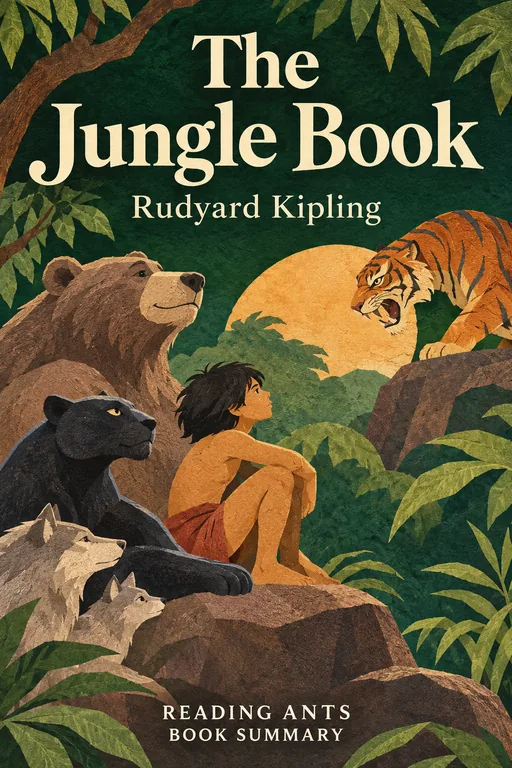
The Jungle Book: the longer summary
In One Sentence
A human boy raised by wolves in the Indian jungle learns the Law of the Jungle from a wise bear and a panther, and must outwit a man-eating tiger, in a collection of classic animal stories.
Before You Start (No Spoilers)
The Jungle Book is a collection of stories by Rudyard Kipling, whose stories here are set chiefly among animals and people in India. The most famous tales follow Mowgli, a little boy who wanders into the jungle as a baby and is raised by a family of wolves. Guided by Baloo, a kindly bear, and Bagheera, a sleek black panther, Mowgli learns to live by the Law of the Jungle while being hunted by Shere Khan, a fierce tiger. The book also includes other famous stories, such as Rikki-Tikki-Tavi, about a brave mongoose who fights cobras. Each story ends with a poem. Published in 1894, the collection combines prose adventures with poems that give different voices to the animals.
Who’s Who
- Mowgli: a brave, clever human boy raised by wolves.
- Baloo: a sleepy, wise brown bear who teaches Mowgli the Law of the Jungle.
- Bagheera: a powerful, cunning black panther and Mowgli’s protector.
- Akela: the gray leader of the wolf pack.
- Shere Khan: a lame, cruel tiger who wants to kill Mowgli.
- Kaa: a huge, ancient python.
- The Bandar-log: a noisy, foolish tribe of monkeys.
- Rikki-Tikki-Tavi: a fearless young mongoose.
Full Summary
Mowgli’s Brothers
One evening, a naked human baby toddles into a wolf cave in the Seeonee Hills, having escaped from the tiger Shere Khan, who attacked his family. Father Wolf and Mother Wolf decide to keep him, and Mother Wolf gives him the name Mowgli. Shere Khan demands the boy, but Mother Wolf drives him away.
At the wolf pack’s council, the wolves must decide whether to accept the human cub. Baloo the bear speaks for him, and Bagheera the panther offers a freshly killed bull as payment for Mowgli’s life. The pack accepts him. Mowgli grows up among the wolves, learning from Baloo the laws and languages of the jungle.
Years later, as the old leader Akela grows weak, Shere Khan turns the young wolves against Mowgli. Bagheera tells Mowgli to bring fire from a human village. At the council, Mowgli waves a burning branch, drives Shere Khan away and saves Akela’s life. But he knows he must leave the jungle for a time and live among humans. As he leaves, he weeps for the first time.
Kaa’s Hunting
In an earlier adventure, Mowgli talks with and is flattered by the Bandar-log, the monkey people, whom the other animals despise because they have no law and forget everything. The monkeys kidnap him and carry him through the treetops to the ruins of an ancient city called the Cold Lairs.
Baloo and Bagheera ask for help from Kaa, a giant python feared by the monkeys. At the ruins, Bagheera and Baloo fight the monkeys. Kaa helps defeat them and breaks a stone screen so Mowgli can escape. After the rescue, his hypnotic dance also fascinates Baloo and Bagheera, and Mowgli draws his friends away. Mowgli is safe, and he learns that being part of a community, with rules and loyalty, is better than the careless freedom of the monkeys.
Tiger! Tiger!
When Mowgli goes to live in a human village, a woman named Messua, who lost a son to a tiger long ago, takes him in. Mowgli herds the village buffalo. His wolf brother, Gray Brother, warns him that Shere Khan is coming. Mowgli and his wolf friends drive the buffalo herd into a narrow ravine where the tiger is sleeping, and the stampeding buffalo trample Shere Khan to death.
When Mowgli skins the tiger, the village hunter tries to take the skin. The villagers, frightened by Mowgli’s power over animals, call him a sorcerer and drive him away with stones. Mowgli returns to the jungle and lays Shere Khan’s skin on the wolves’ Council Rock, keeping his promise. He realizes he belongs to neither humans nor wolves completely.
The White Seal
In the cold northern seas, a rare white seal named Kotick is born. Each year, men come to the beaches to club seals for their fur. Horrified, Kotick sets out on a long journey to find a beach where seals can live safely, swimming across the oceans and meeting many sea creatures. At last, guided by sea cows, he discovers a secluded breeding place reached through an underwater passage, and he leads his people there.
Rikki-Tikki-Tavi
In a garden in India, a young mongoose named Rikki-Tikki-Tavi is washed out of his burrow by a flood and adopted by an English family. He is curious and brave. In the garden live two deadly cobras, Nag and his wife Nagaina, who plan to kill the family so they can rule the garden. One night, Rikki-Tikki attacks Nag in the bathroom and holds on until the boy’s father shoots the cobra. He destroys most of the cobra eggs and uses the last one to draw Nagaina away from the family’s young son, Teddy. He then follows her into her underground hole and emerges after killing her. He becomes the hero of the garden.
Elephants and Soldiers
In Toomai of the Elephants, a young boy who works with elephants is jokingly told that he can join the elephant catchers after seeing the elephants dance in the jungle. One night, his elephant carries him to a secret clearing where many elephants gather and stamp the earth, and he is honored for witnessing their hidden activity. In Her Majesty’s Servants, the animals of an army camp, such as horses, mules, camels and elephants, discuss their duties and why they obey orders.
Interpretation: More Than One Boy’s Adventure
Mowgli enters a community with rules
The wolves do not take Mowgli in simply because he is an interesting visitor. The adults have to decide whether a human child can belong to the pack. Mother Wolf is ready to protect him, but her wish must meet the wider group’s custom. Baloo’s support and Bagheera’s payment give him a place within that shared order.
This beginning helps explain why the Law of the Jungle matters so much. In ordinary speech, people sometimes use that phrase to mean that the strongest may do anything. Kipling’s animals instead have rules about hunting, protection, speech and membership. Their law can restrain power, even though those who dislike a decision may still try to undermine it.
Shere Khan wants the boy excluded and works over time to weaken the protection around him. When Akela grows old, the tiger sees a chance to turn the pack’s younger members against both the leader and Mowgli. The danger is political as well as physical. Mowgli must understand shifting loyalties, not merely run faster than an enemy.
Mowgli’s abilities also make him an outsider
Learning the languages of different animals gives Mowgli a way to ask for help. Knowing what to say is important because the jungle contains many groups, each with its own habits and dangers. Baloo’s lessons may feel tiresome to a playful child, yet they provide skills he later needs when friends cannot stand beside him.
Bagheera brings a different kind of knowledge. Having known human captivity, he understands that the boy’s relationship with people cannot be avoided forever. Mowgli can live among wolves and still possess powers they fear, including his ability to handle fire. His difference is not something education can completely remove.
At the council, fire lets him defeat the threat against Akela and himself. It also makes the distance between him and the wolves harder to ignore. He has used a human power to settle a jungle conflict. The tears he sheds as he prepares to leave show that becoming aware of his human identity does not make his animal family less beloved.
The monkey adventure tests a tempting kind of freedom
The Bandar-log flatter Mowgli and make him feel important. They appear to offer a life without the difficult lessons Baloo insists on. Their promises are attractive partly because they pay attention to him in exactly the way he wants at that moment.
Once they carry him off, their lack of steady purpose becomes frightening. They make declarations, forget them and leap toward the next excitement. Their crowded company does not give him the safety of a real community. He cannot depend on a promise simply because many voices repeat it.
The rescue requires help from Kaa, whom the other friends approach because they cannot solve the problem alone. The python is dangerous, but he is not a deceitful enemy in this episode. His frightening power is part of what makes the rescue possible. The episode asks readers to distinguish a creature’s threatening appearance from its actual role in a particular situation.
Human belonging proves difficult too
In the village, Mowgli has to learn practices that other children take for granted. Money, clothing, work and spoken customs are unfamiliar. Messua’s care gives him a household, but it does not immediately teach the whole community to trust him.
His experience with the buffalo draws on knowledge acquired outside the village. Working with Gray Brother and Akela, he uses the terrain and the herd to defeat Shere Khan. It is a planned act, unlike a contest in which the boy would try to match the tiger’s strength directly.
The villagers do not receive his success as straightforward proof of heroism. His unusual command of animals makes them afraid, and the dispute over the tiger’s skin gives fear a practical focus. Mowgli returns to the jungle having discovered that human birth does not guarantee human acceptance. The first volume leaves him between communities rather than ending with a simple choice of one true home.
Kotick’s search turns difference into a responsibility
The White Seal moves the collection far from Mowgli’s jungle. Kotick begins in a crowded breeding place where the other seals accept dangerous human activity as a fact of life. Seeing seals driven away to be killed makes him question what the adults around him have learned to endure.
His unusual color marks him out, but the real change comes from persistence. He travels, asks other creatures for information and refuses to accept that the familiar beach is the only possible home. Most of the creatures he consults cannot solve the problem. The search succeeds through patient attention to clues that others dismiss.
Finding a safe place is not enough. He must persuade other seals to leave what they know. Some do not believe him; others resist changing their habits. His return therefore becomes a test of leadership as well as exploration. The story gives safety a collective purpose: Kotick’s discovery matters because others eventually share it.
Rikki-tikki’s garden is another community under threat
The garden seems smaller and more domestic than the jungle, yet it also contains competing needs and dangers. Rikki-tikki receives care from the human household and begins learning about the creatures nearby. His curiosity helps him notice what a less alert newcomer might miss.
The cobras threaten both the family and the smaller garden animals. Rikki-tikki needs more than courage to oppose them. He watches, listens and uses openings created by others. Darzee’s wife, in particular, provides practical help through distraction, showing that the mongoose is not acting entirely alone.
The fight becomes a struggle over the future when Rikki-tikki finds the cobra eggs. The story presents their destruction as part of protecting the garden, but young readers may find it troubling. It is useful to notice that this is a fierce animal adventure rather than a story in which every creature can be made friendly. Its happy ending depends on the defeat of others.
Toomai sees a life beyond human work
The elephant story begins among people who handle and use elephants. Little Toomai wants to be taken seriously within that working world. He knows and loves Kala Nag, but the adults do not initially treat the boy’s curiosity as proof that he is ready for a greater role.
The journey into the forest lets him witness elephants gathering away from their human keepers. The enormous animals possess a hidden life that the camp’s routines do not reveal. Toomai can observe it because of his relationship with Kala Nag and because he is willing to follow into an unfamiliar place.
When the adults accept his report, they give him public honor. Yet the most important discovery is not merely that a child wins praise. He has seen that animals used for labor remain beings with experiences beyond the work humans assign them. The celebration depends on respecting a mystery, not on completely explaining it.
The final army tale invites questions about obedience
In the camp story, working animals discuss the jobs they do and the orders they follow. A horse, mule, camel or elephant experiences military work differently. Their argument is comic, but it also suggests that a large organization depends on many kinds of effort that are easy to overlook.
The story admires order and presents the chain of command as a source of strength. Modern readers should also ask whose order is being praised. The setting is an imperial army, and the human comparisons reflect unequal judgments about different peoples. The same collection that values loyalty and belonging also carries assumptions produced by British rule in India.
Reading the whole volume makes those tensions clearer. It is not one continuous Mowgli story and does not always offer the same answer about freedom. The tales move between rules that protect, habits that endanger, wild lives outside human control and systems that demand obedience. Those differences give families several things to discuss rather than a single lesson to memorize.
Why It Still Matters
Reading the whole first collection changes the emphasis from one boy’s adventures to several kinds of community. The wolves debate membership, the monkeys offer unstable promises, and Kotick must persuade others to share a safer home. Rikki-tikki’s garden and the military camp have different rules again. The stories do not all treat freedom and obedience in the same way.
The animal characters make these questions vivid through action. A protective rule can be challenged, a leader can become vulnerable, and the smallest participant may supply information that stronger companions lack. At the same time, the human households and army belong to the colonial setting represented in the text. Readers can admire loyalty while asking whose authority is being accepted. These are interpretations of the collection’s scenes, not a claim that every animal stands for one fixed kind of person or that all the tales offer a single political lesson.
Key Takeaways (Interpretation)
- Belonging matters. Mowgli searches for a place where he truly fits.
- Rules protect communities. The Law of the Jungle keeps the animals safe and fair.
- Courage can overcome size. Little Rikki-Tikki defeats deadly cobras.
- Loyalty and friendship sustain us. Baloo, Bagheera and the wolves stand by Mowgli.
- Brains beat brawn. Mowgli uses fire and the buffalo herd to defeat a stronger tiger.
What We Can Learn
The stories teach the value of learning from wise mentors. Mowgli survives because he listens to Baloo and Bagheera, even when their lessons seem boring. Teachers, parents and older friends can help us avoid danger and grow strong.
They also show that it’s okay to feel caught between different worlds. Many children who move to new countries or communities, or who belong to more than one culture, feel like Mowgli. Finding friends who accept you as you are is precious.
Finally, Rikki-Tikki-Tavi reminds us that being small or young doesn’t mean we can’t be brave. Standing up to protect others is a mark of true courage.
Criticism and Counterpoints
The rules do not make every conflict fair. Shere Khan exploits the pack’s divisions, and the army tale praises a hierarchy within an imperial setting. The descriptions of the monkeys also invite questions about how a group is dismissed as unworthy of respect. Meanwhile, Rikki-tikki’s protection of the garden requires killing the cobras and destroying their eggs. Children may need space to discuss that violence rather than being told that every creature’s defeat is uncomplicated. This collection’s different endings should be considered separately.
Who Should Read It
These stories suit readers from about 8 upward, and they are excellent for reading aloud. Readers should expect fierce fights as well as friendship, and several independent stories rather than a single continuous adventure. Adults can enjoy them while also thinking about their historical context.
What to Notice While Reading
- The first volume’s limits. Later Mowgli adventures belong to The Second Jungle Book. This collection ends his main sequence with the tiger’s defeat and his uncertain place between communities.
- Promises and membership. Compare the wolves’ council with the monkeys’ boasts. A noisy group is not always a reliable community.
- Helpers of different sizes. Kaa, the birds and the sea cows contribute in different ways. Heroes often need knowledge they do not possess.
- Animals as characters and animals as symbols. The creatures have vivid habits, but Kipling also uses them to discuss human rules and power.
- Empire in the background. The English household and army camp belong to a colonial world. Notice whose viewpoint is treated as normal.
Questions to Think About
- Which rules help protect Mowgli, and who tries to misuse them?
- Why do the monkeys’ promises appeal to him?
- What must Kotick do after discovering the safe beach?
- How does Toomai’s experience change what the adults think he knows?
- Do all the stories value obedience in the same way?
Want the whole book?
A summary is a taste, not the meal. Here is where to find the full book.