 Reading Ants
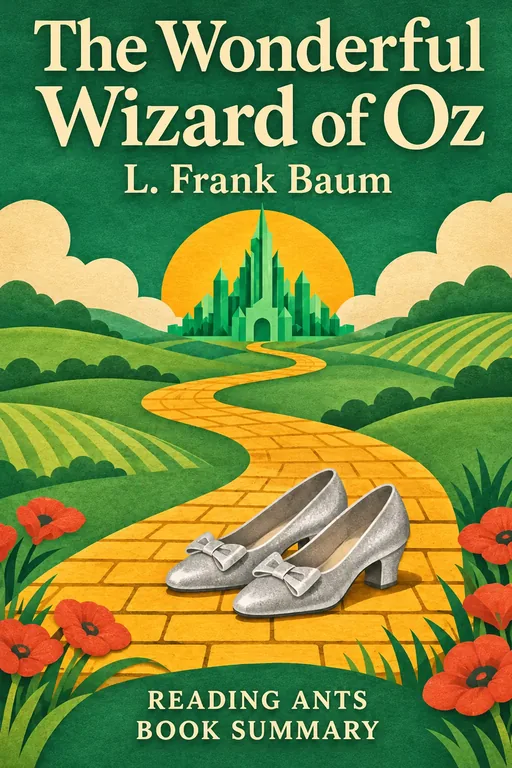
The Wonderful Wizard of Oz: the longer summary
In One Sentence
Swept by a cyclone to the magical Land of Oz, a Kansas girl follows the yellow brick road with three unusual friends to ask a great wizard for help, and learns they already had what they were seeking.
Before You Start (No Spoilers)
The Wonderful Wizard of Oz, published in 1900, follows a child through a country of talking animals, witches and strange communities. Dorothy, a young girl, lives on a gray, dusty farm in Kansas with her Aunt Em, Uncle Henry and her little dog Toto. One day a cyclone lifts their house into the sky and drops it in the colorful Land of Oz, where it lands on the Wicked Witch of the East. To get home, Dorothy must reach the Emerald City and ask the powerful Wizard of Oz for help. Along the way she makes three unusual friends, each with a wish of his own. The original journey continues beyond the exposure of the Wizard, so reaching the Emerald City is only part of Dorothy’s search for a way home.
Who’s Who
- Dorothy: a brave, practical girl from Kansas who wants to go home.
- Toto: Dorothy’s loyal little black dog.
- The Scarecrow: who wants a brain.
- The Tin Woodman: who wants a heart.
- The Cowardly Lion: who wants courage.
- The Wizard of Oz: the mysterious ruler of the Emerald City.
- The Wicked Witch of the West: a cruel witch who wants Dorothy’s magic shoes.
- Glinda: the Good Witch of the South.
- The Good Witch of the North: who welcomes Dorothy to Oz.
Full Summary
The Cyclone
Dorothy lives on the flat, gray Kansas prairie, where everything, even her aunt and uncle, seems faded by sun and wind. One day a cyclone strikes. Dorothy runs into the house to catch Toto, and the whirling wind carries the house up into the sky. It lands with a bump in a beautiful country full of flowers and streams: the Land of Oz.
The little Munchkin people and the Good Witch of the North greet her joyfully. Dorothy’s house has landed on the Wicked Witch of the East and killed her. Dorothy takes the dead witch’s magic silver shoes, and the Good Witch gives her a protective kiss on her forehead, and tells her that only the great Wizard of Oz, who lives in the Emerald City, can help her get home. She must follow the road of yellow brick.
Three New Friends
On her journey, Dorothy meets a Scarecrow hanging on a pole. He longs for a brain, so he won’t be thought foolish, and he joins her to ask the Wizard for one. Next they find a Tin Woodman, rusted stiff in the forest. After they oil his joints, he explains that he was once a man who loved a Munchkin girl, but a witch’s curse caused him to chop off pieces of himself, which a tinsmith replaced with tin. He has no heart and wants one, so that he can love again. Finally, a roaring Lion leaps out at them, but when Dorothy slaps his nose, he admits he is a coward. He wants courage.
Along the way, the friends cross a deep ditch, escape fierce beasts called Kalidahs, and rescue Dorothy and the Lion from a deadly field of sleep-inducing poppies.
The Great and Terrible Wizard
In the Emerald City, everyone wears green-tinted glasses, so everything looks green. The Wizard agrees to see each traveler alone, appearing to each in a different form: a giant head, a lovely lady, a terrible beast and a ball of fire. He tells them he will grant their wishes only if they kill the Wicked Witch of the West, who rules the land of the Winkies.
The Wicked Witch of the West
The Witch sees them coming with her one powerful eye and sends wolves, crows, bees and soldiers against them, but the friends defeat them all. Then she uses a magic Golden Cap to summon the Winged Monkeys, who capture Dorothy and the Lion and tear apart the Scarecrow and the Tin Woodman. Because of the Good Witch’s kiss, the Witch cannot harm Dorothy, so she makes her a servant and tries to steal her magic shoes. When the Witch tricks her and takes one shoe, Dorothy angrily throws a bucket of water over her. To Dorothy’s surprise, the Witch melts away completely. Dorothy frees the Lion and the Winkies, who help repair the Scarecrow and the Tin Woodman.
The Truth About the Wizard
Back in the Emerald City, the friends demand their rewards. When Toto knocks over a screen, they discover that the Wizard is just an ordinary old man from Omaha, who arrived in Oz long ago in a hot-air balloon and pretended to be a powerful wizard. Still, he gives the Scarecrow a substitute brain made of bran and pins, the Tin Woodman a silk heart stuffed with sawdust, and the Lion a drink presented as courage. Each is satisfied, because each already had what he wanted: the Scarecrow had been thinking cleverly, the Tin Woodman had been caring, and the Lion had been brave all along.
Going Home
The Wizard plans to take Dorothy home in his balloon, but when Toto runs off, Dorothy chases him, and the balloon floats away without her. The friends travel south to visit Glinda, the Good Witch of the South. On the way, they face fighting trees, a china country with fragile people, and a giant spider-like monster that terrorizes the forest animals, which the Lion defeats.
Glinda tells Dorothy that her silver shoes could have carried her home all along. Before leaving, Dorothy gives Glinda the Golden Cap, and Glinda uses the three commands available to her as its new owner to send the Scarecrow to rule the Emerald City, the Tin Woodman the Winkies, and the Lion the forest animals, then gives the cap to the Winged Monkeys to set them free. Dorothy clicks her heels together three times and wishes to go home. In an instant she is back in Kansas, running to Aunt Em, so happy to be home again.
The Journey Beyond the Familiar Scenes
Kansas gives Dorothy a reason to return
Baum begins with a landscape whose lack of color reaches into the lives of its people. Aunt Em and Uncle Henry work hard, and their surroundings seem worn down by weather and effort. Toto brings Dorothy a kind of happiness that the farm cannot easily provide. This opening matters because the wish to return home does not depend on Kansas being beautiful or comfortable. It depends on belonging to people there.
The cyclone carries the house rather than simply carrying Dorothy alone. A piece of ordinary life lands inside a fantastic country and immediately changes its politics by killing the Wicked Witch of the East. Dorothy has not intended to free anyone. The Munchkins welcome her as a liberator for an action she did not choose. From the start, other people read power into her circumstances without understanding her.
The good witch who greets her cannot send her to Kansas. She offers protection and a direction instead: Dorothy must seek the Wizard in the Emerald City. The silver shoes also pass into Dorothy’s possession before she understands their use. Like the abilities of the companions she will meet, an important resource exists before anyone recognizes what it can do.
The companions reveal themselves through work
The Scarecrow asks for brains because he thinks a head filled with straw cannot produce useful thought. Yet he repeatedly helps the group solve practical problems. He considers routes, dangers and ways to move the others. His lack is mainly a belief about himself, not an absence visible in his behavior.
The Tin Woodman has a different fear. His metal body makes him think he cannot feel properly without a heart. His concern for living creatures contradicts that belief. He is careful about causing pain and easily moved by another being’s suffering. His body also creates genuine difficulties: water can make him rust, so his friends must care for him physically even while he cares about them emotionally.
The Lion believes that fear disqualifies him from being brave. He can describe his anxiety more readily than he can recognize the courage involved in facing danger while frightened. His size and strength do not remove the need for encouragement. The group works because nobody’s useful qualities make the others unnecessary. Their friendship depends on accepting both ability and vulnerability.
The road requires different kinds of help
The journey is a chain of obstacles rather than a single contest. Gaps in the road, water, dangerous animals and strange landscapes demand different responses. One companion’s strength is useful in a situation where another’s body or habits become a disadvantage. Dorothy’s role is often to keep the group committed to staying together.
The field of poppies makes this especially clear. Beauty becomes danger when the flowers’ scent sends living creatures to sleep. The Scarecrow and Tin Woodman can continue moving, but they cannot simply wish the heavy Lion to safety. The assistance of the field mice shows that small creatures working together can provide help that large travelers cannot supply alone.
Such episodes also give Dorothy relationships outside her original party. Kindness produces connections, and those connections later become practical resources. Baum does not make every rescue a reward automatically delivered by magic. Often somebody has to notice a problem, ask for assistance and organize a response. The fairy-tale world still requires cooperation.
The Wizard’s authority rests on distance
At the Emerald City, visitors are prepared to see what they have been told is there. The green spectacles help make the city’s famous appearance something administered by its rulers. The Wizard also appears differently to different members of the group. Each encounter encourages the visitor to believe in extraordinary power while preventing a simple shared account of what they have seen.
His demand that they destroy the Wicked Witch of the West changes the journey. The travelers have asked for help with personal wishes and are instead assigned a dangerous public task. The supposed authority figure moves the burden onto the people asking for assistance. Dorothy’s lack of experience makes this especially unfair: she has never claimed to be a trained fighter.
The witch sends threats against them, and the companions’ separate abilities become necessary again. Eventually the Winged Monkeys carry out the witch’s command through the Golden Cap. Their involvement has its own rules and history; they are not simply evil animals who choose to attack Dorothy. The book repeatedly gives apparently frightening creatures a situation that requires explanation.
An ordinary action defeats an extraordinary threat
The witch wants Dorothy’s shoes but cannot simply treat the girl as an unprotected prisoner. The protection Dorothy has received limits the witch’s power. That does not prevent intimidation, forced work or deception. Dorothy’s vulnerability remains real even though she possesses magical objects.
When Dorothy throws water over the witch, she is acting in anger, not performing a carefully planned heroic attack. She does not know the result in advance. The witch’s destruction therefore resembles the earlier death of the eastern witch: Dorothy brings liberation without setting out to become a conqueror. The freed Winkies help restore the companions, making rescue something the group receives as well as gives.
The return to the Wizard exposes a different kind of weakness. Behind his frightening appearances is an ordinary man using devices and performance. He cannot honestly supply the transformations he has promised. Yet the tokens he gives the Scarecrow, Tin Woodman and Lion encourage them to trust qualities they have already demonstrated. His deception and his helpfulness coexist, which makes him more complicated than a simple villain.
The story continues after the balloon
Dorothy’s chance to leave with the Wizard fails when the balloon departs without her. The discovery of a false wizard does not itself bring the journey to an end. The travelers must still cross unfamiliar country to seek Glinda in the south. This extended route keeps the exposure of a fraud from becoming an automatic solution to Dorothy’s practical problem.
Their later adventures include a land of delicate china people, whose small bodies and homes can break. Dorothy has to recognize that something she might consider a charming object has its own life and wishes. The companions also move toward futures suited to the qualities others have seen in them. They are becoming members and leaders of communities, rather than merely collecting presents.
Glinda finally explains the silver shoes. The answer has been close to Dorothy throughout the story, but she could not use knowledge she did not have. Her return is therefore not proof that the journey was pointless. It has given her friends, experience and a changed understanding of what home means. Oz is real within the novel; Dorothy returns from another country, rather than waking to discover that the entire adventure never happened.
Why It Still Matters
Dorothy’s companions repeatedly perform the qualities they believe they lack. The Scarecrow helps devise plans, the Tin Woodman cares about suffering, and the Lion acts when frightened. The Wizard’s tokens recognize something already visible in their conduct. This gives the adventure a gentle irony: a title or certificate can change confidence without creating ability from nothing.
The story also separates impressive power from useful care. The Wizard demands a dangerous task he cannot perform himself, while the field mice provide real help by working together. Glinda answers Dorothy’s question more effectively than the performances in the Emerald City. Dorothy’s wish for Kansas survives encounters with places that are richer and more colorful because her attachment is to people, not scenery. These patterns give the changing landscapes a shared emotional purpose without reducing every strange encounter to a single lesson.
Key Takeaways
- We often already have what we seek. The Scarecrow, Tin Woodman and Lion already possess brains, heart and courage.
- Friends make journeys possible. The companions succeed together.
- Appearances can deceive. The great Wizard is an ordinary man.
- Home is precious. Even a gray farm is where Dorothy belongs.
- Courage means acting despite fear. The Lion is brave while afraid.
What We Can Learn
The story encourages us to believe in ourselves. Like the Scarecrow, we might think we aren’t smart enough, or like the Lion, that we aren’t brave. Often, these qualities are already within us and show up when we face challenges.
It also teaches the value of friendship and teamwork. Dorothy’s friends each contribute their own strengths, and together they overcome dangers none could face alone.
Finally, it reminds us not to be fooled by impressive appearances. Powerful-seeming people may be just like us, and true worth lies in kindness, loyalty and courage, not titles or tricks.
Criticism and Counterpoints
A reader can find the Wizard’s gifts reassuring while questioning his earlier demand that a child destroy a witch. His fear explains his behavior without making it fair. The story also treats some violent victories as part of a cheerful adventure: wolves, birds and other threats are killed, and Dorothy’s house has already killed the eastern witch before she understands what happened.
The characters’ claims about themselves are not always reliable explanations. Believing that the Scarecrow already thinks well does not mean that every problem can be solved merely through confidence. The companions also need equipment, knowledge and other creatures’ help. Keeping those practical needs visible gives a fuller reading than treating the journey as a simple instruction to believe in oneself.
Who Should Read It
This book is perfect for readers of about 6 to 10, and for families reading aloud. It is easy to read and full of humor and adventure. Readers may want to pause over the stronger fights and threats rather than assume that every scene is gentle.
What to Notice While Reading
- Silver shoes and incomplete knowledge. Dorothy possesses an important resource long before she learns what it can do. Follow who knows its powers and who does not.
- Abilities before certificates. List the useful things each companion does before receiving a token from the Wizard. Their actions provide evidence against their own judgments.
- Small helpers. The field mice show that strength can come from numbers and organization, not just from a powerful individual.
- Kinds of rule. Compare the witches, the Wizard, Glinda and the communities choosing new leaders. Being impressive and being helpful are separate qualities.
- The southern journey. The chapters after the balloon keep the book from ending with the exposure of a fraud. Dorothy still has to seek reliable knowledge.
Questions to Think About
- Why does Dorothy want to return to a place described as gray and difficult?
- Which action best shows each companion already possessing the quality being sought?
- Is the Wizard kind, dishonest, frightened, or some mixture of these?
- Why should Dorothy respect the wishes of the china people?
- What has Dorothy gained if the shoes could have taken her home earlier?
Want the whole book?
A summary is a taste, not the meal. Here is where to find the full book.