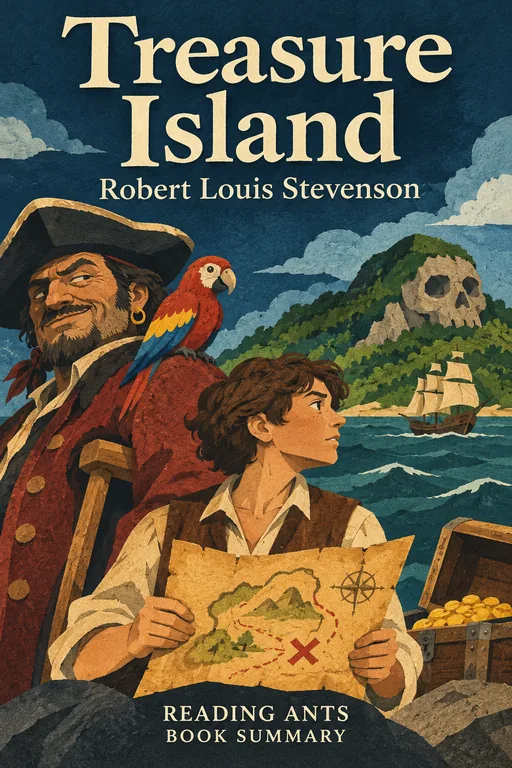
Treasure Island: the longer summary
Before You Start (No Spoilers)
Treasure Island is the adventure story that taught the world what pirates should look like: a one-legged sea cook with a parrot on his shoulder, a map marked with an X, a blind man tapping along a road in the dark, and a chest full of gold. Most of that comes from this book, written by Robert Louis Stevenson and published as a magazine serial and then as a novel in 1883. The story is told by Jim Hawkins, a boy who starts as an innkeeper’s son and ends as a hero, and it is fast, atmospheric and full of tension.
It is easy reading, with short chapters and strong cliffhangers, and many readers finish it in a few days. But it is not a simple story. The most memorable character is Long John Silver, the pirate who is also charming, clever and kind to Jim, and who is never quite who you expect. The book is about growing up, about trust and betrayal, and about the way greed makes people dangerous.
There is a good deal of violence, and some pirates and sailors are killed, but Stevenson describes it briefly and with a light touch. A reader of about ten or eleven can handle it, and it makes a very good read-aloud.
What follows gives away the whole story, including what happens to the treasure and to Silver.
Part One: The Old Buccaneer
A stranger at the inn. Jim Hawkins’s parents run the Admiral Benbow Inn, a lonely inn on the English coast. One day a rough old sailor arrives with a sea chest and takes a room. He tells them to call him Captain, though they later learn that his name is Billy Bones. He drinks heavily, bullies the guests with sea songs and tells Jim to keep a watch for a sailor with one leg. He pays Jim a small coin every month to watch the road.
Black Dog. One day, a pale stranger with two missing fingers, called Black Dog, comes to the inn and asks for the captain. The two quarrel and fight with swords, Black Dog is wounded and runs away, and the captain collapses with a stroke. Dr. Livesey, who looks after him, warns him that he must give up rum or he will die.
The black spot. Billy Bones’s old shipmates track him down. First, a blind man named Pew arrives and, using Jim as a guide, gives the captain a paper with a black spot on it, which is a sign among pirates that a man has been condemned. Billy Bones is so shocked that he has a second stroke and dies. Jim and his mother know the pirates will come back for the chest, so they open it and find a small amount of money and an oilskin packet. They flee just before a gang of pirates, led by Pew, arrives and tears the inn apart. Pew is killed in the confusion when the revenue officers ride up and the pirates scatter.
The map. Jim brings the packet to Dr. Livesey and to the local landowner, Squire Trelawney. Inside is a map of an island, with a cross marking the spot where the notorious pirate Captain Flint buried his treasure. The squire is wildly excited and immediately plans an expedition. Livesey agrees, though he warns the squire to keep it secret.
Part Two: The Sea Cook
Hispaniola. The squire buys a ship, the Hispaniola, and hires a crew in Bristol, with the help of a man he trusts: a one-legged innkeeper named Long John Silver, who will serve as the ship’s cook. Silver is cheerful, intelligent, and clearly well liked, and he brings in several members of the crew. Jim is delighted with him. The ship’s captain, Smollett, is a stern, careful man who does not like the way the squire has talked about the voyage and does not like the crew. He tells them frankly that he believes there are rumors of a treasure hunt and that the crew is not to be trusted. He insists on changes, and the squire and doctor reluctantly agree to store the weapons in the stern near the cabin.
The apple barrel. On the voyage, Jim, hungry one evening, climbs into an empty apple barrel on deck to get an apple. While he is inside, he overhears Silver talking with other sailors. Silver, it turns out, is a former pirate who served under Captain Flint, and he is leading a plan to seize the ship once the treasure is found. Most of the crew are in on it. Jim, in fear, creeps to the captain, the squire and the doctor and tells them everything. They agree that they should pretend to know nothing until they reach the island, and that they should plan to take the ship back.
Part Three: My Shore Adventure
The island. When the Hispaniola arrives, the crew is eager to go ashore, and Smollett, to keep them calm, lets half of them go. Jim sneaks into one of the boats and escapes onto the island. From a hiding place in the trees, he sees Silver talking with a sailor named Tom, who refuses to join the mutiny. Silver kills him and his own crew murder another man nearby. Jim is horrified and runs.
Ben Gunn. Running through the woods, Jim meets a strange, ragged man, who is half mad from three years of being marooned on the island. His name is Ben Gunn, and he was once a pirate who had been with Flint. He is lonely, craves cheese and wants to be taken home. He tells Jim that he has a plan and might be able to help.
Part Four: The Stockade
Abandoning the ship. Meanwhile, back on the ship, the loyal men, led by Smollett, the squire and the doctor, realize that the mutiny has begun. They load boats with supplies and weapons, and Dr. Livesey and the others make their way ashore, leaving the ship to the pirates. They take possession of a log stockade on the island.
The fight. Jim, who has found his friends, helps defend the stockade. The pirates, led by Silver, attack, and there is a series of fights in which each side loses men. Silver also sends a message under a white flag, asking for the map, and is refused. The captain is wounded, but the loyal party survives, thanks to its better leadership and the pirates’ disorder.
Part Five: My Sea Adventure
Jim’s secret mission. Jim, restless, slips away at dawn. He finds Ben Gunn’s coracle, a small round boat of skin and wood, and rows out to the Hispaniola, which is guarded by only two pirates, Israel Hands and another. He cuts the anchor cable and lets the ship drift, hoping to run it ashore. The two pirates have been fighting, and one is dead and the other badly wounded. Hands, the coxswain, promises Jim that he will show him how to sail. They run the ship aground at a quiet beach, but Hands then tries to kill Jim. Jim climbs the rigging, and, as Hands throws a knife that pins his shoulder, Jim fires both pistols and Hands falls into the water, dead. Jim takes the ship, which he controls for the moment, and hides her in a safe place.
Part Six: Captain Silver
Captured. Jim returns to the stockade in the dark, only to find that the pirates have taken it. Silver, who now commands them, has captured the doctor and the others, and he uses Jim as a hostage. Most of the pirates are impatient with Silver, who has lost many men, and some of them give him the black spot, a sign that they are removing him. Silver, quick-witted, shows them that he has the map, which the doctor had given him as part of a secret agreement to keep Jim safe, and the mutineers accept him again.
The treasure hunt. Silver leads the pirates, with the prisoners, across the island following the map and a series of clues, with Jim on a rope. They reach the spot where the treasure should be. It is an empty hole. A previous visitor, Ben Gunn, has already dug it up and moved it to a cave. The doctor and his party appear and, in a quick fight, they capture or scatter the remaining pirates.
Home. Ben Gunn leads them to the cave, which contains a great pile of coins and gold bars. The group carry it to the ship, and, with a few pirates marooned on the island, they sail for England. Silver, who has stayed with them as a prisoner, slips away at a port in the West Indies with a small bag of coins. The squire and the doctor are relieved, and Jim says he will never again go back to the island, though he often has nightmares about it.
How the Book Came to Be
Stevenson began the story on a rainy holiday in Scotland, when he drew a map of an imaginary island for his young stepson. He has said that the map came first and the story grew out of it: he looked at the coastline and the names and started to write. The book first appeared as a serial in a boys’ magazine before it was published as a novel. Because he was writing chapter by chapter, with each part ending on a hook, the story moves fast and every chapter seems to bring a new danger or surprise. He also wanted to write a book that was fun to read, and that is part of why it has lasted.
Other Moments Worth Remembering
Dr. Livesey’s calm. Throughout the book, the doctor is the steadiest voice. He is brave, he does not boast, and he has a gentle way of correcting people. Notice how often he is right and how often he is willing to treat even an enemy fairly.
Captain Smollett’s warnings. Smollett is not a likable character, but he sees the danger before anyone else. His speech to the squire and the doctor, in which he says plainly what he does not like about the ship, the crew and the voyage, is the first clue that Stevenson wants us to trust competence over charm.
The squire’s mistake. Trelawney is generous and enthusiastic, and his boasting about the treasure is the reason the pirates know about the voyage. His error shows that good intentions are not enough.
Jim’s coracle. The small, round boat that Ben Gunn made is an odd, hard-to-steer craft that spins in circles. It is a small, funny detail, and it also shows how resourceful, and how reckless, Jim is in his lone trip to the ship.
Silver’s choices. Silver’s behavior is always based on calculation, and he changes sides when he thinks it is safe. He is willing to protect Jim when it helps him. This makes him one of the most interesting villains in English fiction, since the reader is never certain whether any kindness is real.
Who’s Who
- Jim Hawkins: the narrator, brave, curious and sometimes careless, who grows up quickly.
- Long John Silver: the ship’s cook and the leader of the mutineers, charming, shrewd and dangerous. The most famous pirate in fiction.
- Dr. Livesey: a sensible doctor and magistrate who is calm in a crisis.
- Squire Trelawney: the generous, excitable landowner who finances the expedition and talks too much.
- Captain Smollett: the disciplined captain of the Hispaniola, blunt and always right about danger.
- Billy Bones: the old buccaneer whose chest sets the story in motion.
- Blind Pew: the blind beggar who delivers the black spot.
- Black Dog: a pirate who visits the inn.
- Ben Gunn: the marooned former pirate, half mad but good-hearted.
- Israel Hands: Silver’s coxswain, who fights Jim on the ship.
- Captain Flint: the dead pirate whose treasure is hidden on the island. His name is also that of Silver’s parrot.
Key Scenes Explained
The arrival of the captain. The first chapters set up the danger without showing it. The old sailor is afraid of something, and the reader, like Jim, does not know what.
The apple barrel. This is the moment that everything changes. By overhearing Silver, Jim learns the truth, and from then on the story is a game of knowing and not showing what you know.
Silver and Jim. Silver’s relationship with Jim is the heart of the book. He is a kind of father figure who is also a threat, and Jim can neither fully trust nor fully hate him.
Jim and the Hispaniola. Jim’s solo trip to the ship is his coming-of-age moment. He is on his own, and he makes a smart, brave decision, but also a risky one.
The empty hole. The treasure is gone when they arrive, which turns the pirates’ expectation upside down, and they fall apart. It is also a satisfying twist, since the person who has taken it is the harmless Ben Gunn.
Why It Still Matters
Treasure Island established the image of pirates in popular culture. Skull and crossbones, buried treasure, parrots, the phrase “pieces of eight,” and the one-legged pirate all owe a lot to this novel. Its structure, a boy hero and a charming villain, has been copied many times. It is also a book about moral choices: Silver is not purely evil, and Jim, the hero, behaves with courage but also makes mistakes. It has been adapted for film and television dozens of times.
What to Notice While Reading
- Silver is more than a villain. Notice the ways he is generous, funny and persuasive, and the ways in which he is dangerous.
- Jim makes mistakes. He is impulsive and sometimes breaks orders, and the story rewards some of those choices and punishes others.
- The first-person narration. Because Jim tells the story, we sometimes see events only from his limited view. Look for places where he does not understand something until later.
- Greed. Almost everyone in the book wants the treasure, and almost everyone behaves worse because of it.
- The map. The map is a plot device, a symbol and a source of tension. Note who has it, who wants it and what it actually leads to.
Questions to Think About
- Why does Silver treat Jim so well, and is it real affection or a calculation?
- Is Jim a good hero? Which of his choices do you think were wise, and which were reckless?
- What does the book suggest about adventure: is it wonderful, dangerous, or both?
- Why do you think Stevenson lets Silver escape at the end?
- How are the pirates different from the gentlemen, and how are they alike?
If You Liked Treasure Island
Try Kidnapped by Robert Louis Stevenson for another story of a boy caught up in danger, The Adventures of Tom Sawyer for a different kind of boyhood adventure, Robinson Crusoe for the original island story, or Peter Pan for pirates in a fantasy world.
Want the whole book?
A summary is a taste, not the meal. Here is where to find the full book.