 Reading Ants
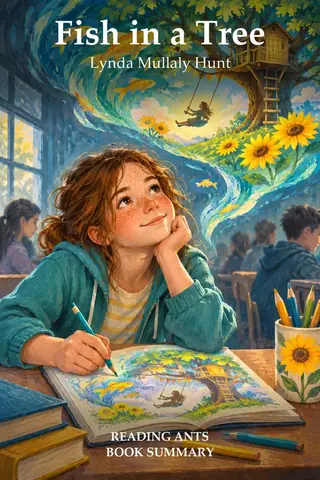
Fish in a Tree
A sixth-grade girl who has hidden for years that she cannot read finds a teacher who sees her talents, learns she has dyslexia, and starts to believe in herself.
Overview
Fish in a Tree is a 2015 novel by Lynda Mullaly Hunt, told in the first person by Ally Nickerson. Ally is in sixth grade, and because her father is in the military and the family has moved often, she has already been to seven schools. At each one she has worked hard at not being found out. Ally is imaginative, artistic and good at math, but reading is a struggle she cannot admit to. The book follows what happens when a new teacher finally looks past her bad behavior and asks what is going on. The title comes from a saying, often credited to Albert Einstein, that if we judge every animal by how well it climbs a tree, a fish will always seem foolish.
Main Characters
- Ally Nickerson: the narrator, a bright, artistic and funny girl with undiagnosed dyslexia.
- Mr. Daniels: the new teacher who notices her gifts and helps her get tested.
- Keisha: an outspoken classmate who dreams of being a baker and becomes Ally’s friend.
- Albert: a classmate who loves science, is bullied, and refuses to fight back at first.
- Shay: a wealthy, mean classmate who picks on Ally and her friends.
- Travis: Ally’s older brother, who struggles with reading too.
- Ally’s family: her father serves in the military and is deployed during the story; her mother and Travis are close to her.
Full Summary
A Secret in Plain Sight
Ally Nickerson has been to seven schools in seven years, and her new classroom looks like the others. She cannot read well, but she has learned many ways to avoid showing it. She acts up, distracts the class, gets sent out of the room, and pretends to be sick when a reading task comes. Most teachers see only a troublemaker, and Ally fears that she is simply stupid. Each time she moves, she has to start the act again, and it is exhausting. Her father’s deployment makes hiding harder than ever. The one thing she feels sure of is her sketchbook, which she calls her Sketchbook of Impossible Things.
The Substitute
Ally’s regular teacher goes on maternity leave, and a new teacher, Mr. Daniels, takes over the class. He is different from the teachers Ally has known. When she misbehaves, he does not just punish her. He looks closely and notices that she has a creative mind, artistic skill and a talent for math. He treats her as someone worth understanding. Ally cannot trust him at first, because kindness has not usually lasted, and she keeps waiting for him to lose patience like the others. But she cannot help being curious about him. He seems to enjoy the way her mind works, and he is willing to say so out loud, which no teacher has done before. Slowly, Ally begins to wonder whether this time might be different.
Finding a Name for the Problem
Mr. Daniels slowly earns Ally’s trust and persuades her to be tested. The result is that Ally has dyslexia, a learning difference that makes reading and writing hard even for very smart people. For the first time she has a word for what she has been fighting. He then works with her on methods that suit the way she learns, and with practice her reading slowly improves. Her confidence grows with it.
Unexpected Friends
As Ally becomes less afraid, she makes friends. Keisha is outspoken and dreams of being a baker. Albert is a big, science-loving boy who often arrives at school with bruises from bullies, yet he will not fight back. The three of them are an unlikely team, but they stand up for each other. Ally begins to see that other people carry their own troubles, and that she does not have to be alone with hers. Spending time with her friends, she worries less about what Shay and others think of her.
Shay and the Election
Shay is wealthy and cruel, and she and her friend Jessica make fun of Ally, Keisha and Albert. When the class holds an election for president, Shay is nominated, and she nominates Ally in return. It is a risky moment for a girl who used to hide at the back of the room. With encouragement from Albert and Keisha, Ally writes a speech and speaks up in front of everyone. When the votes are counted, Ally wins. It is more than a school prize. It shows her that other people respect her and that she has a voice, and that the girl who could not read can still lead. Shay only becomes more hostile, and later, when bullies attack Ally and her friends, Albert finally stands up and fights back to protect them.
Never Too Late
Mr. Daniels tells the class about famous and accomplished people believed to have had dyslexia, such as Albert Einstein, so that everyone understands that difficulty with reading says nothing about how smart a person is. Ally also realizes that her older brother Travis, who struggles with reading and writing, probably has dyslexia too. At first he does not want her help, but in the end she introduces him to Mr. Daniels, who agrees to work with him. The story ends with Ally no longer ashamed. She still has work to do, but she knows she is a capable person with a way of thinking that is her own.
Why It Matters
Fish in a Tree is a well-known children’s novel about dyslexia. It won the Schneider Family Book Award in 2016, which honors books that portray the experience of disability, as well as the Crystal Kite Award. The author has said that she struggled with reading as a child herself, and Mr. Daniels was modeled on her own sixth-grade teacher.
Its importance also lies in the way it treats teachers. The story shows how much difference one adult who is willing to look past a child’s behavior can make. It is easy to use in a classroom or at home to open talks about kindness, bullying and the many ways of being smart.
Key Takeaways
- Smart comes in many forms. A student who cannot read well may still be a brilliant artist, thinker or problem solver.
- Behavior is often a message. Ally acts out to cover her fear, and a good teacher asks why.
- A name can bring relief. Learning that her struggle is called dyslexia lets Ally stop blaming herself.
- Friends help us be brave. Keisha and Albert show Ally she can be honest about herself.
- It is never too late to get help. Even Ally’s older brother can still find support.
What We Can Learn
If you find something difficult, such as reading, math or speaking in front of others, it does not mean you are not clever. Look for a trusted adult, a teacher or a parent, and tell them what is really happening. Hiding a problem usually makes it heavier.
The book also asks us to look at classmates more carefully. A child who jokes around, daydreams or seems to be rude may be covering up something they cannot say. You can be the person who asks kindly instead of laughing. Standing up for someone who is being bullied, as Ally and her friends do for Albert, does not need to be dramatic. Sitting with someone at lunch or telling an adult is often enough.
Criticism and Counterpoints
Kirkus Reviews, while praising the book’s warmth, found its messages heavy-handed: objects such as a coin with a flaw and cupcakes with hidden letters are used to spell out the themes, and some characters, including the snobbish rival, the brainy boy and the unconventional teacher, seem like stereotypes. A teacher who arrives at just the right moment and a class election that crowns the hero may also make real life look simpler than it is. Even so, reviewers such as those at School Library Journal praised the book for choosing hard work and small changes over an unrealistic happy ending.
Who Should Read It
This book is a good fit for readers from about nine or ten to twelve, especially children who struggle with reading or who feel they do not fit in. It includes teasing and one scene of boys physically attacking three children, so it is worth a talk with younger readers. It is also useful for parents and teachers who want to understand how a learning difference can feel. Readers who like fast plots may find it quiet, because most of the action is about friendship and feelings at school.
Want the whole book?
A summary is a taste, not the meal. Here is where to find the full book.
You reached the end 🎉
Nicely done. Mark this one as read, and we will suggest what to read next.
Read this next
Wonder
R. J. Palacio
A ten-year-old boy born with a rare facial difference goes to school for the first time, and through bullying, friendship and courage he helps everyone around him learn to choose kindness.
🧸 Children's Books
The One and Only Ivan
Katherine Applegate
A gorilla named Ivan, who lives in a small cage in a shopping mall, promises to rescue a baby elephant named Ruby and finds his voice through painting.
🧸 Children's Books
Because of Winn-Dixie
Kate DiCamillo
A lonely ten-year-old girl named India Opal Buloni adopts a stray dog in a Florida grocery store and, with his help, makes new friends and learns to cope with the mother who left her.
🧸 Children's Books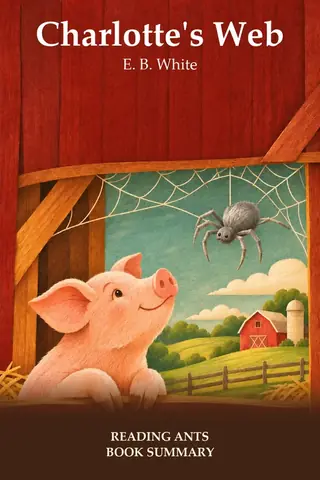
Charlotte's Web
E. B. White
A lonely pig named Wilbur learns he is going to be killed, and his clever friend Charlotte, a spider, comes up with an amazing plan to save his life.
🧸 Children's Books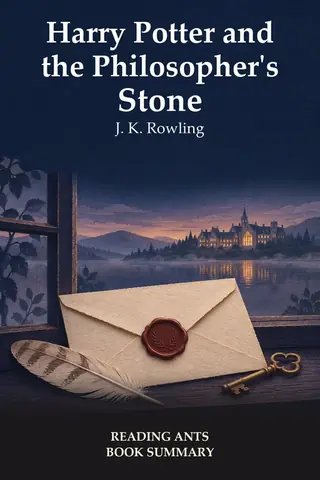
Harry Potter and the Philosopher's Stone
J. K. Rowling
An unloved orphan boy discovers on his eleventh birthday that he is a famous wizard, and during his first year at a magical school he makes true friends and faces the dark wizard who killed his parents.
🧸 Children's Books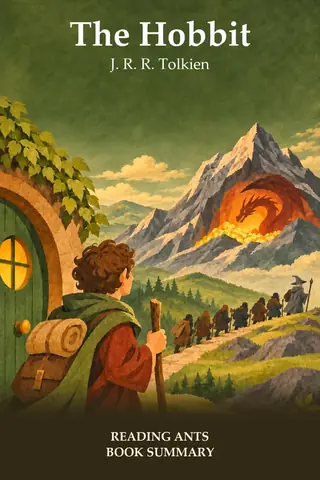
The Hobbit
J. R. R. Tolkien
A comfortable, home-loving hobbit is swept into a dangerous quest with thirteen dwarves to win back their treasure from a dragon, and discovers along the way that he is far braver and cleverer than he ever imagined.
🧸 Children's BooksWant something different?
Pick another topic and we will show you three books to start with.