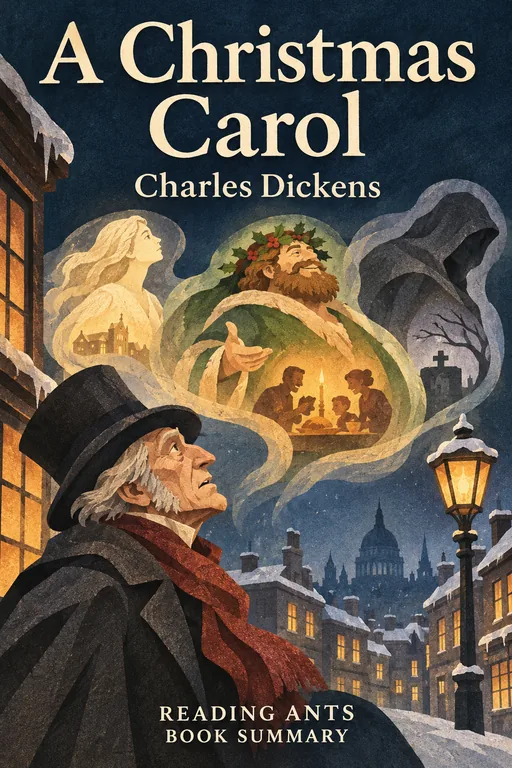
A Christmas Carol: the longer summary
In One Sentence
On Christmas Eve, a cold-hearted, miserly old man is visited by the ghost of his dead partner and three spirits, who show him his past, present and future, and by morning he is transformed into a generous, joyful man.
Before You Start (No Spoilers)
A Christmas Carol, published in December 1843, follows a businessman forced to confront the effects of his choices. Ebenezer Scrooge is a rich, greedy businessman in London who hates Christmas and cares about nothing but money. He pays his clerk, Bob Cratchit, a tiny wage and refuses to give to charity. On Christmas Eve, the ghost of his former business partner, Jacob Marley, appears in chains and warns him that he will be visited by three spirits. Through their visions, Scrooge sees how his greed has hurt others and himself. The visions join private regrets with scenes of poverty and exclusion, asking whether he can change while there is still time to act.
Who’s Who
- Ebenezer Scrooge: a cold, stingy old businessman.
- Jacob Marley: Scrooge’s dead business partner, now a ghost.
- Bob Cratchit: Scrooge’s poorly paid, cheerful clerk.
- Tiny Tim: Bob’s youngest son, who is seriously ill.
- Fred: Scrooge’s warm-hearted nephew.
- The Ghost of Christmas Past: a spirit who shows Scrooge his youth.
- The Ghost of Christmas Present: a jolly giant who shows Christmas as it is now.
- The Ghost of Christmas Yet to Come: a silent, hooded spirit.
- Fezziwig: Scrooge’s kind former employer.
Full Summary
Marley’s Ghost
On a foggy Christmas Eve, Scrooge works in his cold counting-house, refusing even to let his clerk, Bob Cratchit, have more coal for the fire. His cheerful nephew, Fred, invites him to Christmas dinner, but Scrooge dismisses Christmas as humbug. When two gentlemen ask for donations for the poor, Scrooge says the poor should go to prisons and workhouses, and dismisses the possibility that those institutions might fail to help them.
That night, in his gloomy home, the ghost of Jacob Marley, his partner who died seven years ago, appears, wrapped in heavy chains made of cash boxes, keys and ledgers. Marley explains that he forged these chains in life through his greed and selfishness, and is doomed to wander the world, unable to help others. He warns Scrooge that his own chain is even longer, and that three spirits will visit him to give him a chance to escape Marley’s fate.
The Ghost of Christmas Past
At one o’clock, a strange, glowing spirit appears and takes Scrooge back in time. He sees himself as a lonely boy left at school over Christmas, finding comfort in books. He sees his beloved sister, Fan, arriving to bring him home. He sees his old employer, Mr. Fezziwig, throwing a joyful Christmas party for his workers, and realizes how much happiness a generous boss can give.
Then he sees himself as a young man, as his fiancée, Belle, ends their engagement, saying that he now loves money more than her. Finally, he sees Belle years later, happily married with children, and realizes what he has lost. Overcome, he begs the spirit to show him no more.
The Ghost of Christmas Present
The second spirit, a jolly giant in a green robe, surrounded by a feast, shows Scrooge how people are celebrating Christmas that very day. They visit the Cratchits’ small home, where Bob’s family makes the most of a tiny goose and pudding. Bob’s youngest son, Tiny Tim, who uses a crutch and is very ill, cheerfully says that God should bless everyone. The spirit warns that, unless things change, Tiny Tim will die. Scrooge is moved.
They visit miners, lighthouse keepers and sailors celebrating, and Fred’s lively party, where the guests play games and Fred kindly toasts his uncle. Before leaving, the spirit reveals two wretched children hiding beneath his robe, named Ignorance and Want, and warns Scrooge to beware of them both.
The Ghost of Christmas Yet to Come
The final spirit is a silent, hooded figure who only points. It shows Scrooge businessmen joking about the death of a man nobody liked, and poor people selling the dead man’s belongings, even his bed curtains. In the Cratchit home, the family is grieving: Tiny Tim has died. Finally, the spirit leads Scrooge to a neglected grave. On the tombstone is his own name. Scrooge falls to his knees and promises to change his life, to honor Christmas and to keep its spirit all year round.
A New Man
Scrooge wakes in his own bed and discovers that it is Christmas morning. The spirits did it all in one night. Laughing with joy, he flings open the window, sends a boy to buy the biggest turkey in the shop and has it delivered secretly to the Cratchits. He gives a generous donation to the charity collectors and goes to Fred’s house for Christmas dinner, where he is warmly welcomed.
The next day, he surprises Bob Cratchit by raising his salary and promising to help his family. He takes a lasting, protective interest in Tiny Tim, who does not die. From then on, it is said, Scrooge knows how to keep Christmas well, better than anyone.
How the Spirits Change Scrooge’s Judgment
A cold office expresses a way of thinking
Scrooge’s harshness begins in ordinary choices. He will not pay for enough warmth for Bob Cratchit, rejects Fred’s invitation and treats the charity visitors as a nuisance. These encounters are different, but his response follows the same rule: anything that does not increase his money appears to be a demand he should resist.
Bob cannot answer him as an equal because he needs his job. Fred can argue more freely, yet his uncle refuses to join a celebration that offers no financial return. The charity visitors challenge Scrooge’s beliefs about strangers. He sends responsibility for them toward institutions and away from himself. His coldness therefore reaches outward from one workplace into his family and the wider city.
Dickens makes the weather reinforce the pattern. The streets are dark and cold, but other people create light, food and company within them. Scrooge has the means to join those pleasures and deliberately shuts himself away. His poverty is emotional rather than financial. That distinction prepares the central reversal: the man with the fullest purse has one of the smallest lives.
Marley cannot repair his own mistakes
Marley’s ghost first frightens Scrooge through its impossible appearance. The greater warning, however, is that death has not freed Marley from the habits of his business life. The chain’s objects connect his present suffering to the money and records that once absorbed him. He carries the shape of his own priorities.
The ghost now understands obligations that he refused to see when alive. He wants to help suffering people but cannot act effectively in their world. His knowledge has arrived after the useful moment. Scrooge still has the power to change a wage, accept an invitation or give food, which makes the visit an opportunity as well as a threat.
This distinction continues through the story. Regret alone is not the desired ending. Marley regrets deeply, but his regret cannot make him a good neighbor again. Scrooge must learn while he can still do something. The spirits’ purpose is not simply to make him miserable about himself; it is to restore the connection between seeing another person’s need and taking useful action.
The past recovers a self he has buried
The first spirit does not begin by showing Scrooge a villainous childhood. It reveals loneliness, imagination and a child who needs affection. Seeing his younger self allows him to feel pity without immediately defending the adult he has become. His sister Fan’s arrival brings a warmth he had almost forgotten.
The memory also changes Fred’s meaning. Fred is not merely an inconvenient cheerful visitor; he is Fan’s son and part of a family Scrooge once loved. Dickens does not make this a long lecture. Recognition links the boy at school with the older man who shut out his nephew earlier that evening.
Fezziwig’s party offers a second form of memory. Scrooge has experienced a workplace where the employer makes people feel valued. The celebration costs something, but its value cannot be reduced to an account book. When Scrooge defends Fezziwig’s kindness, he is already arguing against his own treatment of Bob. A remembered example gives him evidence that authority can be generous without becoming meaningless.
Belle reveals that change happened through choices
The broken engagement shows that Scrooge’s present isolation was not inevitable. Belle sees a man increasingly governed by fear of poverty and desire for money. She does not simply accuse him of having insufficient feeling. She recognizes that his priorities have changed so much that their earlier promise no longer means the same thing to him.
The later scene of her family is painful because it presents a possible life rather than a punishment arranged by an enemy. Scrooge sees affection continuing without him. He cannot buy entry into a past he helped close off. His distress grows from understanding that money, which he treated as protection against loss, has accompanied a different and deeper loss.
He tries to stop the visions when they become unbearable. That resistance is important. Remembering is not automatically pleasant or healing. The spirit requires him to remain with evidence he has avoided. Only then can his unhappiness become an understanding of how he reached this point, rather than another excuse to withdraw.
The present gives strangers names and homes
The second spirit expands Scrooge’s attention beyond his own biography. At the Cratchits’, a small meal carries a great deal of excitement because the family has worked to make it special. Their affection does not erase their poverty. Bob’s limited income affects what they can afford, and Tiny Tim’s fragile health makes that insecurity frightening.
Scrooge’s question about Tim’s future marks a change from his opening remarks about poor people in general. A category has become a child whose family he has seen. The spirit returns the logic of his earlier statements to him, allowing him to hear its cruelty in a specific case. He can no longer treat suffering as a distant calculation without remembering the people inside it.
The visits to isolated workers broaden this recognition. People separated by distance or difficult labor still make room for celebration and connection. Fred’s party also continues without Scrooge, but Fred does not simply turn his uncle into an object of hatred. The invitation remains emotionally available. Scrooge discovers that participation may still be possible if he stops refusing it.
Fear of death becomes concern for the living
The final spirit never explains its scenes in a comforting voice. Scrooge has to connect them himself. Businessmen discuss a death with little feeling, and people sell possessions taken from the dead man’s room. Objects once guarded as private property have become goods to bargain over. A life spent protecting possessions has left nobody eager to protect its owner’s memory.
The Cratchits’ grief provides the opposite picture. Their loss matters because Tim belonged to them and was loved. The contrast does not say that a poor person’s life automatically has greater worth. It shows how relationships make a death different for those who remain. Scrooge begins to understand the kind of absence his own behavior has prepared.
The grave makes the implication unavoidable, but Scrooge asks whether this future can change. That question links fear to responsibility. On waking, he does not know every detail of what will happen. He knows enough to begin acting: food for the Cratchits, support for charity, dinner with Fred and better treatment of Bob. The story confirms his transformation through continued conduct, rather than leaving it at one delighted Christmas morning.
Why It Still Matters
The story makes an argument about responsibility through a sequence of experiences rather than a single speech. Memory first helps Scrooge feel for the child he once was. Observation then brings him into other people’s households. Finally, an uncertain future makes the consequences of continuing unchanged impossible to dismiss. The methods differ because his resistance has several sources.
Dickens also makes the change visible in material things. Bob needs warmth and a better wage; the Cratchits need food and support; Fred offers a place at a table. Generosity is not merely a pleasant state of mind. Scrooge must do things that alter what other people can enjoy or endure.
The conclusion returns to the same kinds of choices that established his character at the beginning. He has another chance to respond to a child, a charity collector, his nephew and his clerk. Those repetitions allow readers to judge change by conduct. His joy is important, but the narrator’s account of the years afterward matters more than a single morning of excitement.
Key Takeaways
- It’s never too late to change. Scrooge transforms in a single night.
- Generosity brings joy. Giving makes Scrooge happier than hoarding ever did.
- Greed isolates us. Scrooge’s love of money cost him love and friendship.
- We are responsible for others. The poor, like Tiny Tim, depend on the kindness of society.
- The past, present and future connect. Our choices today shape tomorrow.
What We Can Learn
A Christmas Carol teaches that kindness and generosity make life richer. Sharing what we have, whether money, time or simply a kind word, can bring happiness to others and to ourselves.
It also reminds us to think about how our choices affect the future. Like Scrooge, we can ask: What kind of person am I becoming? What will people remember about me?
Finally, the story encourages us to notice those in need, especially at holidays, when loneliness and poverty can feel even harder. Inviting someone to share a meal, or supporting a local charity, keeps the spirit of the story alive.
Criticism and Counterpoints
Scrooge’s transformation takes place through supernatural intervention in a single night. That design compresses changes that might be slower and less complete in ordinary life. It makes a powerful fable, but should not be treated as a realistic account of how every harmful habit disappears.
The happy ending also concentrates on one wealthy man’s actions. Better wages and continued support help the Cratchits, yet the narrative does not provide a complete system for preventing poverty or protecting every child. Ignorance and Want explicitly widen the problem beyond one household. It is therefore possible to welcome Scrooge’s generosity while asking what additional public obligations the story leaves undeveloped.
Tiny Tim’s vulnerability supplies strong emotional pressure. Readers can be moved by his survival while noticing how much the outcome depends on adults choosing to provide care that should not have been uncertain.
Who Should Read It
This short book is perfect for readers of all ages and is a wonderful family read-aloud during the holiday season. Younger children may find the ghosts a little scary. Reading the visits separately can help younger listeners follow the changes in time and the difference between an imagined future and an event that has already happened.
What to Notice While Reading
- Small decisions before large visions. Coal, an invitation and a charity request establish Scrooge’s character. The ending reverses those kinds of decisions in concrete ways.
- Different methods of teaching. The first spirit uses memory, the second uses observation and the last uses uncertainty and fear. Each reaches something the others could not fully change.
- Food and warmth. Meals and fires make care visible. They also remind readers that kindness has material needs, not just cheerful words.
- Scrooge’s questions. Notice when he stops arguing and begins asking about other people. His attention changes before his behavior can change.
- The two children beneath the robe. Ignorance and Want widen the story from one employer’s failings to a society’s neglect. Private generosity is necessary, but the warning is public too.
Questions to Think About
- Why does Marley need to show his regret rather than merely frighten Scrooge?
- How does remembering Fezziwig challenge Scrooge’s idea of a good employer?
- Does the Cratchits’ enjoyment of Christmas mean they need no help?
- Why does the final spirit remain silent?
- Which action after Scrooge wakes gives the strongest evidence that his change will last?
Want the whole book?
A summary is a taste, not the meal. Here is where to find the full book.