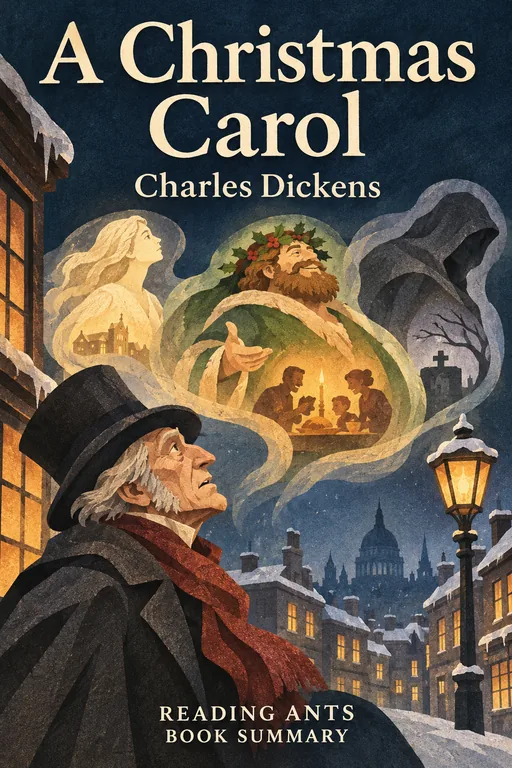
A Christmas Carol
On Christmas Eve, a cold-hearted, miserly old man is visited by the ghost of his dead partner and three spirits, who show him his past, present and future, and by morning he is transformed into a generous, joyful man.
Overview
A Christmas Carol, published in December 1843, is one of the most famous stories ever told about Christmas. Ebenezer Scrooge is a rich, greedy moneylender in London who hates Christmas and cares about nothing but money. He pays his clerk, Bob Cratchit, a tiny wage and refuses to give to charity. On Christmas Eve, the ghost of his former business partner, Jacob Marley, appears in chains and warns him that he will be visited by three spirits. Through their visions, Scrooge sees how his greed has hurt others and himself. Charles Dickens wrote this short novel partly to draw attention to the suffering of the poor, and it helped shape how the world celebrates Christmas.
Main Characters
- Ebenezer Scrooge: a cold, stingy old businessman.
- Jacob Marley: Scrooge’s dead business partner, now a ghost.
- Bob Cratchit: Scrooge’s poorly paid, cheerful clerk.
- Tiny Tim: Bob’s youngest son, who is seriously ill.
- Fred: Scrooge’s warm-hearted nephew.
- The Ghost of Christmas Past: a spirit who shows Scrooge his youth.
- The Ghost of Christmas Present: a jolly giant who shows Christmas as it is now.
- The Ghost of Christmas Yet to Come: a silent, hooded spirit.
- Fezziwig: Scrooge’s kind former employer.
Full Summary
Marley’s Ghost
On a foggy Christmas Eve, Scrooge works in his cold counting-house, refusing even to let his clerk, Bob Cratchit, have more coal for the fire. His cheerful nephew, Fred, invites him to Christmas dinner, but Scrooge dismisses Christmas as “humbug.” When two gentlemen ask for donations for the poor, Scrooge says the poor should go to prisons and workhouses, and if they would rather die, they should do so and reduce the surplus population.
That night, in his gloomy home, the ghost of Jacob Marley, his partner who died seven years ago, appears, wrapped in heavy chains made of cash boxes, keys and ledgers. Marley explains that he forged these chains in life through his greed and selfishness, and is doomed to wander the world, unable to help others. He warns Scrooge that his own chain is even longer, and that three spirits will visit him to give him a chance to escape Marley’s fate.
The Ghost of Christmas Past
At one o’clock, a strange, glowing spirit appears and takes Scrooge back in time. He sees himself as a lonely boy left at school over Christmas, finding comfort in books. He sees his beloved sister, Fan, arriving to bring him home. He sees his old employer, Mr. Fezziwig, throwing a joyful Christmas party for his workers, and realizes how much happiness a generous boss can give.
Then he sees himself as a young man, as his fiancée, Belle, ends their engagement, saying that he now loves money more than her. Finally, he sees Belle years later, happily married with children, and realizes what he has lost. Overcome, he begs the spirit to show him no more.
The Ghost of Christmas Present
The second spirit, a jolly giant in a green robe, surrounded by a feast, shows Scrooge how people are celebrating Christmas that very day. They visit the Cratchits’ small home, where Bob’s family makes the most of a tiny goose and pudding. Bob’s youngest son, Tiny Tim, who uses a crutch and is very ill, cheerfully says that God should bless everyone. The spirit warns that, unless things change, Tiny Tim will die. Scrooge is moved.
They visit miners, lighthouse keepers and sailors celebrating, and Fred’s lively party, where the guests play games and Fred kindly toasts his uncle. Before leaving, the spirit reveals two wretched children hiding beneath his robe, named Ignorance and Want, and warns Scrooge to beware of them both.
The Ghost of Christmas Yet to Come
The final spirit is a silent, hooded figure who only points. It shows Scrooge businessmen joking about the death of a man nobody liked, and poor people selling the dead man’s belongings, even his bed curtains. In the Cratchit home, the family is grieving: Tiny Tim has died. Finally, the spirit leads Scrooge to a neglected grave. On the tombstone is his own name. Scrooge falls to his knees and promises to change his life, to honor Christmas and to keep its spirit all year round.
A New Man
Scrooge wakes in his own bed and discovers that it is Christmas morning. The spirits did it all in one night. Laughing with joy, he flings open the window, sends a boy to buy the biggest turkey in the shop and has it delivered secretly to the Cratchits. He gives a generous donation to the charity collectors and goes to Fred’s house for Christmas dinner, where he is warmly welcomed.
The next day, he surprises Bob Cratchit by raising his salary and promising to help his family. He becomes like a second father to Tiny Tim, who does not die. From then on, it is said, Scrooge knows how to keep Christmas well, better than anyone.
Why It Matters
A Christmas Carol is one of the most popular and most adapted stories ever written. It has been made into countless plays, films, TV specials and cartoons, including versions with the Muppets and Mickey Mouse. It was an instant success in 1843 and has never gone out of print.
The story helped revive and shape the modern celebration of Christmas, emphasizing family gatherings, feasting, generosity and goodwill. The word “Scrooge” became a common name for a stingy person, and “Bah! Humbug!” a famous expression of grumpiness. Dickens also used the story to make readers think about poverty, child welfare and the duty of the rich to help the poor, messages that remain relevant today.
Key Takeaways
- It’s never too late to change. Scrooge transforms in a single night.
- Generosity brings joy. Giving makes Scrooge happier than hoarding ever did.
- Greed isolates us. Scrooge’s love of money cost him love and friendship.
- We are responsible for others. The poor, like Tiny Tim, depend on the kindness of society.
- The past, present and future connect. Our choices today shape tomorrow.
What We Can Learn
A Christmas Carol teaches that kindness and generosity make life richer. Sharing what we have, whether money, time or simply a kind word, can bring happiness to others and to ourselves.
It also reminds us to think about how our choices affect the future. Like Scrooge, we can ask: What kind of person am I becoming? What will people remember about me?
Finally, the story encourages us to notice those in need, especially at holidays, when loneliness and poverty can feel even harder. Inviting someone to share a meal, or supporting a local charity, keeps the spirit of the story alive.
Criticism and Counterpoints
Some critics find the story sentimental, with characters like Tiny Tim designed to pull at readers’ heartstrings, and Scrooge’s change so sudden that it is hard to believe. Others argue that Dickens’s solution to poverty, personal kindness by wealthy individuals, ignores deeper problems that require social reform and fair wages, not just charity at Christmas.
The story also reflects Victorian ideas about family and Christianity, which may feel narrow to some modern readers. Nonetheless, its message of compassion and change continues to resonate with readers of all backgrounds.
Who Should Read It
This short book is perfect for readers of all ages and is a wonderful family read-aloud during the holiday season. Younger children may find the ghosts a little scary. Many families make it a yearly tradition, reading it or watching an adaptation together.
Want the whole book?
A summary is a taste, not the meal. Here is where to find the full book.
You reached the end 🎉
Nicely done. Mark this one as read, and we will suggest what to read next.
Read this next
Oliver Twist
Charles Dickens
An orphan boy born in a workhouse escapes to London, where he falls into a gang of child thieves, and despite cruelty and crime around him, his goodness survives until he finds a loving home and learns the secret of his birth.
📜 Classics
Great Expectations
Charles Dickens
A poor orphan boy suddenly receives a fortune from a secret benefactor and becomes a gentleman in London, but he learns that wealth and status mean nothing without loyalty, kindness and gratitude.
📜 Classics
Andersen's Fairy Tales
Hans Christian Andersen
A Danish storyteller wrote magical, funny and often heartbreaking tales, such as *The Little Mermaid*, *The Ugly Duckling* and *The Emperor's New Clothes*, that speak to children and adults about love, courage and being true to yourself.
🧸 Children's Books
The Picture of Dorian Gray
Oscar Wilde
A beautiful young man wishes that his portrait would grow old instead of him, and as he lives a life of selfish pleasure and cruelty, his face stays perfect while the painting reveals the ugliness of his soul.
📜 Classics
A Tale of Two Cities
Charles Dickens
During the French Revolution, the lives of a French aristocrat who rejects his family, the woman he loves and a brilliant but wasted English lawyer become entangled, until one man makes the ultimate sacrifice for love.
📜 Classics
Pride and Prejudice
Jane Austen
Quick-witted Elizabeth Bennet and the proud, wealthy Mr. Darcy badly misjudge each other, and only by facing their own faults do they find their way to love.
📜 ClassicsWant something different?
Pick another topic and we will show you three books to start with.