 Reading Ants
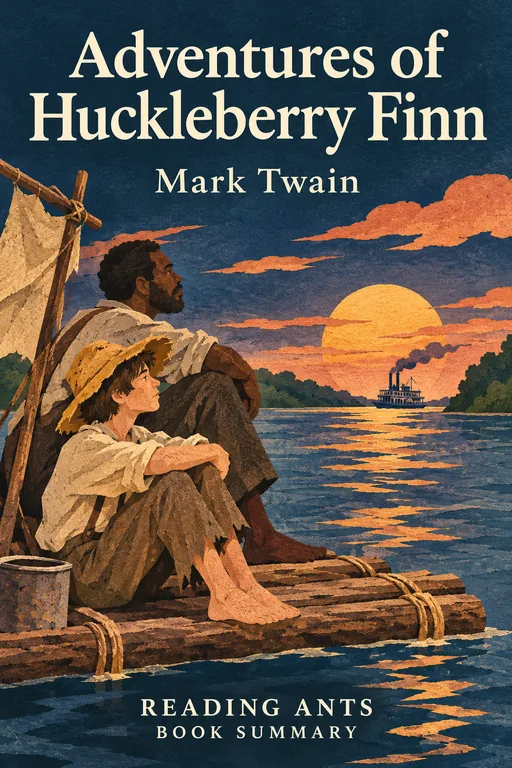
Adventures of Huckleberry Finn: the longer summary
In One Sentence
A runaway boy and an escaped enslaved man float down the Mississippi River on a raft, and as they face swindlers, feuds and danger, the boy learns to follow his conscience rather than the racist rules of his society.
Before You Start (No Spoilers)
Adventures of Huckleberry Finn, published in 1884 in Britain and 1885 in the United States, is narrated by Huck Finn, a poor, uneducated boy from a small town on the Mississippi River in the 1830s or 1840s, before the American Civil War. Huck has been living with a kind widow who wants to “civilize” him, but when his violent, drunken father kidnaps him, Huck fakes his own death and escapes. On an island, he meets Jim, an enslaved man who has run away because he was about to be sold away from his family. Together they travel down the river on a raft toward freedom. Told in Huck’s own funny, vivid voice, the novel is a sharp satire of racism and hypocrisy and an adventure in which the narrator’s judgments repeatedly need to be questioned.
Who’s Who
- Huckleberry Finn: a clever, independent boy with a good heart.
- Jim: an enslaved man escaping to freedom, kind and wise.
- Pap: Huck’s violent, drunken father.
- Widow Douglas and Miss Watson: the sisters who try to raise Huck; Miss Watson owns Jim.
- Tom Sawyer: Huck’s imaginative, adventure-loving friend.
- The Duke and the King: two con men who join Huck and Jim.
- The Grangerfords: a family locked in a deadly feud.
- The Wilks sisters: orphans the con men try to cheat.
Full Summary
Escape
After the adventures of The Adventures of Tom Sawyer, Huck has a fortune held for him by a judge and lives with the Widow Douglas, who tries to teach him manners and religion. Huck initially resists the widow’s rules and schooling, though he gradually becomes used to school before Pap returns. Then his father, Pap, a cruel drunk, returns and demands Huck’s money. He kidnaps Huck and locks him in a cabin in the woods, beating him often.
Huck escapes by faking his own murder, using a pig’s blood to make it look as if robbers killed him. He paddles to Jackson’s Island in the Mississippi, where he discovers Jim, Miss Watson’s enslaved man, who has run away after hearing she plans to sell him downriver, far from his wife and children. Huck promises not to turn him in.
Down the River
When Huck learns that men are coming to search the island for Jim, the two set off on a raft, traveling at night and hiding by day. Their plan is to reach Cairo, Illinois, and then travel up the Ohio River to the free states. On the raft, they live peacefully, talking, fishing and watching the stars. Huck comes to see Jim as a friend and a wise, caring person, not as property.
But Huck is troubled. Everything he has been taught says that helping an enslaved person escape is a terrible sin. At one point, he decides to turn Jim in, but when men searching for runaways approach, he tricks them into leaving by pretending his family has smallpox.
In the fog, they miss Cairo and drift further south, deeper into slave territory. Later, a steamboat smashes the raft, and they are separated.
The Feud
Huck is taken in by the wealthy Grangerford family, who are locked in a decades-old feud with another family, the Shepherdsons. Nobody even remembers how it began. When a Grangerford daughter elopes with a Shepherdson, violence erupts, and several members of both families, including Huck’s friend Buck Grangerford, are killed. Horrified, Huck flees and finds Jim, who has repaired the raft.
The Duke and the King
Two con men join them on the raft, claiming to be a long-lost duke and the rightful king of France. Huck sees through them but plays along to avoid trouble. They cheat towns along the river with fake plays and scams. In one town, they pretend to be the English brothers of a man who has just died, hoping to steal the inheritance from his three orphaned daughters. Huck, moved by the kindness of the eldest sister, Mary Jane, secretly helps her uncover the fraud.
Later, the King betrays Jim, selling him to a farmer named Silas Phelps for a reward by claiming Jim is a runaway.
The Decision
Huck is torn. He writes a letter to Miss Watson telling her where Jim is, and feels relieved, as if he has done the right thing. But then he remembers Jim’s kindness, his friendship and the times Jim protected him. He destroys the letter, accepting what he believes will be spiritual condemnation rather than betraying his friend. His action rejects the racist rule he has been taught, even though he still lacks a clear argument against that rule.
Tom Sawyer’s Scheme
At the Phelps farm, Huck is mistaken for Tom Sawyer, who is Mrs. Phelps’s nephew and expected for a visit. Then Tom himself arrives and adopts the name of his brother Sid. Tom eagerly agrees to help free Jim, but insists on turning the escape into a ridiculous adventure based on books he has read, with secret messages, rope ladders and pointless delays, while Jim stays locked in a shed.
During the escape, Tom is shot in the leg. Jim refuses to leave him and stays to help a doctor treat him, which leads to Jim’s recapture. Then Tom reveals that Miss Watson died two months earlier and freed Jim in her will. Tom knew all along that Jim was free, but wanted the adventure. Jim tells Huck that his father, Pap, is dead; it was Pap’s body they had seen in a floating house earlier. Aunt Sally (Mrs. Phelps) wants to take Huck into her household. He plans instead to leave for the Territory rather than accept another attempt to organize his life.
Interpretation: More of the River Journey
The first escape changes the meaning of home
Huck’s problem at the beginning is more dangerous than his dislike of manners. The Widow Douglas offers a stable household, but his father can still claim control over him. Pap wants access to the money Huck has acquired, and his authority as a parent makes the boy vulnerable. Huck must think for himself because the adults around him cannot reliably protect him from the adult who poses the greatest threat.
His false murder is a carefully staged story. He arranges signs for other people to interpret and then leaves before they can ask questions. Later he will use invented identities and explanations to survive many encounters. The skill is neither entirely admirable nor simply dishonest. In a world where telling the truth can expose him or Jim to violence, Huck often uses a lie to prevent harm.
Jim’s escape has a different purpose. Huck wants to avoid being confined, beaten or forced into respectable habits. Jim is escaping a system that can legally sell him away from his family. Sharing the island brings the two together, but it does not make their dangers equal. Huck can enter white communities under another name. Jim’s presence must often remain hidden even when they badly need help.
Jim refuses to be merely the target of jokes
The raft creates space for conversation that the shore usually denies them. Jim speaks about his family and his plans, while Huck begins to understand the emotional life that his upbringing has taught him to overlook. Their friendship grows through ordinary time together, not only through spectacular rescues.
After the fog separates them, Huck tries to persuade Jim that the separation never happened and was only a dream. Jim initially accepts the story, then sees the evidence of what actually occurred. He explains how frightened he was when he thought Huck was lost and how hurtful the joke feels. Huck has to recognize that another person’s grief cannot fairly be turned into amusement.
His apology matters because it cuts across the hierarchy he has been taught. He is not just being kind to someone supposedly beneath him; he is admitting that Jim has judged his conduct correctly. The friendship requires Huck to change, and Jim becomes an active moral voice within it. This is a more demanding relationship than one in which Jim simply helps the boy without ever criticizing him.
Respectability does not make the shore safe
The Grangerfords welcome Huck into a household that appears cultured and generous. They have fine objects, a proud family history and confidence in their own standing. Those qualities do not prevent them from carrying a murderous feud into everyday life. Violence has become a duty that the younger generation is expected to inherit.
The church episode sharpens the contradiction: people can listen to religious teaching and still keep weapons close because they expect to kill their neighbors. Huck is drawn to the family and especially to Buck, so the eventual bloodshed does not remain an abstract lesson about hypocrisy. It destroys people he has begun to love.
Returning to Jim and the raft brings relief. Yet the river is not outside history or society. The current carries them farther into territory where Jim’s position is especially dangerous. Their peaceful stretches are temporary shelters within a larger system they cannot simply sail away from. The raft offers companionship and a different way of relating, but it cannot guarantee freedom by itself.
The frauds turn other people’s needs into opportunities
The self-styled Duke and King understand that audiences want entertainment, moral certainty and impressive identities. They keep changing their performance to suit the people they expect to cheat. Their invented titles are obvious to Huck, but he also knows that challenging aggressive adults on a raft may be dangerous. His apparent cooperation often conceals his judgment of them.
The Wilks inheritance scheme is particularly cruel because it uses grief. The sisters want to welcome the relatives they believe have arrived after their father’s death. Their trust is a form of generosity, and the frauds treat it as a weakness to exploit. Huck’s sympathy for Mary Jane makes it increasingly impossible for him to remain passive.
His effort to protect the inheritance requires more than privately deciding the men are bad. He moves money, manages explanations and eventually confides in Mary Jane. The episode shows him directing his ingenuity toward another person’s welfare. He still lies, but the novel asks readers to judge the purpose and effect of those lies instead of treating truthfulness as a rule detached from circumstances.
A mistaken conscience meets lived experience
When Huck writes to Miss Watson, he briefly feels that obedience will restore his moral safety. The feeling is disturbing because readers can see that the obedient act would expose Jim to enslavement again. Huck’s inherited conscience has been trained by an unjust society. Feeling righteous is therefore not reliable evidence of doing right.
What changes his decision is memory. He thinks of Jim watching over him, calling him a friend and hoping for a future with his family. The person he knows becomes more real than the category society has supplied. Huck cannot yet express a complete argument against slavery, but he can refuse to betray Jim.
That gap between understanding and language gives the scene much of its force. Huck imagines that he is choosing wickedness, while his action represents a major moral advance. Twain makes readers stand outside the narrator’s stated judgment and assess the behavior for themselves. The novel’s irony depends on noticing how often Huck’s words underestimate what his conduct reveals.
The last escape exposes Tom’s privilege
Tom’s elaborate rescue plan borrows from adventure stories and adds difficulties that have no practical purpose. Huck thinks of direct ways to free Jim, but Tom prefers the experience of performing a dramatic escape. Jim must endure the consequences while the boys argue over what makes a suitable adventure.
The revelation that Tom knows Jim has already been legally freed changes the whole episode. Tom has been taking risks with somebody else’s safety for entertainment. Jim, meanwhile, gives up his chance to flee in order to help the wounded Tom. His choice demonstrates care that is more substantial than the supposedly heroic planning around him.
The ending does not solve every problem. Jim’s legal status has changed, but the society surrounding him has not suddenly become just. Huck avoids another attempt to civilize him, yet his imagined destination is also a place with its own people and conflicts. The last wish for escape is understandable without becoming a complete answer to the inequalities the journey has revealed.
Why It Still Matters
The novel makes Huck’s voice part of its moral problem. Readers hear the language and assumptions he has learned, then watch him act in ways that expose their failures. His friendship with Jim asks for a judgment that Huck himself cannot always put into words. That difference between a narrator’s explanation and the meaning of his actions gives the story much of its force.
The river does not lead into a world free from injustice. Even the most peaceful stretches remain exposed to capture, fraud and violence. A useful reading therefore pays attention both to the relief the raft offers and to the conditions it cannot change. Jim’s grief, plans and decisions also deserve attention beyond their effects on Huck. He is seeking a future with his own family, not merely supplying an education for a white boy.
Key Takeaways (Interpretation)
- A trained conscience can mislead. Huck has learned to feel guilty about helping Jim; memories of his friend lead him to reject that harmful lesson.
- Friendship crosses racial lines. Huck’s bond with Jim challenges racist beliefs.
- Society can be hypocritical. Respectable people support slavery and violence.
- Freedom takes many forms. Huck seeks freedom from society, Jim from slavery.
- Experience teaches truth. Huck learns about humanity through his own adventures, not through lessons.
What We Can Learn
Huck’s story teaches us that sometimes the rules we are taught are wrong. Thinking for ourselves, and listening to our conscience, can lead us to do what is right even when others disagree.
It also shows the power of getting to know people as individuals. Huck’s prejudices begin to fall away as he spends time with Jim and sees his kindness, wisdom and love for his family.
Finally, the novel encourages us to be wary of tricksters and con artists, like the Duke and the King, who use lies to take advantage of others, and to stand up for people being cheated, as Huck does for the Wilks sisters.
Criticism and Counterpoints
The text repeatedly uses racist language and sometimes gives Jim a comic role that limits the seriousness granted to him. Readers should examine those features rather than treating the friendship as proof that every part of the representation is fair. The extended escape at the Phelps farm is particularly troubling because Tom makes Jim endure danger for entertainment. It can be read as an exposure of Tom’s privilege, but that interpretation does not remove the burden placed on Jim or require every reader to find the episode satisfying.
Who Should Read It
This novel suits older teenagers and adults, ideally with discussion of its historical context and racial language. Readers who love adventure, humor and American history will find it rewarding. Discuss Jim as a person with his own family and intentions, rather than considering him only through what Huck learns.
What to Notice While Reading
- Huck’s judgments and Huck’s actions. They do not always agree. Sometimes he calls a humane act wrong because his community has given him a harmful moral vocabulary.
- Jim’s voice. Notice his anger, reasoning, plans for his family and decisions about helping others. These moments complicate the comic stereotypes elsewhere in the novel.
- The cost of entertainment. Tom’s games and the frauds’ performances both depend on people who have less power over what is happening to them.
- River and shore. The raft allows peace but remains exposed to the social world. The contrast is powerful without being a simple division between perfect nature and evil towns.
- Racial language. The narrator’s language reflects the racism of the setting. Reading critically means examining its harm and the limits of the novel’s challenge to it.
Questions to Think About
- Why is Huck willing to apologize after the fog, and what does Jim teach him?
- How can the Grangerfords appear admirable while continuing a deadly feud?
- What makes Huck’s decision about the letter different from simply following his feelings?
- Why does Tom’s knowledge make the final rescue morally troubling?
- Which freedoms do Huck and Jim share, and which remain very different?
Want the whole book?
A summary is a taste, not the meal. Here is where to find the full book.