 Reading Ants
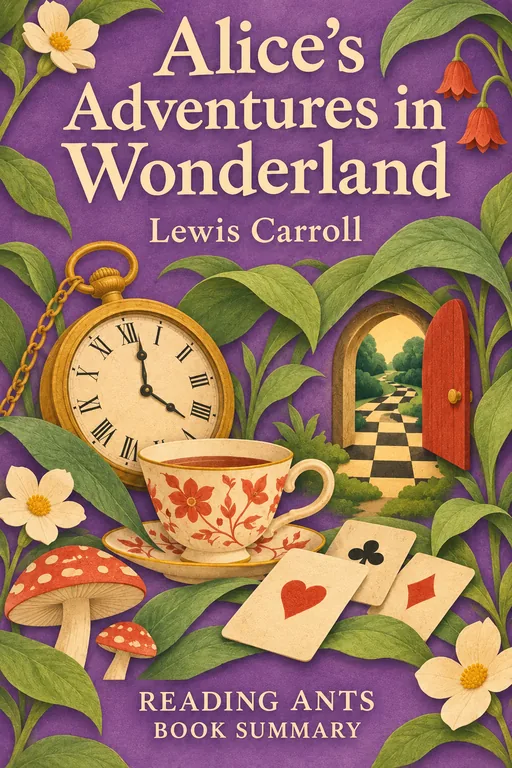
Alice's Adventures in Wonderland: the longer summary
In One Sentence
A curious girl follows a white rabbit down a hole into a crazy world where she keeps changing size, meets mad and marvelous creatures, and stands up to a furious Queen.
Before You Start (No Spoilers)
One hot afternoon, a bored girl named Alice sees a White Rabbit hurry past, wearing a waistcoat and checking a pocket watch. She follows it down a rabbit hole and lands in Wonderland, a place where nothing makes sense: drinks make you shrink, cakes make you grow, cats grin and vanish, and a tea party never ends. The story uses jokes, altered lessons and arguments to unsettle familiar rules. Alice tries to use what she knows, but her own habits sometimes confuse or frighten the creatures she meets.
Who’s Who
- Alice: a curious, polite and sensible young girl.
- The White Rabbit: a nervous rabbit worried about being late.
- The Caterpillar: a rude, sleepy creature sitting on a mushroom.
- The Cheshire Cat: a mysterious cat who grins and disappears.
- The Mad Hatter and the March Hare: hosts of an endless, crazy tea party.
- The Dormouse: a very sleepy guest at the tea party.
- The Queen of Hearts: a furious queen who wants everyone’s head cut off.
- The Gryphon and the Mock Turtle: two odd creatures who tell Alice strange stories.
Full Summary
Down the Rabbit Hole
Alice is sitting on a riverbank with her sister, bored, when a White Rabbit runs by, muttering that he will be late. Curious, Alice follows him down a rabbit hole and falls for a very long time, past cupboards and shelves, until she lands in a hall full of locked doors. Through a tiny door she sees a beautiful garden, but she is too big to fit.
She finds a bottle with a label inviting her to drink, takes some and shrinks, but then she has left the key on a table too high to reach. A cake with a label inviting her to eat makes her grow huge. Upset, she cries enormous tears, then shrinks again and almost drowns in her own pool of tears, which she shares with a mouse and other animals.
Strange Creatures
To dry off, the animals run a silly race organized by a Dodo, in which everyone runs in circles and everyone wins. Then Alice meets the White Rabbit again, who mistakes her for his housemaid and sends her to his house. There she drinks from another bottle and grows so big that she fills the whole house, with one arm out of the window. The animals throw pebbles at her, which turn into little cakes, and eating one shrinks her again.
In the woods, Alice meets a Caterpillar sitting on a mushroom, smoking a long pipe. He asks her who she is, and she admits she hardly knows, having changed so many times that day. He tells her that one side of the mushroom will make her grow and the other side will make her shrink. Alice nibbles carefully until she learns to control her size.
The Duchess and the Cheshire Cat
Alice visits the house of a Duchess, where the cook throws pots and pans and fills the air with so much pepper that everyone sneezes. The Duchess hands Alice a crying baby, which turns into a pig and trots away into the woods.
On a tree sits the Cheshire Cat, who grins widely and can vanish bit by bit until only his grin remains. The Cat refuses to recommend a route until Alice can name a destination. He tells her that everyone in Wonderland is mad, including her, otherwise she wouldn’t have come.
The Mad Tea Party
Alice comes to a table where the Mad Hatter, the March Hare and a sleepy Dormouse are having tea. They shout that there is no room, though the table is huge. The Hatter asks Alice to explain a connection between a bird and a piece of furniture, although he does not know an answer himself. Because the Hatter offended Time, it is always six o’clock, so it is always teatime, and they keep changing places at the table as they use the cups, without time to wash them. The conversation becomes so rude and ridiculous that Alice leaves.
The Queen’s Croquet Game
At last Alice reaches the beautiful garden. Gardeners shaped like playing cards are painting white roses red, because they planted the wrong color by mistake and fear the Queen will cut off their heads. The Queen of Hearts arrives and invites Alice to play croquet, using live flamingos as mallets and hedgehogs as balls. The game is chaos, and the Queen demands the execution of anyone who annoys her, although the King later orders pardons.
The Queen sends Alice to meet the Gryphon and the Mock Turtle, who tells her a long, sad, silly story about his school under the sea, with absurd versions of familiar school subjects, and they show her a dance called the Lobster Quadrille.
The Trial
A trial begins: the Knave of Hearts is accused of stealing the Queen’s tarts. The jury includes animals and birds, and the evidence makes no sense. The Mad Hatter and the Duchess’s cook are called as witnesses. Meanwhile Alice starts growing again.
When Alice is called as a witness, she refuses to follow the silly rules. The Queen wants punishment ordered before the court has even decided guilt. Alice, now full-sized, says this is nonsense. The Queen orders her head cut off, but Alice dismisses the entire court as ordinary playing cards. The cards fly up at her, and suddenly she wakes up on the riverbank with her sister brushing leaves from her face. It was all a wonderful dream.
Interpretation: A Closer Look at Alice’s Journey
A child tries to manage an unfamiliar world
The fall down the rabbit hole is strange partly because Alice has time to think about it. She does not simply scream and land. She looks at the objects around her, wonders where she is going, and tries to use the geography she has learned. Her scraps of school knowledge do not explain the journey, but she keeps reaching for them. This habit stays with her throughout the book: when the world becomes confusing, she tries a rule, a lesson or a polite question.
In the hall, her problem is practical. She wants to enter the garden and has to fit both herself and a key through the right sequence of actions. Each apparent solution creates a new difficulty. Becoming small makes the door usable but the table unreachable. Becoming enormous makes her helpless in another way. She is changing faster than she can understand the consequences. The joke depends on an experience many children recognize: a place built for somebody else’s size can make even a simple task exhausting.
Her tears then become a real obstacle. Once she is small again, she swims in the water she produced while large. Carroll makes an emotion change the physical world of the story. Alice must now cope with the results of an earlier version of herself. She also has company, and that brings another kind of problem: she has to learn that her favorite subjects are not comforting to everyone.
Good intentions do not guarantee good conversation
Alice talks fondly about her cat, Dinah, to creatures that have good reason to fear cats. She is not trying to threaten the Mouse or the birds. She simply assumes that something she loves must be pleasant to discuss. Their alarm makes her social mistakes visible. Wonderland’s inhabitants are often rude, but Alice is not always the considerate person she believes herself to be.
The Dodo’s race gives another example of a familiar activity losing its usual purpose. Nobody has a clear starting point or finish, and everybody receives a prize. The creatures want the ceremony of a competition without its ordinary rules. Alice accepts the arrangement and provides the prizes. She is both an outsider trying to understand and a participant keeping the absurd performance going.
The White Rabbit’s house makes the difference between identity and appearance even more obvious. He mistakes Alice for a servant and orders her about. He does not ask who she is. Once she grows inside his house, the animals outside treat her as a problem to remove. From inside, she knows she is still a girl who made a mistake. From outside, she looks like an alarming intrusion. Neither side has the whole picture.
The mushroom teaches experiment rather than obedience
The Caterpillar’s questions unsettle Alice because she has been relying on a stable answer to who she is. She tries reciting a familiar poem, but the words come out differently. Even her memory, which ought to be something she can carry anywhere, no longer seems reliable. The Caterpillar does not solve this by explaining Wonderland. Instead, he gives her a tool and leaves her to discover how to use it.
Eating the mushroom requires care. Alice must judge how much to take from each side and correct one change with another. At one point her neck becomes so long that a Pigeon mistakes her for a serpent. Alice objects that she is a girl, but the Pigeon argues from what it sees and from her admission that she eats eggs. Their disagreement becomes a comic argument about categories: a creature can collect facts and still reach the wrong conclusion.
Learning to adjust her size matters because it gives Alice some control. She does not become the ruler of Wonderland, and she still makes mistakes, but she can now prepare before entering a small house. Her progress is modest and practical. She learns through repeated attempts rather than through a speech explaining the right lesson.
Houses, tea tables and gardens offer uncertain hospitality
The Duchess’s kitchen is a distorted household. A cook, a baby and a visitor should suggest ordinary domestic life, yet the room is full of sneezing and flying objects. Alice takes the baby outside because she thinks it needs protection. When it becomes a pig, the rescue changes meaning. Carroll does not pause to explain the transformation; the story moves on, leaving Alice to accept another broken expectation.
The tea party also looks welcoming before Alice approaches it. There is a table, food and company. Once she sits down, the hosts turn conversation into a series of traps. They correct her language, demand answers, change the subject and criticize her manners while behaving badly themselves. Alice discovers that knowing the usual rules of politeness does not help if other people apply them only when convenient.
She eventually leaves by choice. This is an important change from scenes in which she is carried along by physical transformations. She can decide that a conversation is unpleasant and stop taking part. Reaching the garden afterward seems like a reward, since it was her original goal. Yet the lovely place contains frightened gardeners and an angry queen. An attractive destination has not guaranteed a sensible society.
The court exposes the weakness of arbitrary power
The croquet match depends on equipment that will not remain equipment. Flamingos move their heads, hedgehogs wander away, and the card soldiers cannot hold the course in place. Winning becomes almost meaningless because players are not acting under stable conditions. The Queen responds by threatening punishment rather than by making the game fair.
The trial gives that habit a more serious shape. A court should test evidence before deciding what happened. Here, authority invents rules when it needs them and treats confusing material as proof. Alice’s increasing size accompanies her increasing confidence, but her strongest act is verbal: she refuses to agree that nonsense becomes reasonable merely because a king or queen announces it.
The ending does more than cancel the adventure. After Alice wakes and tells her sister what happened, the sister continues imagining the creatures and sounds of Wonderland. The dream is over for Alice, but its power passes to a listener. The final movement looks toward Alice growing older while retaining sympathy for children and their stories. Imagination survives the return to ordinary life.
Why It Still Matters
Alice’s adventure turns familiar forms of order into puzzles. A race has no sensible finish, a tea party offers little hospitality, croquet equipment will not stay in place, and a court reverses the work it ought to do. The comedy makes authority questionable by showing what happens when its rules stop serving a shared purpose.
Alice herself remains open to criticism. Talking fondly about her cat frightens animals who might be its prey, and her confidence in lessons does not always help her understand a new situation. Her growth is therefore more interesting than the victory of a flawless child over foolish adults. She learns to experiment, leave an unpleasant conversation and resist the court. The sister’s final imagining also keeps the ending from dismissing the journey as meaningless. A dream can stop happening and still continue through the listener who receives its story.
Key Takeaways (Interpretation)
- Curiosity leads to adventure. Alice’s willingness to follow the rabbit opens a whole new world.
- Growing up can be confusing. Alice’s constant changes in size mirror how children feel as they change.
- Adult rules can be silly. Wonderland mocks authority that makes no sense.
- Keep your common sense. Alice stays polite and logical while everyone else is mad.
- Imagination is powerful. Dreams and play can be as rich as real life.
What We Can Learn
Alice teaches us to stay curious. Asking questions, exploring new places and following our interests, even when they seem odd, can lead to wonderful discoveries.
She also shows the value of standing up for yourself. When the Queen’s trial becomes unfair, Alice speaks up, even though she is the only one who does. It’s okay to question rules that make no sense.
Finally, the book reminds us that it is normal to feel unsure about who we are. Like Alice telling the Caterpillar she isn’t sure who she is, everyone goes through changes, and that is part of growing up.
Criticism and Counterpoints
The adventure advances through sudden changes rather than a tightly connected quest. A reader looking for an explained system of magic may therefore feel frustrated. Wordplay and altered lessons also require attention to sound, so some jokes work better aloud than in a quick paraphrase. Alice’s confidence can obscure her own mistakes, especially when she assumes every listener will welcome talk of Dinah. The story gives her increasing courage, but it does not require accepting every opinion she expresses as the author’s final judgment.
Who Should Read It
This book is lovely read aloud to children from about 5 upward, and confident readers of 8 or older can enjoy it alone. Adults often appreciate its clever logic and humor even more than children do. Readers who prefer clear plots may find its dreamlike style puzzling.
What to Notice While Reading
- Alice’s own mistakes. Watch the conversations about Dinah. The book questions her assumptions as well as the creatures’ behavior, so she is more interesting than a perfectly sensible visitor among fools.
- Rules that keep moving. The race, tea party, croquet match and court each imitate an organized activity. Ask whether the rules serve a useful purpose or simply let somebody claim authority.
- Size and confidence. Being large sometimes makes Alice helpless, and being small sometimes gives her access. Physical size and real power do not match in a simple way.
- Sound changing meaning. Poems, lessons and arguments often turn on words that resemble one another. Read difficult passages aloud; the joke may be easier to hear than to explain.
- The framing riverbank. The quiet beginning and ending hold the chaos together. The sister’s final thoughts give the story affection that the rude creatures themselves often lack.
Questions to Think About
- When does Alice misunderstand another creature’s point of view?
- What does the Pigeon get right about Alice, and where does its reasoning fail?
- Why does Alice leave the tea party instead of continuing to argue?
- What makes the trial unfair before the Queen announces her preferred order of events?
- Does knowing that Wonderland is a dream make its events less meaningful? Why does the story continue briefly after Alice wakes?
Want the whole book?
A summary is a taste, not the meal. Here is where to find the full book.