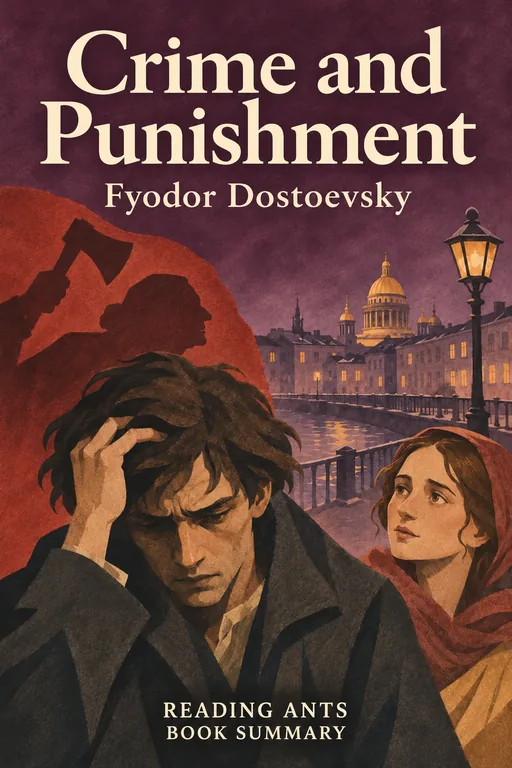
Crime and Punishment: the longer summary
Before You Start (No Spoilers)
Crime and Punishment is a novel about a young man who commits a murder and then cannot live with it. It is often called a detective story told from the murderer’s side: we know who did it from the start, and what keeps us reading is how the guilt works inside him and how a clever investigator slowly closes in. Dostoevsky’s novel was first published in 1866. The setting is the dirty, crowded, hot summer streets of St. Petersburg.
The main character, Raskolnikov, is a poor, proud, brilliant student who has talked himself into believing that a few extraordinary people are above ordinary morality. The book tests that idea, and Raskolnikov, to his own surprise, finds that it does not hold. Around him are some of fiction’s most unforgettable characters: a drunk who loves his daughter, a woman whose faith and compassion challenge his justifications, a sly police magistrate who plays with him like a cat, and a rich, sinister man who knows too much.
It is intense, emotional and sometimes feverish, and it deals with big questions about guilt, forgiveness and faith. It is not a gentle read, and the pace is not always fast, but it is far more gripping than its reputation suggests. It is a book for a mature reader of thirteen or older. What follows gives away the whole plot.
Who’s Who
- Rodion Romanovitch Raskolnikov: a former law student, twenty-three, poor, proud, ill and isolated.
- Sonia (Sofya Semyonovna) Marmeladov: a gentle young woman who has been forced into prostitution to support her family, and who has a deep, simple faith.
- Semyon Marmeladov: Sonia’s father, a former clerk whose drinking repeatedly harms his family.
- Katerina Ivanovna: his proud wife, who suffers from tuberculosis, a serious lung disease, Sonia’s stepmother.
- Dounia (Avdotya Romanovna) Raskolnikov: Raskolnikov’s sister, beautiful, strong-willed.
- Pulcheria Raskolnikov: his loving mother.
- Razumihin: Raskolnikov’s loyal, cheerful friend.
- Porfiry Petrovitch: the clever investigating magistrate.
- Pyotr Petrovitch Luzhin: Dounia’s pompous fiancé.
- Arkady Svidrigaïlov: her former employer, a rich man with a dark past.
- Alyona Ivanovna: the old pawnbroker, and her half-sister Lizaveta.
- Zossimov: Razumihin’s doctor friend.
Part One: The Murder
A man in a closet of a room. On a stifling July day, a young man leaves his tiny attic room, so low that he feels he is being suffocated, and goes to rehearse something that he has been thinking about for weeks. He is Raskolnikov, so poor that he has had to drop out of university and has pawned his last possessions. He visits an old woman, Alyona Ivanovna, a pawnbroker who charges cruel interest, to rehearse the visit. He notes the layout of her flat, when she is alone and where she keeps her money. On the way out he is sick with disgust at himself.
A drunk’s confession. In a tavern he meets Marmeladov, a drunken former civil servant, who tells him about his family: his consumptive second wife, Katerina Ivanovna, and her three small children, and his daughter Sonia, who has gone out on the street to earn money for the family. Marmeladov, ashamed and tearful, drinks the family’s last money.
The letter. Raskolnikov receives a letter from his mother. His sister Dounia has been working as a governess in the house of a man named Svidrigaïlov, who pursued her, and she has been unfairly blamed by his wife. To escape, she has agreed to marry Luzhin, a well-off, self-satisfied official, and his mother and sister are coming to Petersburg. Raskolnikov realizes that the marriage is a sacrifice for his sake, and he is furious.
A dream and a theory. On a walk, Raskolnikov finds a dazed young girl being followed by a man whom he suspects may exploit her, and he gives a policeman money to protect her. He then dreams of a horrible scene from childhood in which peasants beat a horse to death, and he wakes in terror. But he also has a theory: that a few extraordinary people, like Napoleon, have the right to step over moral rules for the sake of a greater good. The old pawnbroker is useless and vicious, and her money could help many people. If he were to kill her and use the money, wouldn’t it be a good thing?
The axe. Raskolnikov overhears that the pawnbroker’s half-sister Lizaveta, a simple, kind woman, will be away the next evening. He takes an axe from a porter’s lodge, hides it under his coat and goes to the old woman’s flat. He kills her. Then Lizaveta unexpectedly comes in, and he kills her too. Terrified, he takes a purse and some trinkets and, as people arrive at the door, narrowly manages to slip out of the building without being seen. He returns to his room, frightened by the traces of the crime and unsure how to conceal them.
Part Two: Fever and Fear
The summons and the hiding place. The morning after the killings, Raskolnikov is summoned to the police station over a debt. He is already agitated and faints when he hears the officers discussing the murders. The summons is not a murder charge, but his reaction makes him fear that he has exposed himself. After leaving, he hides the purse and trinkets under a stone in a yard without examining the money. He makes a confused visit to Razumihin and then returns home, where fever overtakes him.
Care he cannot easily accept. Razumihin and the doctor Zossimov look after him during his illness. Raskolnikov is pulled between wanting protection and fearing that conversation will reveal what he has done. His outward symptoms can be explained as illness and poverty, so the people helping him do not possess the explanation that the reader knows.
A family in crisis. Later, Raskolnikov finds Marmeladov after he has been run over by a carriage. He helps carry him home, where the injured man dies with his daughter Sonia beside him. Raskolnikov gives money to the family for its immediate needs and the funeral. The generosity does not erase the murders, but it shows that compassion and destructive pride remain together in him.
Part Three: The Cat and the Mouse
The family arrives. His mother and Dounia arrive in the city. Raskolnikov, cold and strange, tells his sister that she must not marry Luzhin. He is jealous and frightened. The family realizes there is something wrong with him.
Razumihin. Razumihin, who is warm-hearted and a little foolish, falls in love with Dounia at first sight, and he offers to look after the family. He is the best of friends, and a glimpse of an ordinary, honest life that Raskolnikov rejects.
Porfiry. Razumihin introduces Raskolnikov to a relative, Porfiry Petrovitch, the magistrate in charge of the murder inquiry. Porfiry is friendly, talkative and seems casual, but he is clever and has read Raskolnikov’s newspaper article, in which Raskolnikov put forward his theory of extraordinary men. Porfiry draws him out in a long, polite conversation that is really an interrogation, and Raskolnikov has to keep his nerve.
A strange visitor. A stranger tells Raskolnikov that he is a murderer, then runs away, and Raskolnikov spends hours in terror. He does not yet understand how much the stranger knows or whether the accusation will reach the police. Raskolnikov is losing his sense of what is real.
Part Four: Sonia
A broken engagement and another threat. Svidrigaïlov arrives in Petersburg and approaches Raskolnikov, bringing the threat of his continuing interest in Dounia. During a family meeting, Luzhin demands deference and exposes his wish for a dependent wife. Dounia rejects him. The proposed marriage that was supposed to secure the family’s future ends instead.
The reading. Raskolnikov visits Sonia and asks her to read the New Testament account of Lazarus being raised from the dead. Her faith unsettles him. He promises that, if he returns the next day, he will tell her who killed Lizaveta. He has not yet confessed the murders to her.
A second interview interrupted. He then goes to Porfiry’s office. The questioning becomes a struggle over suspicion and psychological pressure. Before the confrontation can reach the point Porfiry intends, the painter Nikolay enters and confesses to the killings. Raskolnikov receives an unexpected opportunity to leave, but Porfiry does not simply accept the false confession as a solution.
The accuser explained. The man who earlier called Raskolnikov a murderer later apologizes. He had heard about Raskolnikov’s strange return to the murdered woman’s rooms and reported his suspicions. Learning the limited basis of the accusation brings temporary relief, not actual safety.
Part Five: Funeral Dinner and Fall
Luzhin’s trick. At the memorial meal for Marmeladov, Luzhin accuses Sonia of stealing a hundred-rouble note. He has planted it on her after inviting her to his room. Lebeziatnikov saw the money being slipped into her pocket and exposes the trick. Raskolnikov explains Luzhin’s motive for trying to discredit her and him. Sonia is cleared, but the crowded gathering breaks into further anger and confusion.
The confession to Sonia. After the accusation has been exposed, Raskolnikov goes to Sonia and reveals that he killed both women. She is horrified but refuses to abandon him. He tries different explanations and admits that the crime tested his claim to exceptional power more than it served a practical plan to help others. Sonia urges him to acknowledge his guilt publicly and accept punishment. He resists, yet their conversation breaks the isolation in which he has been defending his theory. Svidrigaïlov listens from an adjoining room and learns the secret.
Katerina Ivanovna’s death. The household’s crisis continues in the street. Katerina, seriously ill and increasingly distraught, takes the children out to perform and beg. She collapses and dies after being brought to Sonia’s room. Svidrigaïlov offers money for the funeral and the children’s care, then lets Raskolnikov understand that he overheard the confession. Another person’s knowledge now gives the secret a new danger.
Part Six: The Walls Close In
Porfiry’s final visit. Porfiry comes to Raskolnikov’s room and says that he believes him guilty. He explains why he does not accept Nikolay’s confession as the truth. Instead of staging an immediate arrest, he urges Raskolnikov to confess voluntarily. The apparent escape created by the painter has not ended the investigation.
Dounia faces Svidrigaïlov. Using the knowledge he overheard, Svidrigaïlov draws Dounia into a locked room and presses his demands. She fires a revolver; the first bullet grazes his head, and another attempt misfires. When she drops the weapon and tells him she will never love him, he finally lets her leave. His threat has failed, but the scene makes clear that release is his decision after a frightening exercise of power.
Svidrigaïlov’s last night. After arranging help for Sonia and the children and giving away more money, he spends a disturbed night away from home. Rain, feverish dreams and memories fill the final hours. At dawn, he shoots himself. The novel does not turn his gifts into an acquittal of his earlier conduct.
The public admission. Raskolnikov says goodbye to his family and visits Sonia, who gives him a cross. He goes to the crossroads and kneels, but still struggles to make a full public admission. At the police office he hears of Svidrigaïlov’s suicide and nearly leaves without confessing. Seeing Sonia waiting outside helps bring him back. He returns and states that he killed the pawnbroker and Lizaveta.
Epilogue: Siberia
The sentence and the family. Raskolnikov receives eight years of penal servitude. The court takes several circumstances into account, including his confession, his condition, his failure to use the stolen money and evidence of earlier generous acts. Sonia follows him to Siberia and lives near the prison. Dounia marries Razumihin, and the couple hopes eventually to join them there. Raskolnikov’s mother becomes seriously ill and dies. Her delirious remarks suggest she understands more about her son’s fate than the family has admitted; it is not accurate to say she knows nothing of it.
A beginning rather than a completed conversion. At first Raskolnikov remains bitter and distant from Sonia. During an illness, he dreams of a spreading plague in which people are convinced of their own exclusive truth and cannot live together. Later, by the river, he breaks down in front of Sonia and recognizes his love for her. Seven years of his sentence remain. The narrator presents the possibility of a new life, while making clear that renewal will require further effort and suffering. The novel ends before that later story is told.
More Moments Worth Knowing
Raskolnikov’s article. Before the murder, Raskolnikov wrote an article arguing that humanity is divided into two kinds of people: the ordinary, who must obey the law, and the extraordinary, who may break it if their ideas require it. He half believes it and half fears it. Porfiry has read the article and uses it as a trap, asking questions in a friendly way that make Raskolnikov defend the idea out loud. This is how the book turns a philosophical theory into a police matter.
The return to the scene. One of the strangest moments in the book comes after the fever, when Raskolnikov walks back to the building and goes up to the old woman’s flat. Workmen are painting it. He rings the doorbell again and again, just to hear the sound, and asks about the blood. The workmen think he is mad. It is as if he is testing himself, wanting to be caught and wanting to escape at the same moment.
The tavern and the clerk. In a café, Raskolnikov taunts a police clerk, Zametov, with the story of how a clever man could have committed the crime and got away with it. He almost tells the clerk that he is the killer. This is the first of several occasions when he cannot help playing with danger.
Marmeladov’s family. Dostoevsky spends a great deal of time on the family of the drunk Marmeladov, and on the proud, ill Katerina Ivanovna. Their poverty is not a side story: it is the world that makes Raskolnikov’s theory seem so cruel, since the people he thinks of as nobodies are as human as he is. Katerina’s end, parading her children in the street, is among the saddest passages in the book.
Svidrigaïlov’s visions. The rich, sinister Svidrigaïlov reports visits from the ghost of his dead wife, and by nightmares in which he sees what his life has become. His last night, wandering through the rain and the wind, is a fine example of how Dostoevsky writes a mind falling apart. He is both a villain and a tragic figure, a man who sees clearly what he is and cannot change.
Razumihin. The cheerful, talkative friend is the book’s picture of an ordinary decent life. He is poor, too, but he works, he helps and he does not despair. He is the model of someone who does not need a theory to be good, and when he and Dounia marry at the end, it shows the life that Raskolnikov might have had.
Key Scenes Explained
The first walk and the horse. The dream of the horse being beaten to death is one of the book’s most affecting passages. It shows the part of Raskolnikov that is gentle and horrified by cruelty, and shows that the murder is a betrayal of himself.
The murder. Dostoevsky is not interested in the mechanics but in Raskolnikov’s state. The unexpected arrival of Lizaveta, an innocent, makes his theory impossible: he has killed someone who is neither a villain nor useless.
The cat and mouse with Porfiry. The scenes with the magistrate are tense because they are polite. Porfiry often uses an apparently conversational manner to keep Raskolnikov talking. He knows that the real prosecution is inside Raskolnikov’s own mind.
Lazarus. The reading is the spiritual center of the book. The story of a man raised from the dead anticipates Raskolnikov’s own possible resurrection.
The final dream. The plague dream is a warning: a world in which each person thinks he alone is right is a world of chaos. It gives the opposite of Raskolnikov’s theory.
Why It Still Matters
The account keeps an argument and a person’s life in contact. Raskolnikov tries to make murder an abstract test of exceptional power, but Lizaveta’s unexpected arrival, the unused stolen property and his body’s reactions refuse to fit a clean demonstration. Other characters give him possible ways of living: Razumihin works and helps, Sonia remains compassionate, Luzhin turns dependence into advantage, and Svidrigaïlov combines generosity with coercion.
These contrasts support a reading about responsibility that is more demanding than simply identifying the criminal. The investigation matters, but so does Raskolnikov’s attempt to decide what his own act means. The epilogue does not erase the victims or finish his rehabilitation. It ends at a point where love may make a different life possible, leaving the cost of actually living it ahead.
What to Notice While Reading
- Heat, noise and dirt. Petersburg is a character: the summer heat, the smells and the crowded streets add to Raskolnikov’s fever.
- Doubles. Raskolnikov has mirrors and opposites, including Razumihin, Svidrigaïlov, Luzhin and Sonia. Each shows a different way he might turn out.
- Money. Nearly every scene turns on money, who has it, who needs it, who gives it away.
- Dreams and fevers. Raskolnikov’s states of mind blur the line between what is real and what is not.
- Small acts of kindness. In a very dark book, notice how often small acts, such as Raskolnikov’s gifts to the Marmeladovs and Sonia’s care, change people.
Questions to Think About
- Why does Raskolnikov commit the murder, and does he give the true reason?
- Why does Sonia, who has suffered so much, offer him compassion?
- Is Porfiry fair or cruel in the way he treats Raskolnikov?
- What is the purpose of Svidrigaïlov’s character?
- Do you think Raskolnikov is really redeemed at the end, or only starting?
How to Read It
The book is long, but it is divided into six parts and an epilogue, each of which has a clear shape. If the first part feels slow, keep going to the murder, which is gripping. Some translations spell the names differently, so the character list above may not match your edition exactly.
If You Liked Crime and Punishment
Try The Brothers Karamazov or Notes from Underground by Dostoevsky, Les Misérables for another story of crime and conscience, The Count of Monte Cristo for justice and revenge, or Frankenstein for another story of guilt and responsibility.
Want the whole book?
A summary is a taste, not the meal. Here is where to find the full book.