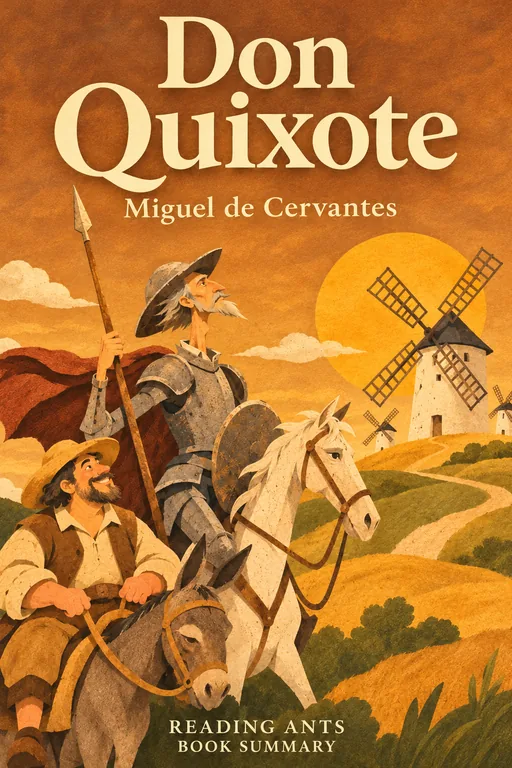
Don Quixote: the longer summary
Before You Start (No Spoilers)
Don Quixote follows a reader who tries to make the world obey the adventure stories he loves. A middle-aged Spanish gentleman reads so many old stories of knights, giants and enchanters that he loses his mind, puts on rusty armor, renames himself Don Quixote of La Mancha and rides out to right the world’s wrongs. He is attended by a plain, sensible, greedy and loyal farmer called Sancho Panza, whom he persuades to be his squire with the promise of an island to govern. Everything the Don sees turns, in his imagination, into a scene from a book: inns become castles, windmills become giants, sheep become armies.
The book was published in two parts, in 1605 and 1615, and the second part is in a way a response to the first: by then the characters have become famous, and other characters have read about them. The jokes are slapstick at first, but as the book goes on, Cervantes makes the story deeper and more moving. The people who mock him are not always wiser or kinder. His mistakes can be funny and painful at the same time.
It is a very long book, with many side stories, and the translation matters a lot. Many readers find it easiest to read it in short sessions, since each chapter is a small episode. It is a book for a patient reader of about thirteen or older, and some of the humor, which involves cruel pranks, is not gentle. What follows gives away the whole story, including the ending.
Who’s Who
- Don Quixote (Alonso Quixano): a gentleman of about fifty, tall, thin and obsessed with chivalry. In his sane moments he is wise, kind and well read.
- Sancho Panza: his squire, a short, round farmer who is practical and full of proverbs, and who gradually comes to share Quixote’s dreams.
- Rocinante and Dapple: Quixote’s thin horse and Sancho’s donkey.
- Dulcinea del Toboso: the lady he serves, a peasant woman whom he idealizes as a great princess rather than describing as an ordinary person.
- The curate and the barber: Quixote’s neighbors, who try to cure him.
- Cardenio and Dorothea: two young people he meets in the mountains, whose stories form a long section of Part One.
- Samson Carrasco: a young university graduate who plans to bring Quixote home.
- The Duke and Duchess: nobles in Part Two who treat Quixote as entertainment.
- Cide Hamete Benengeli: the invented Arab historian whom Cervantes pretends wrote the story.
Part One (1605)
The making of a knight. A gentleman of La Mancha, whose name is probably Quixano, lives with his niece and housekeeper. He has read so many chivalry romances that he decides to become a knight-errant. He cleans some old armor, repairs his headpiece with cardboard, names his bony horse Rocinante and picks a country girl, Aldonza Lorenzo, as the lady whom he will call Dulcinea del Toboso.
The first sally. He rides out and arrives at an inn that he takes for a castle. The innkeeper plays along and dubs him a knight in a mock ceremony. On the way home he defends a boy who is being beaten, but when he leaves, the farmer beats the boy even worse. When he charges a group of merchants who refuse his demand about Dulcinea, Rocinante stumbles and throws him. A muleteer accompanying the traders beats the fallen knight with pieces of his lance, and a neighbor takes him home on a donkey.
The burning of the books. While he recovers, his niece, housekeeper, the curate and the barber go through his library and burn most of the romances that have addled his brain, keeping a few good ones. They wall up the room and tell him that an enchanter has made the library disappear.
Sancho. Quixote persuades Sancho Panza, a poor neighbor, to be his squire with the promise of a governorship. They sneak out at night, Sancho on his donkey.
The windmills. The most famous adventure comes early. They see thirty or forty windmills on a plain, and Quixote declares them to be giants. He charges at one with his lance, and the sail picks him up and throws him. Sancho tells him they were windmills, but Quixote says that an enchanter has turned the giants into windmills to rob him of his glory.
Many mistakes. After the windmills, Quixote becomes involved in a fight with a Basque traveler. Later, Rocinante approaches some carriers’ mares, and the resulting struggle leaves master and squire badly beaten. At an inn, Quixote mistakes a planned visit by the servant Maritornes to a carrier for an encounter with a lady who loves him. Darkness and confusion bring more blows. His supposedly healing balm makes him vomit and sweat; when Sancho tries it, the results are worse. Sancho is then tossed in a blanket by people at the inn.
Quixote next mistakes clouds of dust raised by sheep for advancing armies and attacks the animals, despite Sancho’s warnings. The shepherds defend their flocks with stones. Later, seeing a torchlit funeral party, he imagines another adventure involving a dead or wounded knight and attacks when the travelers will not answer him to his satisfaction. His desire to help repeatedly becomes an injury to strangers who never asked for his intervention.
The helmet. Quixote is convinced that the brass basin on a barber’s head, which he sees in the rain, is the golden helmet of Mambrino, a magical item from the old stories, and he takes it. He wears the basin proudly from then on.
The galley slaves. On a road, they meet a chain of convicts being taken to row in the galleys. Quixote questions each of them and decides that they are being treated unjustly, and he frees them by force. Instead of thanking him, they stone him and Sancho and steal their clothes. One of them, Ginés de Pasamonte, will return in Part Two.
The Sierra Morena. They flee into the mountains, where they find a mad young man who turns out to be Cardenio, a nobleman driven mad by the betrayal of a friend who stole his sweetheart. Quixote decides to do penance in the mountains, like the heroes of his books, for his lady Dulcinea, and sends Sancho with a letter to her.
The trick of the curate. Sancho meets the curate and the barber, who have come to find Quixote. They concoct a plan: a young woman, Dorothea, who has also been betrayed, will pretend to be the Princess Micomicona, whose kingdom is under attack, and ask Quixote to help her. He agrees, and the group persuades him to come home. Cardenio and Dorothea each find the lovers they lost, and the stories end happily.
The cage. At an inn, all the strands come together, and after more adventures and a fight, the curate and barber put Quixote in a cage on an ox-cart, telling him he is enchanted, and bring him back to his village. Part One ends with Quixote at home, wondering what will happen next.
Part Two (1615)
A famous man. A month later, Quixote is at home, cared for by his niece and housekeeper. Sancho tells him that a book about their adventures has been published and that everyone in the village, including the young graduate Samson Carrasco, has read it. They decide to go out again. Quixote’s fame now precedes him, and many people they meet know about them.
Dulcinea enchanted. Quixote sends Sancho to find Dulcinea. Sancho, who has not carried out his earlier supposed mission to her and is afraid to admit it, points to three peasant girls on donkeys and says that one of them is she. Quixote sees only ordinary girls. Sancho says that they have been enchanted, and Quixote, shaken, begins to believe that his lady has been turned into a peasant by enchanters.
The Knight of the Mirrors. A knight arrives and challenges Quixote. It is Samson Carrasco in disguise, who hopes to defeat him and send him home. Quixote wins, and the surprised Carrasco goes home to recover, plotting a rematch.
The cave of Montesinos. Quixote goes down into a cave and returns, claiming to have had a vision of great knights and of Dulcinea, who asks for a loan of money. Sancho does not believe a word, and the narrative leaves the nature and truth of the claimed experience unsettled.
The Duke and Duchess. A rich duke and duchess who have read the first part of the book invite the pair to their castle and decide to have fun by pretending that Quixote’s fantasies are real. They stage a series of elaborate hoaxes: a masquerade in which a masked figure announces that Dulcinea can only be disenchanted if Sancho voluntarily gives himself three thousand three hundred lashes, and a supposed flight on a wooden horse named Clavileño. The riders are blindfolded while servants produce wind and other effects around them. The Duke also appoints Sancho to what is described as an island governorship.
The governor of Barataria. Sancho, dressed in fine clothes, is led to a small town called Barataria. The duke’s staff expect him to make a fool of himself, but, to their surprise, he is a wise, fair-minded judge who settles disputes with practical wit. A physician supervises his meals and prevents him from eating much of what is offered, and woken by a mock attack. After ten days, he decides that he is not suited for such work, and goes back to his donkey, saying that he prefers his freedom to rule.
Apart and reunited. Meanwhile, Quixote is courted by the Duchess’s maid, Altisidora, as part of a prank, which he rejects out of loyalty to Dulcinea. After Sancho rejoins him, they meet a band of robbers led by Roque Guinart, who mixes violence with acts of generosity. They continue to Barcelona, where Quixote sees the sea for the first time.
The Knight of the White Moon. In Barcelona, a knight appears and challenges him. It is Samson Carrasco again, and this time, on the beach, Carrasco defeats him. The terms are that Quixote must go home and give up knight-errantry for a year. Quixote, who has lived by his honor, agrees. He is heartbroken.
The end. On the way home, Quixote and Sancho talk about turning shepherd to pass the time, which is a way of keeping some of the dream. At home, Quixote falls ill with a fever and sleeps for more than six hours. When he wakes, he is sane. He says that he is no longer Don Quixote but Alonso Quixano, called the Good. He renounces the books of chivalry, makes his will, asks forgiveness of those he has troubled, and dies surrounded by his friends. Sancho, weeping, begs him to get up and go out on another adventure. The narrator ends by warning later writers not to try to continue the story.
More Moments Worth Knowing
Master Pedro’s puppet show. In Part Two, a traveling showman puts on a puppet play about a knight rescuing a lady from the Moors. Quixote, who cannot tell the difference between a story and reality, jumps up and slashes the puppets to pieces with his sword, shouting that he will save the lady. After the damage is pointed out, he agrees to pay, while still attributing the change from people to puppets to enchanters. The scene is both silly and an image of the whole book: a man who cannot separate fiction from life.
The lion. Quixote sees a cart carrying two lions to the king and demands that the keeper open the cage so that he can fight one. The keeper warns him, and at last opens the cage. The lion looks out, yawns, turns around and lies down again. Quixote declares it a victory and calls himself the Knight of the Lions. It is a perfect example of how his courage is real, even if his judgment is not.
Advice before governing. Before Sancho goes off to be governor, Quixote gives him a long speech of good advice: be fair, be humble, remember where you came from, listen to the poor and the rich alike. It shows that the Don has real wisdom, and it is the advice that Sancho later follows. The advice complicates any judgment that his mistaken adventures make everything he says foolish.
The false sequel. Part Two refers to a rival printed account of Quixote and Sancho’s adventures and makes disagreement with it part of their journey. Quixote changes his proposed route to avoid repeating the rival book’s visit to Saragossa, choosing Barcelona instead. Later, he obtains a formal declaration from Don Álvaro Tarfe that they are not the pair Tarfe claims to have known in that other account. The book’s characters try to establish their own identity against a story already circulating about them.
The inserted tales. Part One contains several stories that have little to do with Quixote, including Cardenio’s entangled history, a read-aloud tale of a husband who insists on testing his wife through a friend, and the account of a captive in Algiers. They give a picture of the world around the main characters, and show Cervantes’s love of storytelling. They also provide a counterpoint: in these stories, people really are betrayed, and love and honor are real matters.
Sancho’s refrains. Sancho constantly quotes proverbs, often with poor timing or in great numbers, which irritates Quixote. But as the book goes on, the proverbs become a form of wisdom, and Sancho’s sayings help him in his judgments as governor. His speech is one of the book’s great comic and human pleasures.
Key Scenes Explained
The windmills. The attack shows both Quixote’s physical courage and his refusal to revise a mistaken explanation. Sancho identifies the objects as windmills before the charge and warns him; he does not share this particular illusion. Blaming an enchanter afterward lets Quixote preserve the story he preferred.
The galley slaves. Quixote’s act is generous and foolish at the same time. The prisoners are, in some cases, guilty, but the scene raises real questions about justice and about the limits of good intentions.
Dulcinea enchanted. Sancho’s lie is the book’s turning point. By inventing an enchantment to cover for his lie, he plants the idea that Quixote’s world and the real world are both true. From then on, the two men start to switch places.
The Duke and Duchess. In Part Two, the jokes are on other people, not just Quixote. The Duke and Duchess are cruel in their pranks, and the reader sees that those who mock him are less decent than he is.
Sancho as governor. It is one of the book’s most satisfying scenes: the simple man turns out to be wiser than the nobles who laugh at him.
The Knight of the White Moon. Quixote’s defeat by Carrasco is the saddest scene. It is not a joke but a loss of purpose, and the book makes the reader feel it.
Alonso Quixano’s death. His return to sanity occurs during his final illness. The timing may suggest a connection between lost purpose and death, but it does not establish that becoming sane literally kills him. Sancho tries to revive their shared project while Quixano insists that he has rejected it.
Why It Still Matters
The two parts repeatedly change who is inventing the adventure. Early on, Quixote misreads ordinary places and objects through stories he already knows. Later, people who have read about him deliberately construct false adventures around his expectations. His vulnerability is no longer only a mistake inside his own mind; it becomes an opportunity that others choose to exploit.
Sancho’s practical judgment complicates the contrast between fantasy and sense. He recognizes many dangers his master misses, yet hopes for advancement help keep him on the road. When he actually governs, experience and attention serve him better than the joke’s organizers expect. He can question the value of the prize without having been entirely foolish to want a better life.
The narrating historian, discovered manuscript and rival book add further uncertainty about how a life becomes a story. Characters discuss versions of themselves and try to decide which account deserves belief. The final death refuses the possibility of endlessly renewing the same adventures. Friendship remains important, but it cannot make the two men choose the same ending.
What to Notice While Reading
- The two men change. Quixote gets more sensible, while Sancho gets more imaginative. Watch how they move toward each other.
- Books inside the book. In Part Two, characters have read Part One, and some have read a false sequel. Cervantes plays with the idea that the characters are real.
- Who is mad? Quixote is deluded, but the people who play tricks on him are often worse. Notice who behaves best.
- The jokes and the sadness. The humor is physical and verbal. Notice the moments when it turns serious.
- The inserted stories. Some chapters stop to tell other tales. Notice how they reflect on the main story’s themes of love, honor and deception.
Questions to Think About
- Is Don Quixote a fool, a hero, or both?
- Why does Sancho keep following Quixote, even when he knows better?
- What does Sancho’s governorship tell us about wisdom and education?
- Why do you think Cervantes ends the book with Quixote’s return to sanity and death?
- How is the Quixote of Part Two different from the Quixote of Part One?
How to Read It
Read the two parts in sequence and use the numbered chapters as stopping places rather than assuming every episode has equal pace. A short list of names helps with Cardenio, Luscinda, Dorothea and Don Fernando, whose histories meet during Part One. The interruptions are part of the book’s design, even when they postpone the main journey.
Keep a separate note of what Quixote believes, what Sancho says he knows, and what the narrator actually describes. Those versions frequently differ. The downloaded Ormsby translation includes both parts through the final death, so the ending here is not borrowed from an adaptation or a shortened selection.
If You Liked Don Quixote
Try Tristram Shandy by Laurence Sterne, Candide by Voltaire for another comic hero on a journey, The Adventures of Tom Sawyer for a boy who lives in a world of stories, or The Count of Monte Cristo for a different kind of adventure.
Want the whole book?
A summary is a taste, not the meal. Here is where to find the full book.