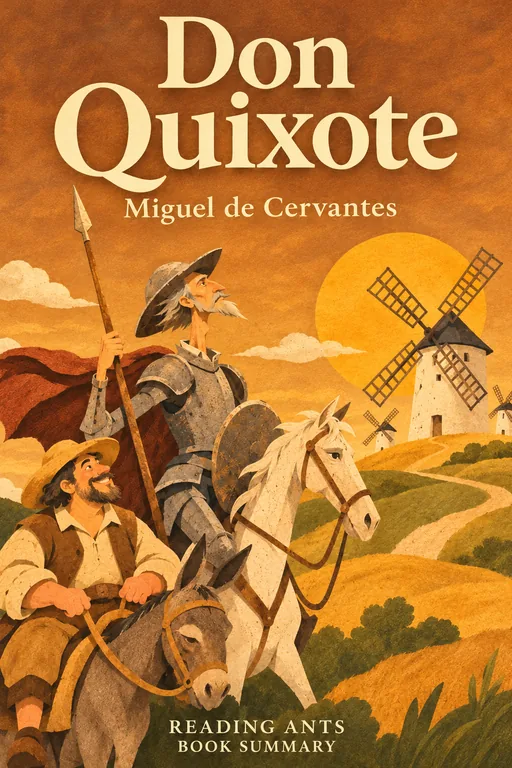
Don Quixote
Original title: Don Quijote de la Mancha
An aging Spanish gentleman reads so many tales of knights that he loses his mind, sets out to become a knight himself with a down-to-earth farmer as his squire, and turns every adventure into glorious, comic disaster.
Overview
Don Quixote was published in two parts, in 1605 and 1615, by the Spanish writer Miguel de Cervantes. Its hero, a poor gentleman from the region of La Mancha, spends his days reading romantic stories about knights, giants and enchanted princesses, until he becomes convinced they are real. Calling himself Don Quixote, he puts on rusty old armor, mounts his bony horse Rocinante and rides out to right the wrongs of the world. His companion, the practical peasant Sancho Panza, follows him for the promise of governing an island. Funny, sad and wise, the book is often called the first modern novel, and it remains one of the most influential works ever written.
Main Characters
- Don Quixote: a thin, gentle, deluded gentleman who believes he is a knight-errant.
- Sancho Panza: his short, plump, practical and talkative squire.
- Rocinante: Don Quixote’s old, skinny horse.
- Dulcinea del Toboso: an ordinary farm girl whom Don Quixote imagines is a noble lady.
- The priest and the barber: friends from his village who try to bring him home.
- Sansón Carrasco: a clever young graduate who tries to cure Don Quixote.
- The Duke and Duchess: wealthy nobles who amuse themselves by playing tricks on the pair.
Full Summary
A Gentleman Loses His Mind
In a village in La Mancha lives a gentleman of about fifty who reads books of chivalry day and night, selling land to buy more of them. Eventually his brain dries up, and he decides to become a knight-errant, wandering the world to help the weak and win glory. He cleans his great-grandfather’s armor, names his horse Rocinante and himself Don Quixote de la Mancha. Every knight needs a lady, so he chooses a local farm girl and renames her Dulcinea del Toboso, though she has no idea.
On his first journey, he mistakes a shabby inn for a castle and asks the amused innkeeper to make him a knight. He tries to rescue a boy being beaten by his master, but as soon as he rides away, the master beats the boy even harder. He returns home badly bruised. His friends, the village priest and barber, burn most of his books, hoping to cure him.
Sancho Panza and the Windmills
Don Quixote persuades a simple farmer, Sancho Panza, to become his squire, promising to make him governor of an island. Sancho rides along on his donkey. Soon they see thirty or forty windmills on the plain. Don Quixote believes they are giants and charges, lance raised. A sail catches his lance and throws him and his horse across the field. He insists that an evil enchanter turned the giants into windmills at the last moment.
Adventure after adventure follows. He attacks two flocks of sheep, believing them to be armies; seizes a barber’s brass basin, convinced it is a famous magic helmet; and frees a chain of prisoners being taken to the galleys, who thank him by throwing stones at him and Sancho.
Stories Within the Story
In the mountains, Don Quixote decides to do penance for Dulcinea, as lovesick knights do in books. There he and Sancho meet young people whose romantic troubles become stories within the novel. Cervantes uses these tales to experiment with different kinds of storytelling, from tragic romance to adventure.
The priest and the barber finally trick Don Quixote into returning home. They put him in a wooden cage on an ox cart, telling him he has been enchanted, and he accepts this as part of his knightly destiny.
Famous Heroes
In the second part, written ten years later, Don Quixote and Sancho set out again and discover something extraordinary: a book about their adventures has been published, and people everywhere have read it. Cervantes also mocks a fake sequel that another author had published in the meantime, and his characters complain about its mistakes.
Sancho has grown clever at handling his master. When Don Quixote demands to meet Dulcinea, Sancho points to three plain peasant women on donkeys and claims one is Dulcinea, transformed by an enchanter. Don Quixote is heartbroken but believes him.
The Duke and Duchess
The pair meet a Duke and Duchess who have read the first book and decide to entertain themselves by pretending to treat Don Quixote as a real knight. They stage elaborate tricks, including a ride blindfolded on a wooden horse supposedly flying through the sky. As a joke, they make Sancho governor of an “island,” actually a small town. To everyone’s surprise, Sancho rules wisely and fairly, judging difficult cases with common sense. After a few days of exhaustion and a staged attack, he resigns, saying he prefers his freedom and simple life.
Defeat and Homecoming
In Barcelona, a mysterious Knight of the White Moon challenges Don Quixote to combat and defeats him. As the price of defeat, Don Quixote must return home and give up knighthood for a year. The knight is really Sansón Carrasco, a young graduate from his village, who wanted to bring him home.
Back in his village, Don Quixote falls ill. After a long sleep, he wakes up sane. He calls himself by his real name again, Alonso Quixano, rejects the books of chivalry, makes his will and leaves money to Sancho. Sancho, weeping, begs him to get up and set out on new adventures, perhaps as shepherds. But the old gentleman dies peacefully, surrounded by friends.
Why It Matters
Don Quixote is one of the most important books in world literature. It is often called the first modern novel, because it explores characters’ inner lives, mixes many styles, and even comments on itself as a book. In a 2002 poll of authors from around the world organized by the Norwegian Book Clubs, it was named the best work of fiction ever written.
The novel gave the world the word quixotic, meaning idealistic but impractical, and the expression “tilting at windmills,” fighting imaginary enemies. Its influence can be traced in writers from Laurence Sterne and Charles Dickens to Gustave Flaubert, Fyodor Dostoevsky and Jorge Luis Borges. The pairing of a dreamer and a realist, Don Quixote and Sancho, became a model for countless later stories.
Key Takeaways
- Imagination is both noble and dangerous. Don Quixote’s dreams make him brave and kind, but also blind to reality.
- Idealism and realism need each other. The dreamer and the practical man balance each other.
- Stories shape how we see the world. Don Quixote’s reading transforms his reality.
- Ordinary people can be wise. Sancho, a simple farmer, governs more fairly than many nobles.
- Mocking others says more about the mocker. The Duke and Duchess’s cruelty makes them look worse than the madman.
What We Can Learn
Don Quixote reminds us that ideals matter. He wants to protect the weak and live with honor, and even when he fails, those goals are admirable. Having big dreams, and the courage to act on them, can make life meaningful.
But the book also warns us to check our ideas against reality. When we see the world only through stories, whether old romances or today’s social media, we can mistake windmills for giants. Friends like Sancho, who tell us honestly what they see, are precious.
Finally, the book shows the value of kindness toward people who are different. Many characters laugh at Don Quixote, while those who care for him, like Sancho, discover his goodness.
Criticism and Counterpoints
Modern readers often find Don Quixote very long, especially the many stories within the story that interrupt the main plot. Some of the humor, based on beatings and humiliation, can feel cruel rather than funny today.
Critics have long debated how to read the book. Some see it mainly as a satire of silly chivalric romances, as Cervantes claimed; others, especially from the Romantic era onward, see Don Quixote as a tragic hero whose idealism is crushed by a harsh world. Its many translations also vary greatly in style, so the choice of translation can strongly affect a reader’s experience.
Who Should Read It
This book suits patient teenagers and adults who enjoy humor, adventure and classic literature. Many readers start with an abridged edition or read the first part only. It is especially rewarding for readers interested in how novels began.
Want the whole book?
A summary is a taste, not the meal. Here is where to find the full book.
You reached the end 🎉
Nicely done. Mark this one as read, and we will suggest what to read next.
Read this next
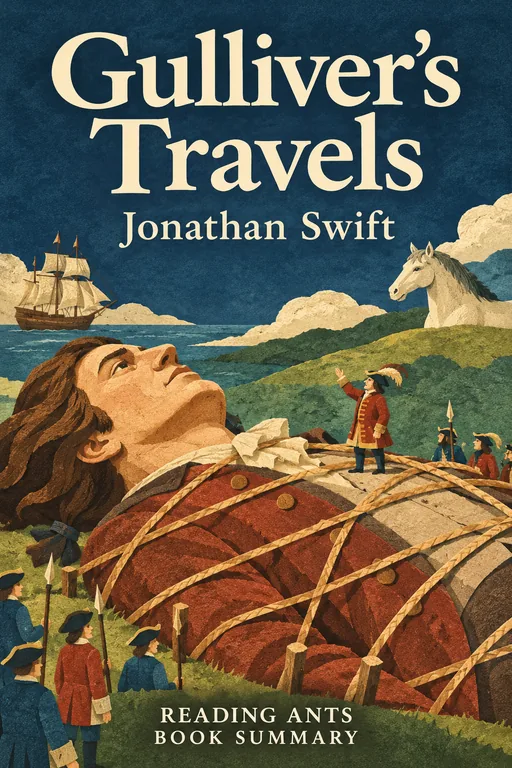
Gulliver's Travels
Jonathan Swift
A ship's surgeon named Lemuel Gulliver visits four strange lands, from a country of tiny people to one ruled by rational horses, and Swift uses these voyages to mock human pride, politics and folly.
📜 Classics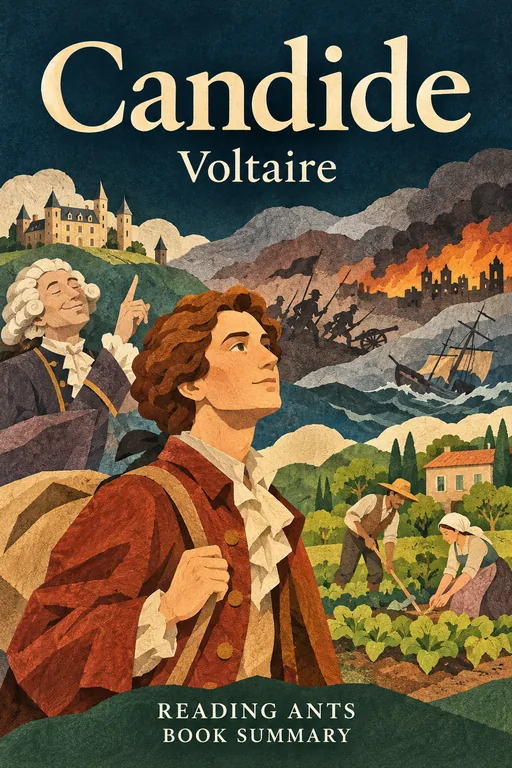
Candide
Voltaire
A trusting young man travels through a world of war, disaster, greed and cruelty, slowly learning that cheerful theories matter less than useful work and care for others.
🌍 World Literature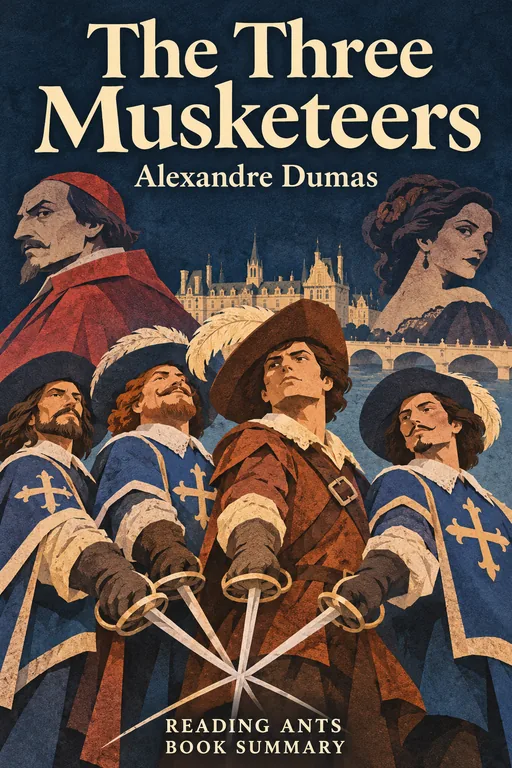
The Three Musketeers
Alexandre Dumas
A young Gascon swordsman travels to Paris in the 1620s to join the King's Musketeers, befriends three legendary soldiers, and together they fight to protect the Queen's honor against the scheming Cardinal Richelieu and the dangerous Milady.
🌍 World Literature
The Little Prince
Antoine de Saint-Exupery
A pilot stranded in the desert meets a small boy from a tiny planet, who teaches him that the most important things in life, like love and friendship, can only be seen with the heart.
🌍 World Literature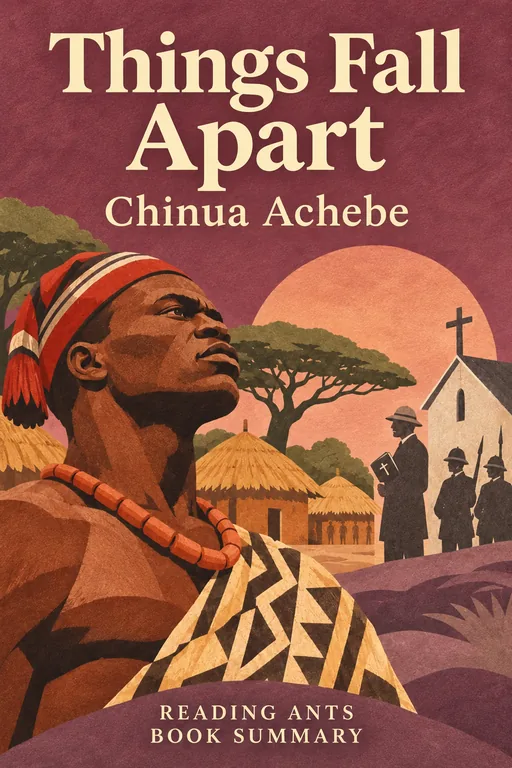
Things Fall Apart
Chinua Achebe
Okonkwo, a proud and fearsome leader in an Igbo village in Nigeria, struggles against his own fears and against the arrival of British missionaries and colonial rulers, who change his world forever.
🌍 World Literature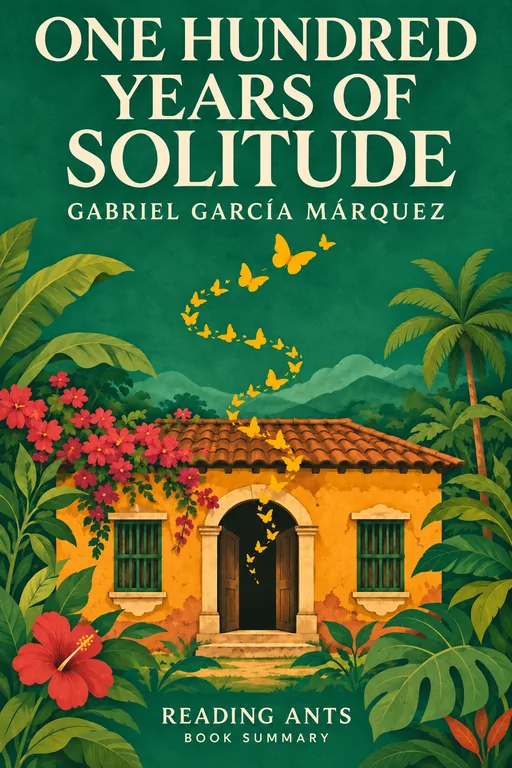
One Hundred Years of Solitude
Gabriel Garcia Marquez
Seven generations of the Buendía family live, love, fight and repeat the same mistakes in the magical Colombian town of Macondo, from its founding to its final destruction.
🌍 World LiteratureWant something different?
Pick another topic and we will show you three books to start with.