 Reading Ants
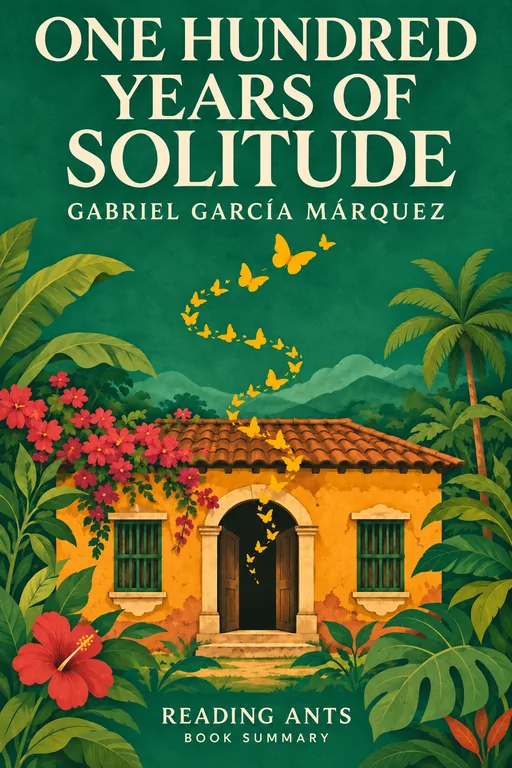
One Hundred Years of Solitude
Original title: Cien años de soledad
Seven generations of the Buendía family live, love, fight and repeat the same mistakes in the magical Colombian town of Macondo, from its founding to its final destruction.
Overview
One Hundred Years of Solitude tells the story of the town of Macondo and the family that founded it. Over a hundred years, the Buendías experience inventions, civil wars, a foreign banana company, a massacre, a rain that lasts nearly five years, and endless love affairs, while the same names, personalities and fates return in each generation. Gabriel García Márquez tells this history in a style called magical realism, in which impossible things, such as a woman rising to heaven or a plague of forgetting, are described as calmly as everyday events. The novel is a family saga, a fairy tale and a history of Latin America all at once. It is one of the most celebrated novels of the twentieth century.
Main Characters
- José Arcadio Buendía: the restless founder of Macondo, obsessed with science and inventions.
- Úrsula Iguarán: his practical wife, who holds the family together for more than a century.
- Colonel Aureliano Buendía: their son, who leads many failed rebellions.
- José Arcadio: their elder son, huge and wild.
- Amaranta: their daughter, who refuses every man who loves her.
- Melquíades: a wise gypsy who leaves behind mysterious manuscripts.
- Remedios the Beauty: a great-granddaughter so beautiful that men die for her.
- Aureliano Segundo and José Arcadio Segundo: twin great-grandsons with opposite lives.
- Aureliano Babilonia: the last Buendía to read Melquíades’s manuscripts.
Full Summary
The Founding of Macondo
José Arcadio Buendía and Úrsula Iguarán are cousins. Úrsula fears their children will be born with a pig’s tail, a legend about marriages within the family. After José Arcadio kills a man who mocks him, the couple leave their village with a group of friends and found Macondo, a peaceful town beside a river, so new that many things don’t yet have names.
Each year, gypsies led by the wise Melquíades bring wonders: magnets, telescopes, ice. José Arcadio Buendía becomes obsessed with science and alchemy, while Úrsula runs the household and a thriving candy business. They have three children: José Arcadio, Aureliano and Amaranta, and they adopt an orphan girl, Rebeca, who arrives eating earth.
Plague, Love and Madness
A plague of insomnia strikes Macondo, causing people to lose their memories. They label everything, even the cow, with notes explaining what it is and how to use it, until Melquíades returns with a cure. Eventually, José Arcadio Buendía goes mad and is tied to a chestnut tree in the courtyard, where he lives for many years until his death, when a rain of tiny yellow flowers falls on the town.
Amaranta and Rebeca both fall in love with the same Italian piano teacher, and their rivalry poisons the house. José Arcadio, who ran away with the gypsies, returns as a giant covered in tattoos and marries Rebeca. Later he is mysteriously shot, and a thread of his blood flows through the streets to reach his mother. Amaranta rejects every suitor and grows bitter, slowly weaving her own burial shroud.
Colonel Aureliano Buendía
Aureliano, the quiet son, marries a young girl who dies soon after. When the government’s Conservatives rig an election, he joins the Liberals and becomes Colonel Aureliano Buendía, leading thirty-two armed uprisings and losing them all. He fathers seventeen sons with seventeen different women during his campaigns; all are later hunted down and killed. He escapes a firing squad and many assassination attempts, but grows hard and empty. Finally, he signs a peace treaty, returns home and spends his last years making little gold fish in his workshop, melting them down and making them again.
New Generations
The family grows. A grandson, Arcadio, rules the town cruelly for a short time and is executed. His children include Remedios the Beauty, so innocent and beautiful that men who desire her meet strange deaths. One afternoon, while folding sheets in the garden, she simply rises into the sky and disappears.
Her brothers, the twins Aureliano Segundo and José Arcadio Segundo, are so alike that the family suspects they swapped identities as children. Aureliano Segundo lives a life of parties with his lover Petra Cotes, whose presence makes his animals multiply miraculously, while his proud wife Fernanda tries to impose strict, aristocratic manners on the household. Their daughter Meme falls in love with a mechanic always followed by yellow butterflies. When Fernanda has him shot, Meme is sent to a convent, and her baby son is secretly brought back to the house.
The Banana Company
The railroad arrives, bringing a foreign banana company that transforms Macondo with money, foreigners and exploitation. When the workers go on strike, soldiers open fire on a huge crowd gathered at the station. José Arcadio Segundo wakes up on a train filled with corpses being carried to the sea to be dumped. Back in Macondo, no one believes him. Everyone repeats the official story that nothing happened, and the massacre is erased from memory.
Then it starts to rain, and it rains for nearly five years. The banana company leaves, and Macondo falls into ruin. Úrsula, now blind and more than a century old, shrinks almost to the size of a baby before she dies.
The Last Buendías
Aureliano Babilonia, Meme’s son, grows up hidden in the decaying house and spends his days studying Melquíades’s old manuscripts, written in a code no one has been able to read. Amaranta Úrsula, Meme’s younger sister, returns from Europe full of energy and tries to restore the house. Not knowing that she is his aunt, Aureliano falls passionately in love with her. They have a son, the only member of the family conceived in love, but he is born with a pig’s tail. Amaranta Úrsula dies after giving birth, and in his grief Aureliano leaves the baby alone, and it is carried off by ants.
The Manuscripts
At last, Aureliano understands Melquíades’s code. The manuscripts tell the entire history of the Buendía family, written a hundred years in advance, ending with this very moment. As he reads, a great wind begins to sweep Macondo away. He realizes that the town will be wiped from the earth as soon as he finishes reading, because families condemned to a hundred years of solitude do not get a second chance on earth.
Why It Matters
One Hundred Years of Solitude is often called the greatest novel ever written in Spanish since Don Quixote. Published in 1967 in Argentina, it became an immediate bestseller across Latin America and then around the world, and it has been translated into dozens of languages. García Márquez won the Nobel Prize in Literature in 1982.
The novel made magical realism famous worldwide and was at the heart of the “Latin American Boom,” when writers from the region gained international fame. It influenced writers on every continent, including Salman Rushdie, Toni Morrison and Isabel Allende.
Beneath its magic, the book tells the real history of Colombia and Latin America: civil wars, foreign companies and forgotten massacres. The banana massacre recalls a real killing of striking workers in Colombia in 1928.
Key Takeaways
- History repeats when we forget it. The Buendías keep making the same mistakes across generations.
- Solitude is a curse. Each character is trapped in loneliness, unable to truly connect.
- Memory is fragile and political. The massacre disappears because powerful people deny it.
- The magical and the real blend. Wonders are treated as ordinary, and ordinary life as wondrous.
- Love can redeem or destroy. Love is rare in the family, and when it finally appears it brings both joy and ruin.
What We Can Learn
The novel reminds us how important it is to remember the past, both in families and in nations. Learning from history, and listening to those who witnessed injustice, helps prevent it from happening again.
It also shows the cost of isolation. Many Buendías shut themselves away in workshops, rooms or pride. Reaching out to others, forgiving, and expressing love openly are ways to break cycles of loneliness.
Finally, the book teaches us to see wonder in everyday life. The arrival of ice in Macondo is as magical as any miracle. Paying attention to the extraordinary in ordinary things can make life richer.
Criticism and Counterpoints
Many readers find the novel hard to follow because characters share the same names over generations. A family tree, included in many editions, helps a great deal. The dense paragraphs and lack of dialogue can make it slow going.
Some critics have questioned how the novel portrays women, many of whom are shown mainly as lovers, mothers or symbols, though others point to strong figures like Úrsula. Modern readers may also find its frequent sexual content and incest disturbing. Some Latin American writers later argued that the success of magical realism led foreign readers to expect all Latin American literature to be exotic and magical.
Who Should Read It
This novel is for older teenagers and adults who enjoy rich, imaginative storytelling and don’t mind a challenge. Readers interested in Latin American history will find it especially rewarding. Those who prefer fast, simple plots may struggle with its many characters and long sentences.
Want the whole book?
A summary is a taste, not the meal. Here is where to find the full book.
You reached the end 🎉
Nicely done. Mark this one as read, and we will suggest what to read next.
Read this next
Love in the Time of Cholera
Gabriel Garcia Marquez
Two people separated in youth meet again in old age, forcing readers to ask whether lifelong romantic devotion is noble, selfish or inseparably both.
🌍 World Literature
The House of the Spirits
Isabel Allende
Four generations of a Latin American family, bound by love, anger and the spirits that haunt them, live through the changes of a country moving toward dictatorship.
🌍 World Literature
Pedro Paramo
Juan Rulfo
A young man travels to a deserted Mexican village to find his father, and finds a town full of whispering ghosts and the story of a cruel landowner.
🌍 World Literature
Midnight's Children
Salman Rushdie
Born at the exact moment India became independent, a boy named Saleem Sinai discovers that his life is mysteriously linked to the nation's history, and tells his story as a wild mix of family saga, politics and magic.
✨ Modern Fiction
Chronicle of a Death Foretold
Gabriel Garcia Marquez
In a small Colombian town, everyone knows that two brothers plan to kill a young man, and yet nobody stops them.
🌍 World Literature
The Little Prince
Antoine de Saint-Exupery
A pilot stranded in the desert meets a small boy from a tiny planet, who teaches him that the most important things in life, like love and friendship, can only be seen with the heart.
🌍 World LiteratureWant something different?
Pick another topic and we will show you three books to start with.