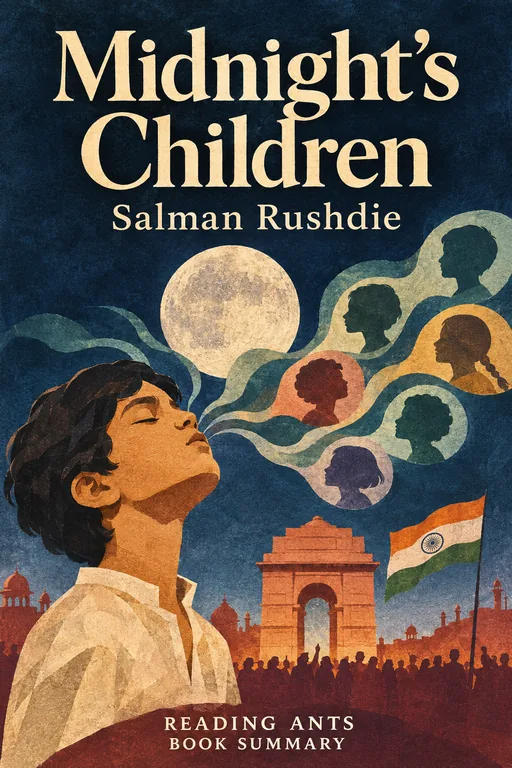
Midnight's Children
Born at the exact moment India became independent, a boy named Saleem Sinai discovers that his life is mysteriously linked to the nation's history, and tells his story as a wild mix of family saga, politics and magic.
Overview
Midnight’s Children, published in 1981 by Salman Rushdie, is narrated by Saleem Sinai, who was born at midnight on August 15, 1947, the moment India gained independence from British rule. Saleem believes that his life and the nation’s destiny are tied together. He also discovers that all the children born in the first hour of independence have magical powers, and he can communicate with them telepathically. Written in a lively, playful style mixing magical realism, history and humor, the novel follows Saleem’s family and the turbulent history of India, Pakistan and Bangladesh over three decades. It won the Booker Prize in 1981 and was later named the “Booker of Bookers,” the best novel to win the prize in its first twenty-five and forty years.
Main Characters
- Saleem Sinai: the narrator, born at midnight on independence day, with a huge nose and a telepathic gift.
- Shiva: another midnight child, Saleem’s rival, with powerful knees and a talent for violence.
- Aadam Aziz: Saleem’s grandfather, a doctor.
- Amina Sinai: Saleem’s mother.
- Ahmed Sinai: Saleem’s father, a businessman.
- Mary Pereira: the nurse who switches the babies.
- Padma: Saleem’s impatient listener, who is with him as he tells his story.
- The Brass Monkey (Jamila): Saleem’s younger sister, who becomes a famous singer in Pakistan.
Full Summary
The Grandparents
Saleem begins by telling the story of his family before his birth, starting in 1915 in Kashmir. His grandfather, Aadam Aziz, a young doctor who studied in Germany, falls in love with Naseem, whom he has to examine through a hole in a sheet, seeing her one body part at a time. After a long, unusual courtship, they marry and move to Amritsar, where he witnesses the horrifying Jallianwala Bagh massacre of 1919, in which British troops fire on a peaceful crowd.
Midnight
Saleem’s mother, Amina, and father, Ahmed Sinai, move to Bombay (now Mumbai) and have a baby at the stroke of midnight on August 15, 1947. A nurse, Mary Pereira, in a political act, swaps the newborn with another baby born at the same moment to a poor street musician’s wife. As a result, Saleem, whose real father is a departing English colonialist, is raised in the wealthy Sinai household, while Shiva, the Sinais’ biological son, grows up in poverty. Prime Minister Nehru writes to Saleem’s family, saying that the baby is a mirror of the nation.
The Children of Midnight
As Saleem grows up, he discovers that he can read minds. At about age nine, he realizes he can bring together the children born between midnight and one o’clock on India’s independence night, of whom 1,001 were born and 581 survive, as a kind of telepathic conference, a council. Each has a special gift: some can travel through time, change gender, or fly, and the strength of the gift is stronger the closer to midnight the child was born. Saleem acts as the leader, and his main rival is Shiva, who has been raised as a street tough with huge knees.
Migrations and War
Years later, Saleem’s family emigrates to Pakistan. There, Saleem’s family is hit by a series of disasters during the war of 1965 against India: a bomb destroys the family home and kills most of his relatives. Saleem loses his memory and is found by the Pakistani army, which uses him as a tracker because of his powerful nose. In the 1971 war that creates Bangladesh, Saleem and a few soldiers wander into the jungle of the Sundarbans, where magical hallucinations sweep through their journey. Saleem regains his memory and escapes with the help of a woman called Parvati.
Emergency
Back in India, Saleem lives in the slums of Delhi and marries Parvati, who bears a son who is not his: Aadam, whose real father is Shiva, Saleem’s great rival. During the Emergency of 1975 to 1977, when Prime Minister Indira Gandhi suspended civil liberties, forcing sterilization campaigns, the “Widow,” as Saleem calls Gandhi, hunts down and sterilizes all the midnight’s children, removing their magical powers. Saleem is operated on as well. Shiva, now a war hero, who has become the Widow’s enforcer, betrays the children, and Parvati is killed.
The End
Saleem, nearly broken physically after his many wounds, returns to Bombay with his stepson, Aadam. He is now living a quiet life as a pickle-factory worker, writing his story as he tells it to Padma, and preparing for his marriage with her. He realizes that his body is cracking and that he will fall apart, as if consumed by all the lives, histories and stories that have run through him. His last words picture the crowd that will trample him to dust, a symbol of the many peoples of India.
Why It Matters
Midnight’s Children is one of the most acclaimed novels of the late twentieth century. It won the Booker Prize in 1981 and was named the Booker of Bookers in 1993 and the Best of the Booker in 2008. It transformed English-language fiction by bringing the rhythms of Indian English, the storytelling traditions of the subcontinent and magical realism into the center of world literature, and inspired a generation of Indian writers in English.
The book is also a creative history of modern India, describing independence, partition, wars and the Emergency through the eyes of a single, unreliable narrator. It was adapted into a film in 2012 directed by Deepa Mehta, with Rushdie writing the screenplay. Rushdie’s later novel The Satanic Verses brought him a death sentence from the Iranian government, making him one of the most famous writers in the world.
Key Takeaways
- Personal and national stories intertwine. Saleem’s life mirrors India’s history.
- Memory is unreliable. Saleem admits to mistakes and exaggerations in his story.
- Hope can curdle into disillusionment. The midnight children’s promise is crushed by politics.
- Identity is complex. Saleem is a mix of many peoples, religions and histories.
- Storytelling shapes truth. History is told by those who narrate it.
What We Can Learn
The novel shows that history is made of many individual stories, and that no single account captures everything. Listening to different voices helps us understand the past.
It also warns about the misuse of power. The government’s attempt to control people, especially during the Emergency, shows how democracy can be damaged when rulers silence critics.
Finally, it celebrates diversity. The children of midnight come from all of India’s languages, religions and classes, and their ability to speak to each other suggests that unity is possible without erasing differences.
Criticism and Counterpoints
Some readers find the novel overwhelming. Its dense, long sentences, wild digressions and many characters make it challenging, and its style mixes Hindi and Urdu words with English. Critics have debated whether magical realism trivializes real historical suffering.
The portrayal of Indira Gandhi, called “the Widow,” led to a libel lawsuit brought by Indira Gandhi in England, and Rushdie agreed to remove a line. The book has also been criticized for its portrayal of women, who are often presented as tragic victims or sexual figures. Some readers feel that Saleem, as a narrator, is too self-centered and unreliable, which is also the book’s point.
Who Should Read It
This novel suits adventurous older teenagers and adults who enjoy rich, challenging literature and are interested in India’s history. It helps to know a little about the history of partition and independence. It is long and demanding but rewarding.
Want the whole book?
A summary is a taste, not the meal. Here is where to find the full book.
You reached the end 🎉
Nicely done. Mark this one as read, and we will suggest what to read next.
Read this next
The God of Small Things
Arundhati Roy
In Kerala, India, a pair of twins grows up in a divided family where a forbidden love across caste lines leads to a tragedy that haunts them for the rest of their lives.
✨ Modern Fiction
One Hundred Years of Solitude
Gabriel Garcia Marquez
Seven generations of the Buendía family live, love, fight and repeat the same mistakes in the magical Colombian town of Macondo, from its founding to its final destruction.
🌍 World Literature
The Tin Drum
Gunter Grass
A boy who refuses to grow up, and who screams glass to pieces, tells the story of Germany's Nazi years from the point of view of an outsider.
🌍 World Literature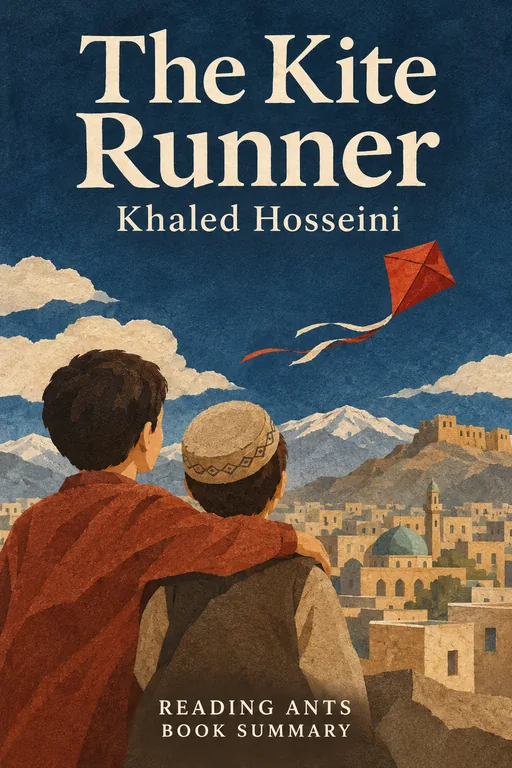
The Kite Runner
Khaled Hosseini
A wealthy boy in Kabul betrays his loyal best friend on the day of a kite tournament, and decades later, after fleeing to America, he returns to a Taliban-ruled Afghanistan to try to make things right.
✨ Modern Fiction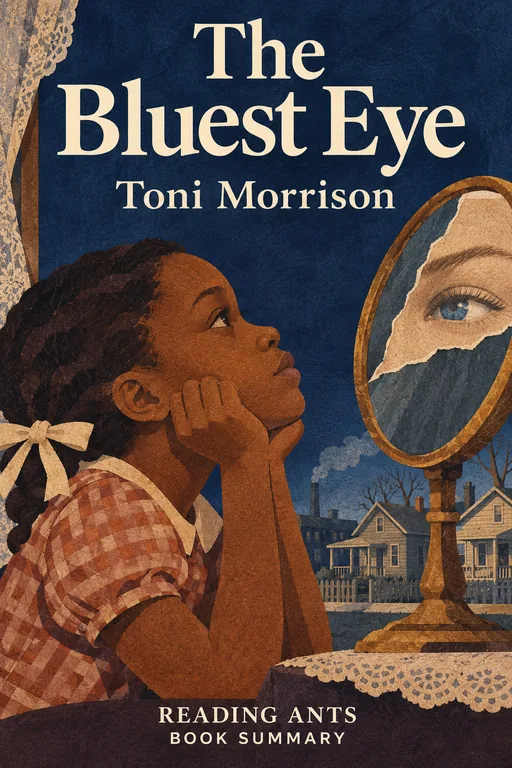
The Bluest Eye
Toni Morrison
In 1940s Ohio, a poor Black girl named Pecola Breedlove, who believes that she is ugly, prays for blue eyes, and the community's failure to protect her leads to tragedy.
✨ Modern Fiction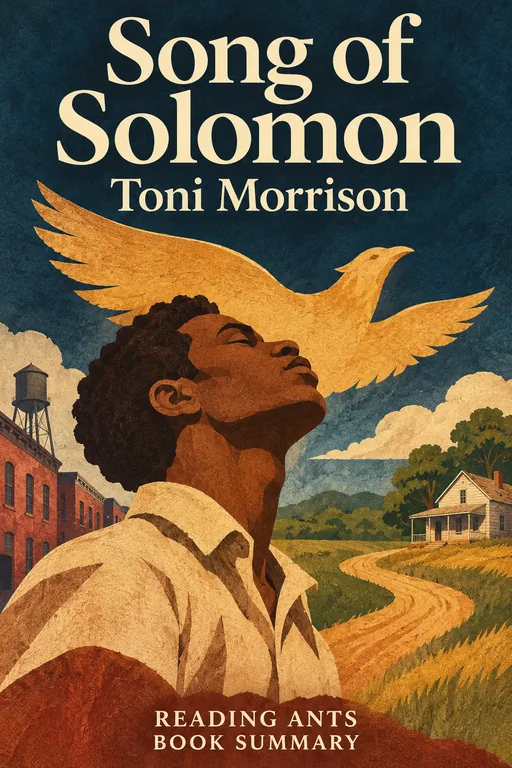
Song of Solomon
Toni Morrison
Macon "Milkman" Dead, a self-absorbed young man from Michigan, goes south in search of a family treasure and finds instead his family's history, and learns to take responsibility and to fly.
✨ Modern FictionWant something different?
Pick another topic and we will show you three books to start with.