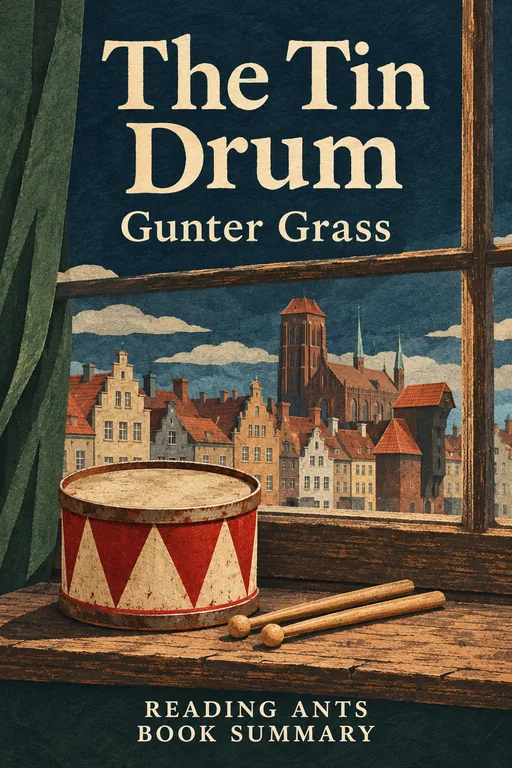
The Tin Drum
Original title: Die Blechtrommel
A boy who refuses to grow up, and who screams glass to pieces, tells the story of Germany's Nazi years from the point of view of an outsider.
Overview
The Tin Drum is a novel by the German writer Gunter Grass, published in 1959. It is set mostly in the free city of Danzig (today Gdansk, in Poland) and later in West Germany, from the 1920s to the 1950s. The narrator, Oskar Matzerath, tells his life from a mental hospital. The book blends comedy, horror and fantasy, and it was one of the first major German novels to look at the Nazi era without turning away. It asks how ordinary people lived through, and took part in, a terrible time. It contains disturbing and sexual scenes, and is for mature readers.
Main Characters
- Oskar Matzerath: the narrator, who stays small, plays his drum and can shatter glass with his voice.
- Agnes Matzerath: Oskar’s mother, who is torn between two men.
- Alfred Matzerath: the grocer, her husband and Oskar’s presumed father.
- Jan Bronski: Agnes’s cousin and lover, and Oskar’s possible real father.
- Maria: a young woman who works in the shop, and whom Oskar desires.
- Bebra: a small-statured performer who becomes Oskar’s mentor.
Full Summary
A Boy Who Refuses to Grow
Oskar tells the story of his family, starting with his grandmother, who hides a fugitive under her skirts, and who thus conceives his mother, Agnes. Agnes marries Alfred Matzerath, a German, but she also loves her cousin Jan Bronski, who is Polish. Oskar is born in 1924 and he is a precocious baby, who sees the grown-up world with clear eyes.
Oskar has an adult’s mind from birth, and he decides never to join the grown-up world. On his third birthday he is given a tin drum, and he deliberately falls down the cellar stairs to stop growing. From this point, he stays the size of a three-year-old, though his mind keeps on growing.
The Drum and the Scream
Oskar beats on his drum day and night. When someone tries to take it away, he screams so high that glass shatters. He uses this power for fun, for revenge and for attention. His schooling ends quickly after a teacher tries to take his drum, and he spends his childhood in the shop and the streets.
He watches the adults around him. He sees his mother’s affair, and the rise of the Nazi party in Danzig, as his father joins in, and neighbors change their opinions. At a Nazi rally, Oskar hides under the stand and plays his drum so that the band’s rhythm falls apart.
Agnes, caught between her husband and her lover, dies before the war, after a binge of eating fish. Oskar, who loves her in his way, grieves.
The Polish Post Office
When the war begins in 1939, the Polish post office in Danzig is attacked by German forces. Jan Bronski is inside, and so is Oskar, who led him there while trying to get his drum mended. Jan is captured and shot, and Oskar feels responsible.
The War Years
Oskar meets Bebra again, the small performer he first knew as a boy at a circus, who convinces him to join a troupe that entertains German soldiers at the front. Oskar sees the war from the sidelines, and he travels through France, where he sees the Atlantic coast fortifications. He falls in love with a young woman in the troupe, who is killed in an attack.
When he returns, he finds that his father, Alfred, has married Maria, who has had a son, Kurt. The Red Army arrives in Danzig, and Alfred is killed by Soviet soldiers when he tries to hide his Nazi badge. At his funeral, Oskar throws his drum into the grave, and when a stone strikes his head, he begins to grow again, although he also develops a hunchback.
The West
With Maria and her child, Oskar leaves Danzig and goes to the west, to Dusseldorf. He works as a stonecutter, as an artist’s model and as a jazz drummer, and he becomes a successful performer. He lives in the postwar German economic recovery, which he observes with irony.
In the end, he is accused of a murder that he did not commit, and he ends up in a mental hospital, where he writes his memoir. He is thirty, and he feels that he is safe in the asylum, from which he looks back on the whole story.
Why It Matters
The Tin Drum made Grass an international figure and is the best-known German novel of the postwar years. Grass won the Nobel Prize in Literature in 1999, and the Nobel committee mentioned this book in particular. It helped to open a discussion in Germany about the Nazi past, a subject that had been avoided. The novel was adapted into a film in 1979 that won the Palme d’Or at Cannes and an Academy Award. Its mix of fantasy and history made it a landmark of magical realism, and it showed younger German writers that it was possible to write about the past with humor, anger and invention.
Key Takeaways
- Looking from outside can reveal truth. Oskar sees what grown-ups prefer to ignore.
- Ordinary people take part in history. The story shows how a society slides into support for evil.
- Refusing to grow up is no escape. Oskar’s choice protects him in some ways but also traps him.
- Humor can face horror. The book uses comedy to make the painful easier to approach.
- Memory is unreliable. Oskar’s narration is often unreliable and self-serving.
What We Can Learn
The book shows how easy it is for people to go along with a crowd, and how quickly neighbors can change when the political winds shift. It encourages us to ask what we would have done in such circumstances, and to speak up when we see injustice.
It also shows how people try to avoid responsibility, by claiming that they were just following orders or that they were too small to matter. Oskar’s story asks us to look honestly at our own part in the world. Finally, it suggests that history cannot be escaped by hiding or by forgetting, and that facing it is part of growing up.
Criticism and Counterpoints
Some readers find the book’s grotesque humor and its sexual scenes offensive, and the narrator is often unpleasant. The novel is long and episodic, and its fantasy elements can be confusing. Others note that Grass, who revealed late in life that he had served in the Waffen-SS as a teenager, was criticized for not saying so earlier, and that this has made some readers look at the book differently. Critics also find that the story sometimes treats serious events with too much playfulness.
Who Should Read It
This book is for mature readers who like challenging literary fiction and are interested in twentieth-century history. It is not suited to younger readers. Those who are put off by crude or disturbing scenes may prefer to skip it, but readers who enjoy inventive, satirical storytelling may find it unforgettable.
Want the whole book?
A summary is a taste, not the meal. Here is where to find the full book.
You reached the end 🎉
Nicely done. Mark this one as read, and we will suggest what to read next.
Read this next
Midnight's Children
Salman Rushdie
Born at the exact moment India became independent, a boy named Saleem Sinai discovers that his life is mysteriously linked to the nation's history, and tells his story as a wild mix of family saga, politics and magic.
✨ Modern Fiction
One Hundred Years of Solitude
Gabriel Garcia Marquez
Seven generations of the Buendía family live, love, fight and repeat the same mistakes in the magical Colombian town of Macondo, from its founding to its final destruction.
🌍 World Literature
Slaughterhouse-Five
Kurt Vonnegut
Billy Pilgrim, a World War II soldier who survived the firebombing of Dresden, becomes "unstuck in time," bouncing between his past, present and future, and finds meaning in the idea that all moments exist forever.
📜 Classics
Catch-22
Joseph Heller
A bombardier named Yossarian tries to survive World War II by pretending to be crazy, but he is trapped by a military rule, Catch-22, that makes every escape impossible.
📜 Classics
All Quiet on the Western Front
Erich Maria Remarque
A young German soldier discovers that modern war destroys not only bodies but also the beliefs, relationships and futures of those forced to fight it.
🌍 World Literature
The Little Prince
Antoine de Saint-Exupery
A pilot stranded in the desert meets a small boy from a tiny planet, who teaches him that the most important things in life, like love and friendship, can only be seen with the heart.
🌍 World LiteratureWant something different?
Pick another topic and we will show you three books to start with.