 Reading Ants
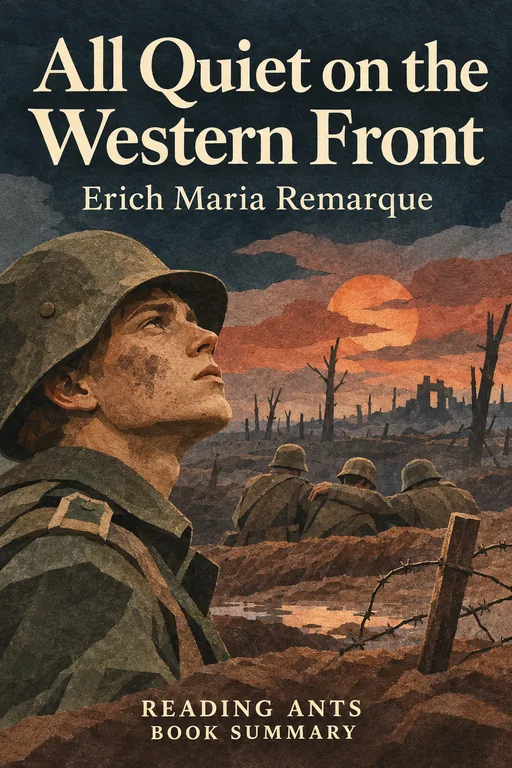
All Quiet on the Western Front
Original title: Im Westen nichts Neues
A young German soldier discovers that modern war destroys not only bodies but also the beliefs, relationships and futures of those forced to fight it.
Overview
All Quiet on the Western Front follows Paul Bäumer, who joins the German army with his classmates during the First World War. Encouraged by patriotic speeches, they expect courage and honor; the Western Front instead brings hunger, terror, boredom and sudden death. Paul narrates without pretending that soldiers on either side are natural enemies. His real subjects are survival, comradeship and the damage done to a generation too young to understand what it was promised. Although fictional, the novel draws on Erich Maria Remarque’s experience as a German veteran. Its plain view of war made it internationally famous and politically threatening to those who wished to glorify combat.
Main Characters
- Paul Bäumer: a sensitive young German infantryman and the narrator.
- Stanislaus Katczinsky: an older, resourceful soldier and Paul’s closest mentor.
- Albert Kropp: Paul’s intelligent classmate and fellow soldier.
- Müller: a practical classmate who thinks about survival and the future.
- Tjaden: a thin soldier with a fierce appetite and hatred of petty authority.
- Kantorek: the teacher whose patriotic pressure helps send the boys to war.
- Himmelstoss: a former postman who abuses his power while training recruits.
Full Summary
Schoolboys Become Soldiers
Paul and several classmates enlist after their teacher Kantorek praises military service. Their idealism quickly collapses. During training, Corporal Himmelstoss humiliates recruits through pointless punishments, teaching them that authority can be cruel rather than noble. At the front, the experienced Kat shows them how to find food, shelter and safety.
Early on, the survivors of Paul’s company rest behind the lines and enjoy an unusually large meal, cooked for 150 men although only about 80 have come back; abundance becomes a measure of death. The group visits Franz Kemmerich, a classmate dying after losing a leg. Hospital staff need his bed, while Müller asks for his excellent boots because he knows Kemmerich cannot use them. The request sounds cold, but scarcity has changed how the boys think. Paul stays as Kemmerich dies and carries the boots away. Death is already ordinary, yet the loss hurts because it strips another piece from their shared youth.
Life at the Front
Paul’s company endures shelling, rats, mud and poor food. The soldiers become skilled at reading sounds and reacting before conscious thought. Their closeness is practical and emotional: a meal, a joke or Kat’s talent for finding supplies can briefly restore their humanity. They resent civilians and leaders who discuss strategy from safety.
During a bombardment, terrified recruits lose control, and some are killed when they leave cover. The survivors later defend themselves against an attack. Paul describes violence as confused and automatic rather than heroic.
Home No Longer Feels Like Home
Paul receives leave and returns to his family. His mother is ill, and their poverty troubles him. Neighbors ask him about the front, but they want confident opinions and exciting stories, not the truth. His old room and books belong to a life he can no longer enter. He visits Kemmerich’s mother and tells her that her son died quickly, hiding the suffering she could not bear to hear.
Paul also sees Kantorek reduced to a trainee under one of his former pupils. The reversal offers little satisfaction. After his leave, and before returning to the front, Paul spends several weeks at a training camp beside a camp of imprisoned Russian soldiers. Seeing their hunger and ordinary faces, he realizes that governments have labeled people enemies who might otherwise have been friends.
The Man in the Crater
Back at the front, Paul volunteers for a patrol and becomes trapped in a shell crater during an attack. A French soldier jumps in, and Paul stabs him in panic. Forced to remain beside the dying man, he gives him water and tries unsuccessfully to treat the wound. He finds the man’s identity papers and learns that he had a civilian life and family.
Paul promises the dead man that he will somehow make amends, but later understands that such promises are part of his shock. His comrades reassure him that killing was necessary. The episode nevertheless makes the enemy personal. Paul sees how military language hides individual human beings, and the knowledge cannot protect either side from the machinery of war.
Hospitals and Losses
Paul and Albert are wounded while helping to evacuate civilians from a village. They travel on a hospital train and are treated in a Catholic hospital. Albert’s leg is amputated, leaving him bitter and frightened about his future. Paul recovers enough to return to duty, but the army he rejoins is collapsing. New recruits are younger and less prepared, while food and equipment grow worse.
One by one, Paul’s friends disappear. Müller is killed and passes Kemmerich’s boots to Paul, continuing the grim chain. Leer dies from a wound. Other companions are killed, wounded or separated from him. The names that once formed a class and a community become a list of absences. Paul feels that even survival may not restore what war has taken.
The Last Companion
Kat is wounded in the leg, and Paul carries him toward medical help under fire. He talks to Kat and plans for their future friendship, encouraged that the wound seems manageable. At the aid station, however, Paul discovers that a small fragment has struck Kat’s head during the journey. His closest friend is dead.
By 1918, Paul is nearly alone. He believes his generation is ruined whether its members die or return home unable to fit into ordinary life. In October, on a day the army report describes as quiet, Paul is killed. His face appears calm, as if the end has released him. The impersonal report behind the title reduces an individual death to nothing worth announcing.
Why It Matters
The novel helped define modern antiwar literature by centering ordinary soldiers rather than generals, victories or patriotic speeches. Its German viewpoint also challenged readers to recognize shared suffering across national lines. Remarque does not present combat as a test that makes boys into fulfilled men; he presents it as a system that separates young people from civilian life and consumes their possible futures.
The book was attacked and burned by the Nazis, who rejected its challenge to militarism. It remains widely read because its questions extend beyond one army or conflict: Who benefits when sacrifice is praised by people far from danger? How can veterans explain experiences that civilians turn into slogans? Its answer is not that soldiers lack courage, but that their courage should not be used to make war seem desirable.
Key Takeaways
- War destroys identity as well as life. Paul survives many battles, but loses his connection to the ambitions and language of his youth.
- Comradeship is a form of survival. Food, practical skill and companionship matter more to the soldiers than abstract promises of glory.
- Enemies are manufactured. Paul’s encounter with the French soldier and Russian prisoners reveals individuals behind national labels.
- Authority deserves scrutiny. Kantorek and Himmelstoss show how institutions can reward confidence and obedience without wisdom.
- A generation can survive and still be lost. The novel includes those who return among war’s casualties because trauma and isolation shape their futures.
What We Can Learn
The novel asks us to test impressive language against the lives affected by it. When leaders describe violence as clean, necessary or glorious, we can ask who faces the actual cost and whether peaceful choices were seriously pursued. It also teaches careful listening. People who have experienced trauma may not be able, or willing, to turn it into a satisfying story for outsiders.
Paul’s friendship with Kat shows the value of small, reliable acts during crisis. Sharing food, noticing danger and staying beside another person can matter more than dramatic declarations. Finally, the book encourages us to resist treating groups as faceless enemies. Learning names, histories and ordinary hopes does not solve every conflict, but it makes cruelty harder to disguise as an abstraction.
Criticism and Counterpoints
Because the novel stays close to Paul’s experience, it offers limited attention to civilians, women, colonial troops and the broader causes of the First World War. Its emotional truth should not be mistaken for a complete history. Some readers also argue that intense depictions of battlefield loyalty can create their own powerful attraction even within an antiwar story.
Paul sometimes speaks for an entire generation, although soldiers’ experiences varied greatly. The book’s strength is its focused witness, not universal coverage. Readers seeking political and military analysis will need history alongside it.
Who Should Read It
Read this if you want a direct, humane war novel about friendship, trauma and lost youth. It suits mature teens and adults, including readers studying the First World War. Those sensitive to repeated death, severe injury and emotional despair may prefer to skip it or read with support.
Want the whole book?
A summary is a taste, not the meal. Here is where to find the full book.
You reached the end 🎉
Nicely done. Mark this one as read, and we will suggest what to read next.
Read this next
A Farewell to Arms
Ernest Hemingway
An American ambulance driver in the Italian army during World War I falls in love with a British nurse, deserts the war and escapes with her to Switzerland, only to lose her in childbirth.
📜 Classics
Slaughterhouse-Five
Kurt Vonnegut
Billy Pilgrim, a World War II soldier who survived the firebombing of Dresden, becomes "unstuck in time," bouncing between his past, present and future, and finds meaning in the idea that all moments exist forever.
📜 Classics
Catch-22
Joseph Heller
A bombardier named Yossarian tries to survive World War II by pretending to be crazy, but he is trapped by a military rule, Catch-22, that makes every escape impossible.
📜 Classics
The Little Prince
Antoine de Saint-Exupery
A pilot stranded in the desert meets a small boy from a tiny planet, who teaches him that the most important things in life, like love and friendship, can only be seen with the heart.
🌍 World Literature
Things Fall Apart
Chinua Achebe
Okonkwo, a proud and fearsome leader in an Igbo village in Nigeria, struggles against his own fears and against the arrival of British missionaries and colonial rulers, who change his world forever.
🌍 World Literature
One Hundred Years of Solitude
Gabriel Garcia Marquez
Seven generations of the Buendía family live, love, fight and repeat the same mistakes in the magical Colombian town of Macondo, from its founding to its final destruction.
🌍 World LiteratureWant something different?
Pick another topic and we will show you three books to start with.