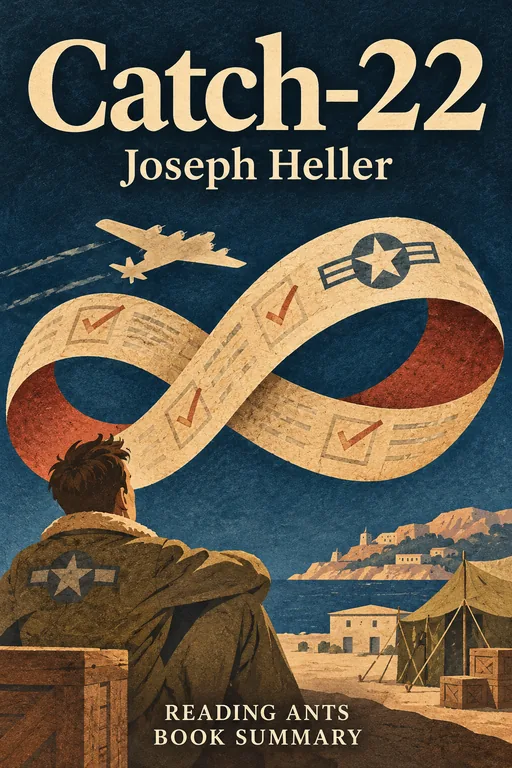
Catch-22
A bombardier named Yossarian tries to survive World War II by pretending to be crazy, but he is trapped by a military rule, Catch-22, that makes every escape impossible.
Overview
Catch-22 is a satirical war novel by Joseph Heller, published in 1961. It is set on a small Mediterranean island, Pianosa, in 1944, where an American bomber squadron is stationed, and it is based on Heller’s own service as a bombardier. The story is told out of order, with events repeated from different angles, which gives it a dizzying, circular quality similar to the logic it mocks. The novel mixes dark humor and horror, and it shows how absurd rules, ambitious officers and greed can make war even more deadly. The phrase “Catch-22” has become part of everyday language for a no-win situation.
Main Characters
- Captain John Yossarian: a bombardier who wants to live, and is terrified of being killed.
- Colonel Cathcart: the ambitious commander who keeps raising the number of missions his men must fly.
- Doc Daneeka: the squadron doctor, who worries only about himself.
- Milo Minderbinder: the mess officer who builds a profitable syndicate that trades with both sides.
- Orr: Yossarian’s quiet roommate, who keeps crashing his plane.
- Chaplain Tappman: a gentle, uncertain army chaplain.
- Major Major Major Major: a man who is promoted because of a computer’s joke and tries to avoid everyone.
- Nately and Snowden: young airmen whose deaths affect Yossarian deeply.
Full Summary
The Catch
Yossarian is in the hospital, pretending to have a liver condition, to avoid flying missions. He is surrounded by odd characters. The more missions that he flies, the more likely he is to be killed, and Colonel Cathcart keeps raising the number of missions required. Yossarian learns about Catch-22 from Doc Daneeka: airmen can be grounded if they are insane, but anyone who asks to be grounded shows that they are sane enough to understand the danger, and so must continue flying. The rule is a trap with no exit.
The Squadron
Yossarian’s squadron is full of odd people. Major Major is promoted by a computer’s joke, and avoids all contact by only seeing visitors when he is out of his office. The chaplain doubts his usefulness. Milo Minderbinder organizes a vast commercial syndicate, M&M Enterprises, in which everyone has a share, trading eggs, cotton and other goods, and even bombing his own base under contract with the Germans. Milo’s profits are justified by the idea that what is good for the syndicate is good for the country.
Yossarian also meets Orr, who is quiet and odd, and who spends much time working on a stove and talking about apples. Orr keeps getting shot down and crashing in the sea, to the amazement of others, which seems at first to be pure bad luck. Yossarian cannot understand how he survives, and later realizes that these crashes were practice.
Missions and Fear
The story moves back and forth in time. In one mission, Yossarian’s plane is hit, and he tries to help a gunner named Snowden who is badly wounded. When he opens Snowden’s flak jacket, he sees the man’s insides spilling out, and realizes that humans are just matter, and that death is sudden and meaningless. This event haunts him through the book, and the full story is only told at the end. Yossarian also loses friends, such as Nately, who loves a young prostitute in Rome, and is killed in a mission.
Cathcart’s Ambition
Colonel Cathcart, who is eager to be promoted, makes the men fly more and more missions, and increases the number each time they near the limit. He enjoys the attention of his superiors, and plans to have his men’s names in the newspapers. Yossarian realizes that the system will never let him go home. He decides to go on strike and refuses to fly. His superiors offer him a deal: if he praises them and says he likes them, he will be sent home. He is tempted.
Cathcart, who is advised by his deputy, Colonel Korn, also adds pressure with schemes of his own to impress his superiors, such as pushing the chaplain to hold prayers before missions. The chaplain’s assistant, Corporal Whitcomb, proposes sending form letters of condolence to the families of the dead, which only deepens the sense of senselessness. General Dreedle, the stern commander of the wing, has his own odd habits, and no one asks what the point of the missions is.
The Escape
Yossarian is horrified by the idea of a deal that would betray his friends, and he decides to run. He learns that Orr, who had often been crashing his plane, has rowed all the way to neutral Sweden, which was his plan all along. Inspired, Yossarian resolves to follow him. The chaplain encourages him, and Yossarian prepares to leave, dodging another knife attack from the young prostitute Nately loved, who blames him for Nately’s death and has already stabbed him once, as he goes. The book ends with Yossarian running away, with the hope that he can make it.
Before this final decision, Yossarian walks through Rome at night and sees the suffering of ordinary people: a woman being beaten, an old man lying in the street and children left alone. The city seems a nightmare of cruelty, and he sees that the war has made everyone suspicious and violent. This sense of a broken world makes his decision to leave feel not cowardly but necessary. That same night he learns that his fellow officer Aarfy has raped and murdered a young maid, Michaela, and feels no guilt; yet it is Yossarian whom the military police arrest, for being in Rome without a pass.
Why It Matters
Catch-22 became a symbol of the absurdity of war and bureaucracy. It was a bestseller, especially during the Vietnam War, when many readers felt that it spoke truthfully about military life. It was adapted into a 1970 film directed by Mike Nichols and a 2019 television series. The title has entered the English language as a term for a self-contradicting rule that traps people.
The novel also influenced a generation of writers and comedians, and is often listed among the best English-language novels of the twentieth century.
Key Takeaways
- War can be absurd. Rules and ambitions can matter more than lives.
- Bureaucracy can trap people. Catch-22 shows a rule with no way out.
- Profit corrupts. Milo trades with the enemy.
- Survival is a form of sanity. Yossarian’s fear is reasonable.
- Resisting is possible. Yossarian chooses to run.
What We Can Learn
The novel shows that rules and logic can be used to justify unreasonable things. When a system seems to make no sense, it may be serving someone’s interests.
It also encourages us to value life and to question orders. Yossarian’s refusal to be a hero for the sake of a colonel’s career asks us to think about what is worth risking.
Finally, humor can be a way to face terrifying realities. Heller makes readers laugh and then shocks them with a death, as a way of showing the cost of war.
Criticism and Counterpoints
Some readers find the novel hard to follow, because of its non-linear structure and its repetitive dialogue, and some find the humor too bleak or forced. Critics also note that female characters are seldom treated with depth, and are often presented as objects of desire or comic figures.
Some veterans said that the book’s portrayal of the military was unfair, since most officers were not so cynical. Others say that the long series of absurd episodes can become tiresome. Still, it is widely admired.
Who Should Read It
This book suits mature teenagers and adults. It is long, with a complicated structure, and contains war violence, sexual references and dark humor. Readers may need patience, but many find it rewarding.
Want the whole book?
A summary is a taste, not the meal. Here is where to find the full book.
You reached the end 🎉
Nicely done. Mark this one as read, and we will suggest what to read next.
Read this next
Slaughterhouse-Five
Kurt Vonnegut
Billy Pilgrim, a World War II soldier who survived the firebombing of Dresden, becomes "unstuck in time," bouncing between his past, present and future, and finds meaning in the idea that all moments exist forever.
📜 Classics
All Quiet on the Western Front
Erich Maria Remarque
A young German soldier discovers that modern war destroys not only bodies but also the beliefs, relationships and futures of those forced to fight it.
🌍 World Literature
One Flew Over the Cuckoo's Nest
Ken Kesey
A rebellious con man named McMurphy fakes insanity to escape prison work, and his clash with the controlling Nurse Ratched transforms the lives of the patients, as seen by a silent patient, Chief Bromden.
📜 Classics
Pride and Prejudice
Jane Austen
Quick-witted Elizabeth Bennet and the proud, wealthy Mr. Darcy badly misjudge each other, and only by facing their own faults do they find their way to love.
📜 Classics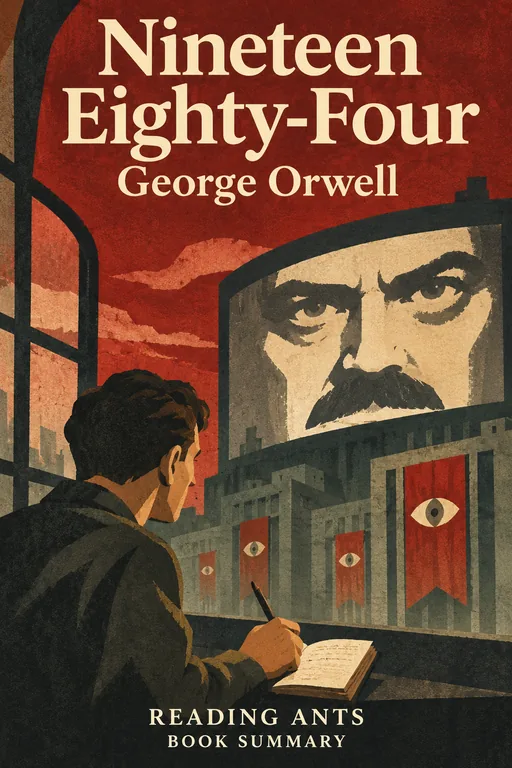
Nineteen Eighty-Four
George Orwell
In a future Britain ruled by an all-seeing Party, one man secretly rebels by keeping a diary and falling in love, and discovers just how completely a totalitarian state can crush the human mind.
📜 Classics
To Kill a Mockingbird
Harper Lee
In a small Alabama town in the 1930s, young Scout Finch watches her father, a lawyer, defend a Black man falsely accused of a crime, and learns hard lessons about prejudice, courage and seeing the world through other people's eyes.
📜 ClassicsWant something different?
Pick another topic and we will show you three books to start with.