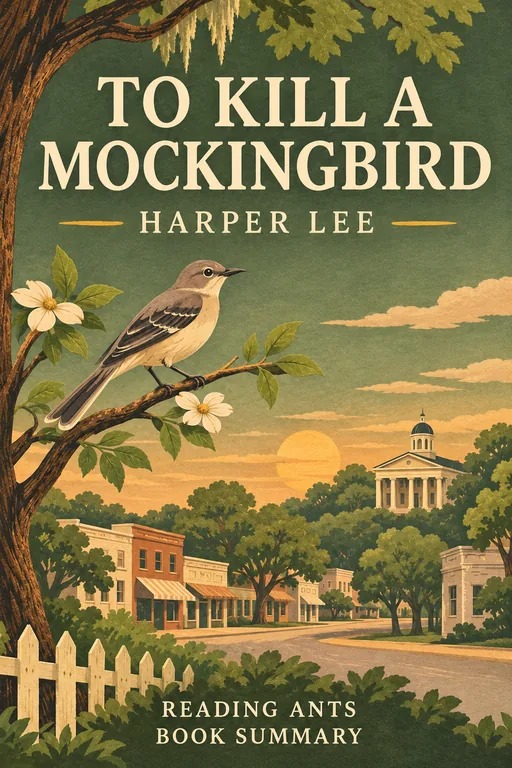
To Kill a Mockingbird
In a small Alabama town in the 1930s, young Scout Finch watches her father, a lawyer, defend a Black man falsely accused of a crime, and learns hard lessons about prejudice, courage and seeing the world through other people's eyes.
Overview
To Kill a Mockingbird is told by Scout Finch, looking back on her childhood in Maycomb, a sleepy, segregated town in the American South during the Great Depression. Scout, her older brother Jem and their friend Dill spend their summers playing games and daring each other to approach the house of Boo Radley, a mysterious neighbor no one ever sees. Then their father, Atticus, agrees to defend Tom Robinson, a Black man accused of attacking a white woman, and the whole town turns against the family. Funny, warm and heartbreaking, the novel won the Pulitzer Prize and became one of the most widely read books in American schools.
Main Characters
- Scout (Jean Louise) Finch: the narrator, a smart, fierce tomboy who is about six when the story begins.
- Jem Finch: Scout’s older brother, who grows from a playful boy into a thoughtful teenager.
- Atticus Finch: their widowed father, a calm, honest lawyer.
- Calpurnia: the Finches’ Black cook, who helps raise the children.
- Dill: an imaginative boy who spends summers in Maycomb with his aunt.
- Boo (Arthur) Radley: a reclusive neighbor surrounded by scary rumors.
- Tom Robinson: a Black farmworker accused of a crime he did not commit.
- Bob Ewell and Mayella Ewell: a poor, hateful white man and his lonely daughter, who accuse Tom.
- Miss Maudie Atkinson: a kind, wise neighbor.
Full Summary
Summers and the Radley House
Scout and Jem Finch live with their father, Atticus, and Calpurnia in Maycomb, Alabama. Their mother died when Scout was very young. One summer they meet Dill, a small boy with big stories, and the three become obsessed with Boo Radley. Local rumors say Boo is a frightening man who has been locked inside his house for years. The children act out scenes from his life, and dare each other to touch the house.
When Scout starts school, she clashes with her teacher and with classmates, and Atticus gives her advice she never forgets: you never really understand a person until you consider things from their point of view.
Gifts in the Tree
Over time, Jem and Scout find small gifts left in a knothole of a tree outside the Radley house: chewing gum, old coins, a pair of carved soap figures that look like them. One night, the children sneak onto the Radley property, and Jem loses his trousers on the fence while escaping. When he goes back for them, he finds them folded and roughly mended. Then Boo’s brother fills the knothole with cement. During a winter fire at Miss Maudie’s house, someone places a blanket around Scout’s shoulders without her noticing. The children slowly realize that Boo is watching over them.
Atticus Takes the Case
Atticus is appointed to defend Tom Robinson, a Black man accused of raping Mayella Ewell, the daughter of Bob Ewell, one of the poorest and most despised white men in town. In Maycomb, a Black man accused by a white woman is almost certain to be found guilty. Atticus decides to defend Tom properly anyway, because otherwise he could not hold his head up.
Classmates and relatives insult Atticus for defending Tom, and Scout gets into fights. Atticus teaches the children about courage through Mrs. Dubose, a bad-tempered old neighbor Jem must read to as punishment. After her death, Atticus explains that she was fighting to break her addiction to morphine before she died. Real courage, he says, is starting something when you know you are beaten, and seeing it through anyway.
The Mob at the Jail
The night before the trial, Atticus sits outside the jail to protect Tom. A group of men arrives to take Tom and kill him. Scout, Jem and Dill have followed Atticus. Not understanding the danger, Scout cheerfully talks to one of the men, Mr. Cunningham, about his son, who is her classmate. Embarrassed, Mr. Cunningham tells the others to leave. A child’s innocent friendliness has reminded him that he is a father and a neighbor, not just part of a mob.
The Trial
The children watch the trial from the balcony, where Black townspeople must sit. Atticus shows that Mayella was beaten by someone who led with his left hand, that Tom’s left arm was badly injured in an accident years ago, and that Bob Ewell is left-handed. Tom testifies that he often helped Mayella with chores because he felt sorry for her, and that she kissed him, which broke a racist social taboo and was treated as a serious crime in that society. Her father saw it through the window. In his closing speech, Atticus asks the all-white jury to do their duty and judge Tom by the evidence.
Even so, the jury finds Tom guilty. Jem is crushed. Yet Miss Maudie points out that the jury took hours to decide instead of minutes, a small sign of change. As Atticus leaves the courtroom, the Black spectators in the balcony stand up in respect.
After the Verdict
Tom is shot and killed while trying to escape from prison, having lost hope in an appeal. Bob Ewell, humiliated in court even though he won, spits in Atticus’s face and swears revenge. Atticus shrugs it off.
On Halloween night, Scout walks home from a school pageant with Jem, still wearing her ham costume. In the dark, someone attacks them. Jem’s arm is broken, and Scout is saved by her costume. A stranger fights off the attacker and carries Jem home. The attacker, Bob Ewell, is found dead with a knife in his ribs.
Boo Radley
Scout realizes that the shy, pale man standing in Jem’s room is Boo Radley. The sheriff decides to report that Ewell fell on his own knife. He says that dragging the gentle, private Boo into the spotlight would be a sin. Scout understands: it would be like killing a mockingbird, a bird that harms no one and only sings.
Scout walks Boo home. Standing on his porch, she imagines the past few years from his point of view, watching the children play, grow and get into trouble. At last she understands what Atticus meant about standing in someone else’s shoes.
Why It Matters
To Kill a Mockingbird is one of the most influential American novels. Published in 1960, during the civil rights movement, it gave millions of white readers a powerful picture of racial injustice in the American South. It won the Pulitzer Prize in 1961, and the 1962 film starring Gregory Peck as Atticus is also considered a classic.
Atticus Finch became a symbol of integrity and of the idea that lawyers should defend the powerless, and many people have said the book inspired them to study law. The novel has been taught in schools for generations and has been translated into many languages.
It is also one of the most debated books in American schools. It has been challenged for its racial slurs and its handling of race. In 2015, Go Set a Watchman, an earlier draft written before Mockingbird, was published and showed a much less admirable Atticus, which sparked fresh debate about the character.
Key Takeaways
- Empathy is learned. Understanding people means imagining life from their side, as Scout finally does with Boo.
- Prejudice can defeat truth. Atticus proves Tom’s innocence, but racism still wins in court.
- Real courage is quiet. It is doing the right thing when you know you will probably lose.
- Innocence deserves protection. Tom and Boo are “mockingbirds,” harmless people damaged by society’s cruelty.
- Childhood ends in learning about injustice. Jem and Scout grow up as they see their town’s flaws.
What We Can Learn
The book’s most famous lesson is to stand in someone else’s shoes. Before judging a classmate, coworker or neighbor, imagine their life, their pressures and their fears. Rumors about Boo Radley turn out to be completely wrong, much like gossip and online pile-ons today.
Atticus also shows how to be brave without being loud. He keeps his temper, treats everyone with respect, even Mrs. Dubose and Bob Ewell, and does his work honestly when it costs him friends. We can practice that kind of courage in small ways: speaking up when someone is mocked, or refusing to join in when a group turns cruel.
Finally, Scout’s moment at the jail shows the power of seeing people as individuals. Reminding someone of a personal connection can break the spell of a crowd.
Criticism and Counterpoints
Many critics argue that the novel centers white characters in a story about racism. Tom Robinson has few lines and little inner life, while the moral spotlight falls on Atticus, a pattern sometimes called the “white savior” story. The Black characters, including Calpurnia, are seen mostly from the outside.
Some readers also find Atticus too perfect, or note that he urges understanding even toward people who support racist violence. The publication of Go Set a Watchman complicated his image further. Supporters argue that the book’s limited view is honest, because it is told by a white child who only partly understands what she sees, and that it still opens important conversations.
Who Should Read It
This book suits readers from about 13 upward, and it works well read alongside discussions of history and civil rights. Adults rereading it often find new layers. The racial slurs and themes of injustice can be upsetting, so younger readers benefit from talking it through with an adult.
Want the whole book?
A summary is a taste, not the meal. Here is where to find the full book.
You reached the end 🎉
Nicely done. Mark this one as read, and we will suggest what to read next.
Read this next
The Help
Kathryn Stockett
In 1962 Jackson, Mississippi, a young white woman named Skeeter secretly collects the stories of Black maids who work in white homes, putting them all at risk in the heat of the civil rights movement.
✨ Modern Fiction
Of Mice and Men
John Steinbeck
Two traveling farmworkers during the Great Depression, quick-witted George and the huge, gentle but mentally disabled Lennie, dream of owning their own small farm, but their dream ends in tragedy.
📜 ClassicsThe Catcher in the Rye
J. D. Salinger
After being expelled from his boarding school, a lonely, sarcastic sixteen-year-old wanders New York City for three days, struggling with grief, phoniness and the frightening idea of growing up.
📜 Classics
Roll of Thunder, Hear My Cry
Mildred D. Taylor
A Black family in 1930s Mississippi fights to keep their land and their dignity in the face of racism, and a young girl learns what it means to stand up.
🎒 Young Adult
A Separate Peace
John Knowles
Looking back from adulthood, a man recalls the summer of 1942 at a New England boarding school, when a moment of jealousy led him to injure his best friend, and how that act haunted his youth.
📜 Classics
Pride and Prejudice
Jane Austen
Quick-witted Elizabeth Bennet and the proud, wealthy Mr. Darcy badly misjudge each other, and only by facing their own faults do they find their way to love.
📜 ClassicsWant something different?
Pick another topic and we will show you three books to start with.