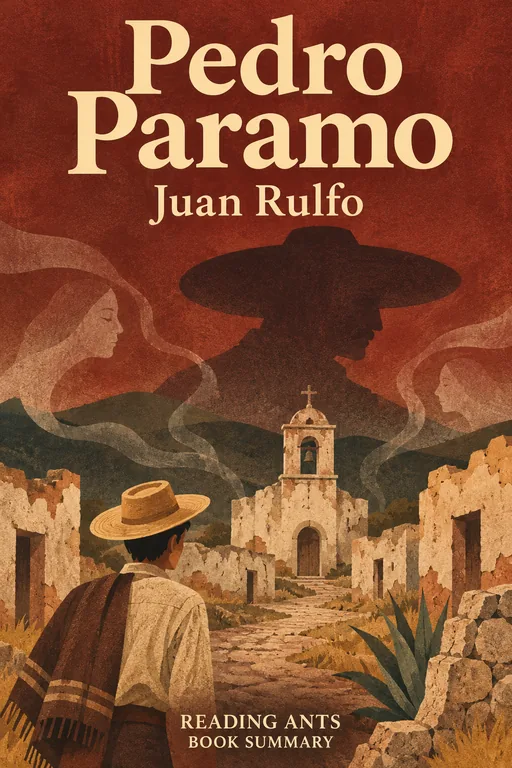
Pedro Paramo
Original title: Pedro Páramo
A young man travels to a deserted Mexican village to find his father, and finds a town full of whispering ghosts and the story of a cruel landowner.
Overview
Pedro Paramo is a short novel by the Mexican writer Juan Rulfo, published in 1955. It is set in a village called Comala, in rural Mexico, in the time before and after the Mexican Revolution. The book is told in fragments, jumping between the present and the past, and between the living and the dead. It is a ghost story and a story about power, love and loss. Rulfo published very little, mainly this novel and the story collection The Burning Plain, but this novel is considered one of the most influential novels in Latin American literature.
Main Characters
- Juan Preciado: a young man who goes to Comala to find his father.
- Pedro Paramo: the powerful, ruthless landowner who rules Comala.
- Dolores Preciado: Juan’s mother, who asks him to seek his father.
- Susana San Juan: the woman whom Pedro has loved since childhood, and who goes mad.
- Abundio: Pedro’s son, a muleteer.
- Eduviges Dyada: a ghost who greets Juan and tells him about his mother.
- Father Renteria: the village priest, who is weak and compromised.
Full Summary
The Promise
Juan Preciado’s mother, Dolores, is dying. Before she dies, she makes him promise to go to Comala, to find his father, Pedro Paramo, and demand what is owed to them. She tells him that the village is a beautiful place, with green fields and the smell of orange blossoms.
After her death, Juan goes to Comala. On the road, he meets a man named Abundio, who says that he too is a son of Pedro Paramo. Abundio leads him to the village.
A Village of Whispers
Comala is not as his mother described it. It is hot, silent and almost empty. As Juan walks through the dusty streets, he hears whispers, murmurs and echoes of voices. He is taken in by a woman, Eduviges, who tells him that she was a friend of his mother.
He realizes that Eduviges herself, like the voices in the streets, is a ghost, and that the village is populated with the dead. Each tells a bit of the story of Pedro Paramo and his rule.
Pedro’s Rise
The narration shifts into the past, and we see Pedro as a boy, who dreams of Susana San Juan, a girl from his village. His father, a landowner, is killed, and Pedro, as he grows up, becomes a landowner himself. He rules by force and by cunning, takes land from his neighbors, marries Juan’s mother for her property and then abandons her.
He has many children with many women, and he treats most of them with indifference. He has his enemies killed, and he buys off the priest. His only real love is Susana.
His son Miguel, who is wild and reckless, causes a great deal of trouble and rapes and kills in the area. Pedro covers up his crimes with money and power. When Miguel is killed in a riding accident, Pedro seems to feel no pain and says only that he is beginning to pay for what he has done.
Susana
Susana, who has been away, returns to Comala with her father, Bartolome, a miner. She is deeply disturbed, haunted by memories of her father and by the loss of her husband. Pedro, who has waited for her for decades, takes her into his home and has her father killed so that she has no one else. He wants to make her his own. But Susana has her own world, in which she lives in dreams of another time, and she does not return his love.
While she lives under his roof, a revolutionary band arrives in the region. Pedro cleverly makes himself useful to them, giving them money and men and placing his own man among them, so that the rebels serve his interests and his land is safe.
Susana dies, and church bells ring for days, but outsiders who come to the village turn the occasion into a noisy fair, while Pedro shuts himself away in grief. In his rage and grief, he swears to punish Comala by crossing his arms and letting it die. He lets his lands go to waste, and the people leave.
The End of Pedro
Years go by, and Comala becomes a ghost town. Pedro, old and alone, sits in a chair at the door of his house, thinking of Susana. One day, Abundio, his son, who is drunk and grieving for his wife, whom he could not afford to bury, approaches him and stabs him. Pedro falls to the ground and crumbles like a pile of stones.
Meanwhile, Juan, who has been listening to the ghosts in Comala, himself dies, struck by the whispers. He is buried in a grave shared with a woman named Dorotea, and goes on listening to the voices of the dead.
Why It Matters
Pedro Paramo is often credited as a forerunner of magical realism, and was a major influence on Gabriel Garcia Marquez, who said that he could recite the book by heart. It was widely praised for the way it uses fragments, voices and time shifts to tell a story, and for its beautiful, spare language. It has been translated into many languages and is considered a classic. It also gives a powerful picture of rural Mexico, of the poverty and the violence that followed the revolution, and of the way that power can destroy a community.
Key Takeaways
- The dead are not gone. The past stays alive in memory and in voices.
- Power can be cruel. Pedro’s rule destroys everything he touches.
- Love can be obsessive. His longing for Susana leads to ruin.
- Fathers matter. The absent father shapes his children’s lives.
- Stories are fragments. We know people only through pieces.
What We Can Learn
The novel reminds us how much the past lives on in the present, in families and in places. We can pay attention to the stories of our elders, and learn from them. It also shows how power without responsibility can bring everything down.
The book is a warning about the harm done by neglect and abuse, especially of children. Finally, it shows the value of listening: Juan comes to understand his world by hearing the voices of those who came before.
Criticism and Counterpoints
Some readers find the book confusing, as it moves between time periods and voices without warning. The sequence of events must be pieced together, and different readers reach different conclusions. Others find the mood too bleak, with little hope or humor. The female characters, such as Susana, are seen mainly through men’s eyes. The brevity of the book can also feel like a limit, since many characters are only sketched.
Who Should Read It
This book is for readers who like short, atmospheric, challenging novels, and who are interested in Latin American literature. It is brief, but it is worth reading slowly or twice. Those who want a clear and linear plot may find it hard, but those who like mysteries of mood and voice will find it haunting.
Want the whole book?
A summary is a taste, not the meal. Here is where to find the full book.
You reached the end 🎉
Nicely done. Mark this one as read, and we will suggest what to read next.
Read this next
One Hundred Years of Solitude
Gabriel Garcia Marquez
Seven generations of the Buendía family live, love, fight and repeat the same mistakes in the magical Colombian town of Macondo, from its founding to its final destruction.
🌍 World Literature
The House of the Spirits
Isabel Allende
Four generations of a Latin American family, bound by love, anger and the spirits that haunt them, live through the changes of a country moving toward dictatorship.
🌍 World Literature
Chronicle of a Death Foretold
Gabriel Garcia Marquez
In a small Colombian town, everyone knows that two brothers plan to kill a young man, and yet nobody stops them.
🌍 World LiteratureAs I Lay Dying
William Faulkner
After the death of their mother, a poor Mississippi family sets out on a nightmarish journey to bury her in the town of her birth, each member driven by a hidden need of their own.
📜 Classics
The Sound and the Fury
William Faulkner
Four sections, told by three brothers and then an outside narrator, trace the slow decline of the once-proud Compson family of Mississippi and the loss of their sister Caddy.
📜 Classics
The Little Prince
Antoine de Saint-Exupery
A pilot stranded in the desert meets a small boy from a tiny planet, who teaches him that the most important things in life, like love and friendship, can only be seen with the heart.
🌍 World LiteratureWant something different?
Pick another topic and we will show you three books to start with.