 Reading Ants
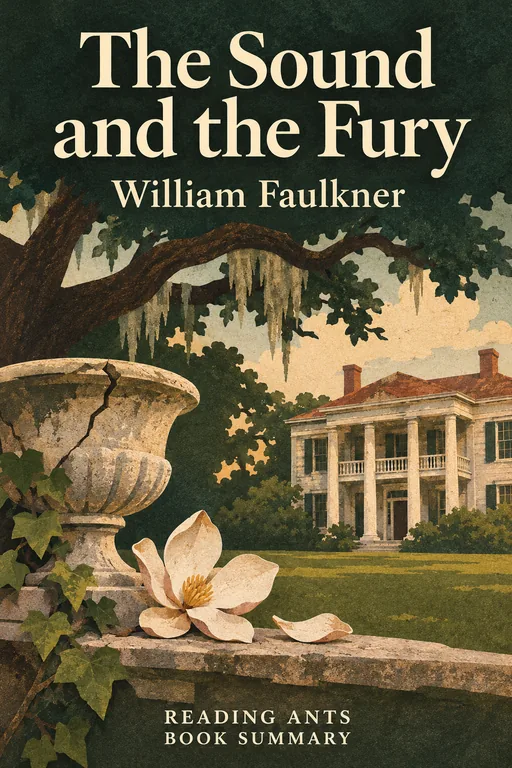
The Sound and the Fury
Four sections, told by three brothers and then an outside narrator, trace the slow decline of the once-proud Compson family of Mississippi and the loss of their sister Caddy.
Overview
The Sound and the Fury is a novel by William Faulkner, published in 1929. It is set in the fictional Yoknapatawpha County in Mississippi, and follows the Compson family as they lose money, status and hope in the early twentieth century. The title comes from a speech in Shakespeare’s Macbeth, about life being a tale told by an idiot, full of sound and fury, signifying nothing. The book is famous for its difficult, experimental structure. The first three sections are narrated by the brothers Benjy, Quentin and Jason, each in a different style, and the last follows the family’s Black servant, Dilsey. The central figure, their sister Caddy, is never given a voice of her own.
Main Characters
- Benjamin “Benjy” Compson: the youngest brother, who is mentally disabled and perceives time without order.
- Quentin Compson: the oldest brother, a Harvard student obsessed with family honor and with Caddy’s purity.
- Jason Compson: the middle brother, cold, bitter and cruel.
- Caddy (Candace) Compson: their sister, warm and loving, who becomes pregnant and is cast out.
- Miss Quentin: Caddy’s daughter, raised at the Compson house.
- Dilsey Gibson: the Compsons’ Black cook and servant, the moral center of the book.
- Mr. and Mrs. Compson: the weak, alcoholic father and the self-pitying, complaining mother.
Full Summary
April Seventh, 1928: Benjy
The first section is told by Benjy, who is thirty-three and has a severe intellectual disability. He does not experience time in the usual order, and his thoughts move freely between the present and scenes from his childhood, which can be confusing, but are marked by changes in the type. He follows his caretaker, Luster, around the property and along a fence by a golf course, where he hears the golfers call “caddie,” which reminds him of his sister. Through his memories we see the children playing in a creek, the death of their grandmother, and Caddy’s growing up, which Benjy senses only by smell and by the change in her. He loves her because she is kind to him, and he cries when she changes her perfume or goes with boys.
June Second, 1910: Quentin
The second section is Quentin’s last day, eighteen years before Benjy’s. He is at Harvard, and he is tormented by his sister Caddy’s loss of virginity, which he sees as a stain on the family honor. The Compsons have sold part of their land to pay for his tuition and for Caddy’s wedding, and Quentin is aware of the sacrifice. He wanders through Cambridge, obsessed by time, breaking the hands of his watch, and thinking about his father’s gloomy remarks. He befriends a lost little girl, and is accused of kidnapping. By night, he weights his pockets with flatirons and drowns himself in the Charles River.
April Sixth, 1928: Jason
The third section is told by Jason, the middle brother, who is the only one still in charge. He is bitter, cynical and mean. He resents Caddy because her husband, Herbert Head, had promised him a job in his bank, and the promise vanished when the marriage ended in divorce. Caddy sends money for her daughter, Miss Quentin, and Jason steals most of it, showing the girl only forged checks. He treats the household with spite and mocks Benjy, and he is hostile to Miss Quentin, who rebels, sneaks out at night and runs wild. He speculates on the cotton market and loses money, while believing that he is the only practical person in the family.
The Day of the Theft
On this day, Jason chases his niece around town, neglecting his job, because she has been seen with a man from a traveling show. Later, Miss Quentin breaks into Jason’s room, discovers the hidden money, much of which is her mother’s and which he stole, and runs away with it. Jason’s cruelty has driven away the one young person in the house, and it shows how far the family has fallen.
April Eighth, 1928: Dilsey
The final section is told by an outside narrator, and follows Dilsey, who is the only person in the house who cares for everyone. It is Easter Sunday. Mrs. Compson stays in bed, and Dilsey takes Benjy to the Black church, where the preacher gives a powerful sermon about suffering and resurrection. Dilsey weeps, thinking that she has seen the beginning and the end, perhaps meaning the fall of the Compsons. Meanwhile, Jason discovers the theft and chases after his niece and the carnival man to a nearby town, but he is hurt in a fight with a carnival worker, fails to find her, and is driven home beaten. The day ends with Benjy bellowing when Luster drives the wagon the wrong way around the monument in the town square. The order is restored when Jason turns the horse around, and Benjy is quiet again.
Why It Matters
The Sound and the Fury is often called one of the greatest American novels. Faulkner’s experiment with multiple viewpoints and stream of consciousness changed what novels could do. He said that it was the book he loved best, because it was the “most splendid failure.” It helped lead to his Nobel Prize in Literature in 1949.
The novel is also a study of the decay of the Old South, showing how pride, racism and a loss of values destroy a family. It is frequently taught and rewards rereading.
Writers from Toni Morrison to Gabriel García Márquez have named Faulkner as an influence, and the novel is a standard test case in courses on narrative technique.
Key Takeaways
- Time shapes consciousness. Each brother relates to time differently.
- Pride and honor can destroy. Quentin’s obsession leads to death.
- Cruelty grows from neglect. Jason’s bitterness comes from a cold family.
- Love can survive in hardship. Dilsey shows steady compassion.
- Absence shapes a story. Caddy is central yet has no narrated section of her own.
What We Can Learn
The novel teaches that every person sees events through their own memories and needs, and that no single account holds the whole truth. Reading the same events from different minds can make us more aware of how we interpret our own lives.
It also warns about the effects of a family built on pride and neglect. The parents fail to give love, and the children carry the wounds, which invites us to consider how families pass on pain.
Finally, in Dilsey’s quiet endurance, it shows how humane care can continue even when the world is falling apart.
Criticism and Counterpoints
Many readers find the novel very hard, especially Benjy’s section, with its jumps in time, and some give up. Critics have debated its handling of race, since Dilsey is admired but the Black characters are mostly seen through a white family’s eyes and sometimes in stereotyped terms. The use of racial slurs and the treatment of disability are troubling to some.
Others note that Caddy has no direct voice, which may be a powerful choice or an erasure of women. Faulkner’s later appendix adds information that changes how some read the book. Still, it is widely praised.
Who Should Read It
This book suits mature, patient readers. It is short but demanding, with explicit themes of suicide and family dysfunction. Many readers find it helpful to read a plot summary first, and then the book, which clarifies the shifts in time.
Want the whole book?
A summary is a taste, not the meal. Here is where to find the full book.
You reached the end 🎉
Nicely done. Mark this one as read, and we will suggest what to read next.
Read this next
As I Lay Dying
William Faulkner
After the death of their mother, a poor Mississippi family sets out on a nightmarish journey to bury her in the town of her birth, each member driven by a hidden need of their own.
📜 Classics
Ulysses
James Joyce
On a single day in Dublin, 16 June 1904, an advertising salesman named Leopold Bloom and a young teacher named Stephen Dedalus wander the city, and their paths finally cross in a novel that recasts Homer's *Odyssey* in everyday life.
📜 Classics
To the Lighthouse
Virginia Woolf
A family spends a summer holiday on the Isle of Skye, a planned trip to a lighthouse is canceled, and ten years later, after a war and several deaths, some of them finally make the journey.
📜 Classics
Beloved
Toni Morrison
A formerly enslaved woman living in Ohio after the Civil War is haunted by the ghost of the daughter she killed to save her from slavery, and by the painful memories she has tried to bury.
✨ Modern Fiction
Pride and Prejudice
Jane Austen
Quick-witted Elizabeth Bennet and the proud, wealthy Mr. Darcy badly misjudge each other, and only by facing their own faults do they find their way to love.
📜 Classics
Nineteen Eighty-Four
George Orwell
In a future Britain ruled by an all-seeing Party, one man secretly rebels by keeping a diary and falling in love, and discovers just how completely a totalitarian state can crush the human mind.
📜 ClassicsWant something different?
Pick another topic and we will show you three books to start with.