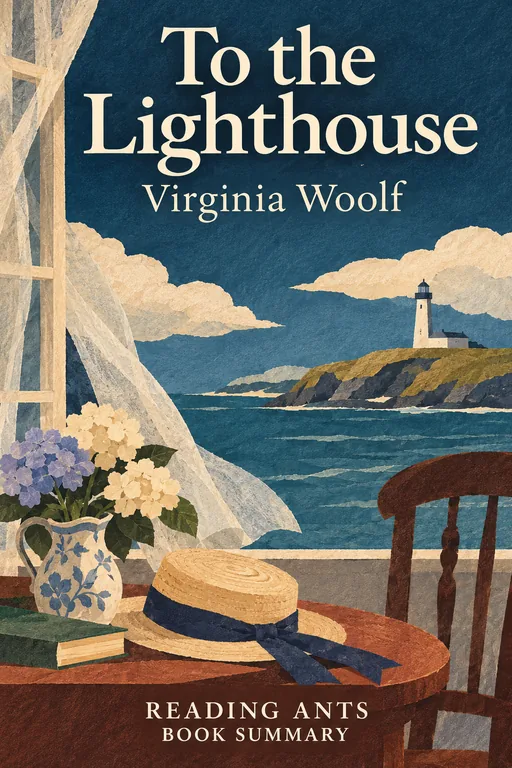
To the Lighthouse
A family spends a summer holiday on the Isle of Skye, a planned trip to a lighthouse is canceled, and ten years later, after a war and several deaths, some of them finally make the journey.
Overview
To the Lighthouse is a novel by Virginia Woolf, published in 1927. It is divided into three parts: “The Window,” set on an afternoon and evening, “Time Passes,” a short interlude of ten years, and “The Lighthouse,” set on a single morning years later. Instead of a plot of dramatic events, the book follows thoughts and moods, moving from mind to mind. It is partly drawn from Woolf’s own childhood memories of summers in Cornwall with her parents, and her portraits of Mr. and Mrs. Ramsay echo those of her own mother and father. The novel is about how people see each other, how time changes everything and how art may preserve a moment.
Main Characters
- Mrs. Ramsay: the warm, beautiful, intuitive mother who brings people together.
- Mr. Ramsay: a philosopher who is brilliant but anxious about his reputation and in need of sympathy.
- James Ramsay: their youngest son, who longs to go to the lighthouse.
- Cam Ramsay: their younger daughter.
- Lily Briscoe: a painter and guest, who struggles with a portrait of Mrs. Ramsay and James.
- Charles Tansley: a young, awkward academic who is Mr. Ramsay’s student.
- Mr. Bankes and Mr. Carmichael: older guests; the former a scientist, the latter a poet.
- Paul Rayley and Minta Doyle: a young couple whose engagement is celebrated.
Full Summary
The Window
On an afternoon, the Ramsay family and their guests are at their summer house. James, who is six, asks if they can go to the lighthouse tomorrow, and Mrs. Ramsay says yes, if the weather is fine. Mr. Ramsay, who values facts, says that it will not be, and James hates him for it. Meanwhile, Lily Briscoe, on the lawn, tries to paint a picture of Mrs. Ramsay reading to James, and struggles with how to balance the composition. Charles Tansley, who feels scorned by the family, accompanies Mrs. Ramsay on a walk into town, and she is kind to him.
At the end of the afternoon, Mrs. Ramsay takes a moment to sit with her thoughts. She thinks about the lighthouse beam, which seems to her to be like a friendly eye, and the way that the light sweeps the bay at night. She is happy but conscious that nothing lasts, and she is troubled that her husband requires her constant sympathy.
The Dinner
The central scene of the book is a dinner party in the evening. Mrs. Ramsay brings together her family and guests, serving a large stew, and as she looks around the table she feels a moment of harmony in which everything seems to hold together, though she knows it will not last. Paul and Minta have just become engaged, and Mrs. Ramsay, who loves matchmaking, is pleased. The table talk drifts, and each person’s private thoughts appear alongside what is said aloud. Afterwards, Mrs. Ramsay sits with her husband, and they share a silent understanding.
Time Passes
The middle section covers ten years in a few pages. The family leaves, and the house is empty and decays through the seasons, with wind and damp and moss entering the rooms. Within parentheses, we learn of events that are of great importance but are passed over quickly: Mrs. Ramsay dies suddenly, Prue marries and dies in childbirth, and Andrew is killed in the war. The house is almost lost until a housekeeper, Mrs. McNab, and her helpers clean it and prepare it for the family’s return.
The prose in this section is nearly without human characters. It describes the dark house, the sea air and the passing seasons, as if time itself were the main character, and the effect is to make the deaths seem even more sudden, since they are mentioned in brackets between descriptions of light and dust.
The Return
Years later, Mr. Ramsay, now a widower, decides to make the trip to the lighthouse with his adolescent children, James and Cam, who are reluctant and resentful. They sail in a small boat, with Mr. Ramsay demanding sympathy and the children quietly rebelling. James, who still remembers the canceled trip, steers the boat and hopes that his father will praise his sailing. Cam, who has seen both sides, begins to feel sympathy for her father.
Lily’s Vision
On the shore, Lily Briscoe, who has returned to the house with Mr. Carmichael, tries to resolve the painting she had started ten years before, with a new attempt. She thinks of Mrs. Ramsay, and of how she has been trying to understand her. As she watches the boat sail toward the lighthouse, she feels that she has captured what she wanted. When the boat reaches the lighthouse, Mr. Ramsay praises James briefly for his steering, which gives James the recognition he wanted. Lily, at the same time, draws a line down the center of her canvas, and says that she has had her vision.
Why It Matters
To the Lighthouse is regarded as one of the greatest novels of the twentieth century and a masterpiece of modernism. Woolf’s technique of showing the stream of thoughts, and her use of the middle section to depict the passing of time, have been admired and imitated. It is often considered her most personal and emotional work.
The novel is also notable for its exploration of gender roles, the nature of art and the tension between different ways of seeing the world, such as Mr. Ramsay’s rigid logic and Mrs. Ramsay’s emotional insight. It is widely taught, and remains a central book for readers who love language.
Key Takeaways
- Time changes everything. The family is scattered, and many are dead.
- Art can hold a moment. Lily’s painting tries to capture a fleeting vision.
- People are complex and often misunderstood. Each character sees others differently.
- Sympathy and honesty can conflict. Mr. Ramsay needs comfort, which the family finds hard to give.
- Small moments carry great meaning. The dinner scene shows a single instant of unity.
What We Can Learn
The novel invites us to recognize how much goes on inside people that we never see. Each member of the family has hopes, fears and resentments that are unspoken, and the book can encourage us to listen more carefully to those around us.
It also shows how hard it can be to give and receive affection. Mr. Ramsay’s need for praise and the children’s resistance to him make it clear that love sometimes arrives late, and we may learn from this to express care while we can.
Finally, Lily’s struggle to paint teaches us about perseverance in creative work. She doubts herself and almost gives up, but ten years later she finds her vision, which shows that patient effort can bring clarity.
Criticism and Counterpoints
Some readers find the book slow, with little action and long passages of inner thought, and others find the shifting viewpoint confusing. Some critics have said that the portrayal of Mrs. Ramsay is too idealized, since she is shown as a perfect nurturer who devotes herself to others. Other readers find Mr. Ramsay to be a caricature of a self-absorbed man.
Feminist critics have debated whether the novel endorses or questions the traditional female role. The upper-class setting, with servants and leisure, may also seem remote from many readers’ lives. Even so, its beauty and insight are widely praised.
Who Should Read It
This book suits mature teenagers and adults. It is short, but it asks for patience, since it moves through thoughts rather than events. Readers who enjoy language and mood, and who have read Mrs. Dalloway, may find it rewarding.
Want the whole book?
A summary is a taste, not the meal. Here is where to find the full book.
You reached the end 🎉
Nicely done. Mark this one as read, and we will suggest what to read next.
Read this next
Mrs Dalloway
Virginia Woolf
On a June day in 1923, Clarissa Dalloway prepares to host a party in London, while the shell-shocked war veteran Septimus Smith moves toward a crisis, and the two lives touch only at the story's end.
📜 Classics
A Room of One's Own
Virginia Woolf
Virginia Woolf argues that a woman needs money and a room of her own, meaning independence and privacy, in order to write fiction, and explains why women writers have been held back through history.
⚖️ Politics & Society
Ulysses
James Joyce
On a single day in Dublin, 16 June 1904, an advertising salesman named Leopold Bloom and a young teacher named Stephen Dedalus wander the city, and their paths finally cross in a novel that recasts Homer's *Odyssey* in everyday life.
📜 Classics
The Sound and the Fury
William Faulkner
Four sections, told by three brothers and then an outside narrator, trace the slow decline of the once-proud Compson family of Mississippi and the loss of their sister Caddy.
📜 Classics
Pride and Prejudice
Jane Austen
Quick-witted Elizabeth Bennet and the proud, wealthy Mr. Darcy badly misjudge each other, and only by facing their own faults do they find their way to love.
📜 Classics
Nineteen Eighty-Four
George Orwell
In a future Britain ruled by an all-seeing Party, one man secretly rebels by keeping a diary and falling in love, and discovers just how completely a totalitarian state can crush the human mind.
📜 ClassicsWant something different?
Pick another topic and we will show you three books to start with.