 Reading Ants
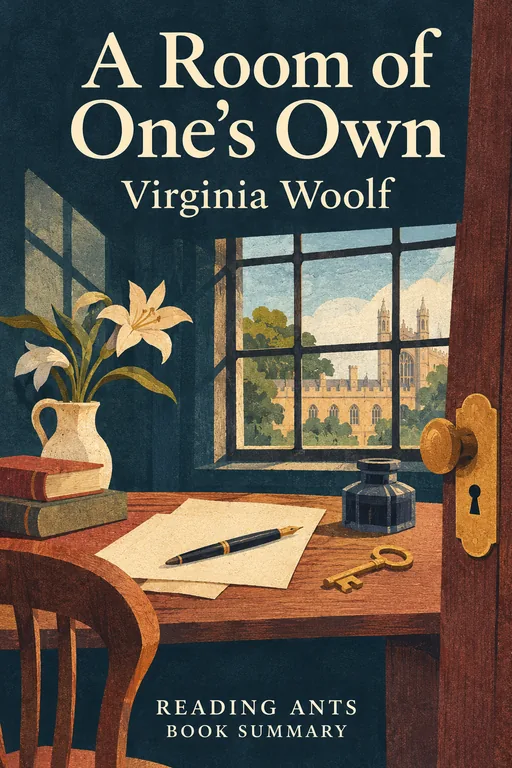
A Room of One's Own
Virginia Woolf argues that a woman needs money and a room of her own, meaning independence and privacy, in order to write fiction, and explains why women writers have been held back through history.
Overview
A Room of One’s Own is an extended essay by the English novelist Virginia Woolf, published in 1929. It is based on two lectures she gave in October 1928 to women students at Newnham and Girton, two women’s colleges at Cambridge University, on the subject of “women and fiction.” Instead of a straightforward lecture, Woolf wrote in a playful, imaginative style, using a fictional narrator who wanders through a university town, a library and a London street while thinking. Her central claim is practical: to write, a woman must have an income, which she suggests as five hundred pounds a year, and a lockable room of her own. The essay is a landmark of feminist literary criticism.
Full Summary
1. A walk through Oxbridge
The idea: The narrator, whom Woolf asks us to call Mary Beton or Seton or Carmichael, sits on a riverbank at an imaginary university and thinks about her topic. She is chased off a grass lawn by a college official because only men are allowed on it, and turned away from the library because women are not admitted without a fellow of the college or a letter of introduction. She then compares a rich lunch at a men’s college with a meager dinner at a women’s college. The contrast shows how wealth and tradition have supported men’s learning, while women’s colleges had to struggle for money.
In real life: Differences in funding between schools or programs can quietly shape the opportunities students get.
2. Why were women poor?
The idea: The narrator goes to the British Museum to find out why women have been poor. She finds many books written by men about women, often angry and contradictory, but very few by women themselves. She reflects that women have been restricted by laws that denied them property and education, and that men have often wanted women to be inferior so as to see themselves as larger. Poverty and lack of freedom, not lack of talent, have kept most women from writing.
In real life: When we notice who is missing from a library shelf or a history book, we can ask why.
3. Shakespeare’s sister
The idea: In one of the most famous passages, Woolf imagines that Shakespeare had a gifted sister, Judith. While William went to school and then to London to become a playwright, Judith, equally talented, was kept at home, forbidden to study, pushed toward marriage and mocked when she tried to join the theater. In despair, she died by suicide. Woolf’s point is that genius needs opportunity, and that countless women’s talents have been wasted.
In real life: Talented people in any age may never be known if they never get the chance to learn or to be heard.
4. Women writers in history
The idea: Woolf looks at the women writers who did succeed, such as Aphra Behn, Jane Austen, the Brontës and George Eliot. She notes that many wrote in the common sitting room, interrupted by family, and used pen names. She says that they had to bend their style to a world made by men, and that anger and fear sometimes weakened their work. Even so, she celebrates their achievement, and says that the progress of women’s writing builds on a long line of women who came before.
In real life: Writers today often credit earlier women authors for making it easier for them to be published.
5. The androgynous mind
The idea: Toward the end, Woolf suggests that the best writing comes from a mind that is not limited to one gender, which she calls “androgynous” or “man-womanly.” A writer, she believes, should be able to draw on both masculine and feminine sides and not be consumed by resentment or by a sense of difference. She says that writing that focuses on the grievance of one sex is flawed, because it distracts from the work. She uses Shakespeare and Coleridge as examples.
In real life: A book or a film that shows characters of all kinds as fully human often feels more truthful.
6. A call to women
The idea: In the last chapter, Woolf encourages her audience to write and to be bold, whether fiction, poetry or other forms, and to prepare for the future by earning money and keeping rooms of their own. She says that if women continue to write, Shakespeare’s sister, the gifted poet Woolf imagined earlier in the book, may live again. She ends by saying that this poet would be born if women worked for her, and that this is possible if they have the freedom to do so.
In real life: Scholarships and writing grants that support new authors apply this idea in practical ways.
Why It Matters
A Room of One’s Own became one of the founding texts of feminist criticism and is still widely read in schools and universities. The phrase “a room of one’s own” has become shorthand for the need for independence and space, and it is used in discussions of gender equality, creativity and economic freedom.
The essay also showed the possibilities of a flexible, personal style in nonfiction, mixing story, argument and humor, and it has inspired many later writers on women’s literature and history. Woolf’s image of Shakespeare’s sister is often quoted by teachers and critics to explain how social conditions, not a lack of talent, can decide whose work survives to be read.
Key Takeaways
- Writers need independence. Money and privacy support creativity.
- Opportunity matters. Talent needs education and freedom.
- Women’s history is hidden. Many women’s contributions were lost.
- Fiction is shaped by society. Who can write affects what is written.
- Aim for open-mindedness. Great writing goes beyond narrow resentment.
What We Can Learn
The essay reminds us that creativity does not occur in a vacuum. If we want to support artists, writers or scientists, we need to consider whether they have time, space and security to do their work.
It also teaches us to question what we are told about the past. If a field looks as if it had few contributions from women or other groups, it is worth asking whether they were prevented from taking part, not whether they lacked ability.
Finally, it encourages us to value our own voices. Woolf’s speech to students was an invitation to take their work seriously and to claim a place in the literary tradition.
Criticism and Counterpoints
Some critics argue that Woolf’s view reflects her own upper-middle-class background, since her solution of a private income and a quiet room is not easy for working-class women, who had much less opportunity. Others point out that she pays little attention to race, empire and women outside Britain, and that her treatment of some writers is dismissive.
Her idea of the androgynous mind has been questioned by feminists who say it downplays real differences and the experience of women. Some also find the essay’s loose structure and imaginary narrator confusing. Despite this, it is admired for its wit and insight.
Who Should Read It
This book suits teenagers and adults who enjoy essays and literature. It is short and lively, though its sentences can be long, and it can be read in an afternoon. It is a good starting point for readers interested in feminism and writing.
Want the whole book?
A summary is a taste, not the meal. Here is where to find the full book.
You reached the end 🎉
Nicely done. Mark this one as read, and we will suggest what to read next.
Read this next
The Second Sex
Simone de Beauvoir
Simone de Beauvoir argues that womanhood is not a fixed biological destiny but a social and historical condition, in which women have been treated as the "Other" to men, and that liberation requires changing that situation.
🕊️ Philosophy & Religion
To the Lighthouse
Virginia Woolf
A family spends a summer holiday on the Isle of Skye, a planned trip to a lighthouse is canceled, and ten years later, after a war and several deaths, some of them finally make the journey.
📜 Classics
Mrs Dalloway
Virginia Woolf
On a June day in 1923, Clarissa Dalloway prepares to host a party in London, while the shell-shocked war veteran Septimus Smith moves toward a crisis, and the two lives touch only at the story's end.
📜 Classics
A Vindication of the Rights of Woman
Mary Wollstonecraft
Mary Wollstonecraft argues that women are not naturally inferior to men, but appear so because they are denied a proper education, and that society would benefit if women were given the chance to develop their reason and independence.
⚖️ Politics & Society
We Should All Be Feminists
Chimamanda Ngozi Adichie
In a short essay adapted from a talk, the Nigerian novelist Chimamanda Ngozi Adichie explains what feminism means to her and why people of every gender should work to end sexism.
⚖️ Politics & Society
The Prince
Niccolo Machiavelli
A Renaissance diplomat advises rulers to judge their actions by results rather than morality, arguing that a successful leader must sometimes be cunning and ruthless to win and keep power.
⚖️ Politics & SocietyWant something different?
Pick another topic and we will show you three books to start with.