 Reading Ants
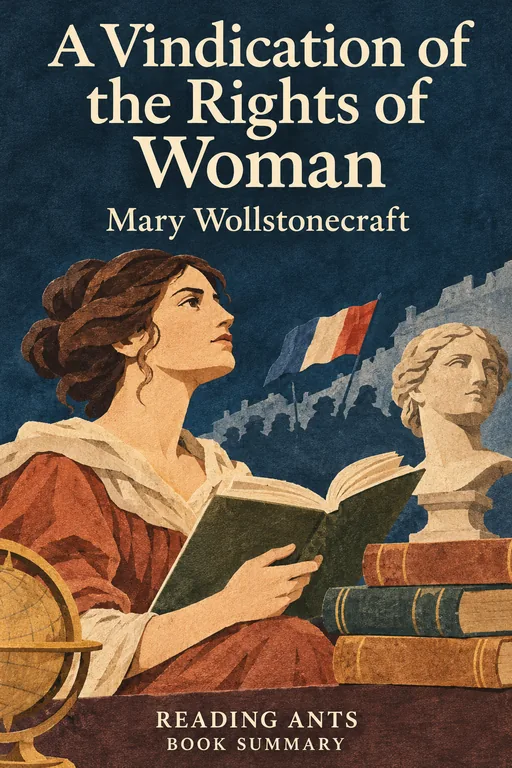
A Vindication of the Rights of Woman
Mary Wollstonecraft argues that women are not naturally inferior to men, but appear so because they are denied a proper education, and that society would benefit if women were given the chance to develop their reason and independence.
Overview
A Vindication of the Rights of Woman was published in 1792 by Mary Wollstonecraft, an English writer and teacher who had earned her living by her pen. She wrote it in a few weeks, during the excitement of the French Revolution, partly in response to a French politician, Talleyrand, whose pamphlet on national education she thought treated the question of women too lightly. She dedicated the book to him. Wollstonecraft had already written a defense of the rights of men, in reply to Edmund Burke. In this book, she turns to the rights of women, and builds her case on the Enlightenment ideals of reason, liberty and equality. It is regarded as a founding work of feminist thought.
Full Summary
1. Reason is the same in both sexes
The idea: Wollstonecraft starts from the claim that reason, which distinguishes humans from animals, is possessed by women as well as men. If women seem less rational, she says, this is because they have been taught to cultivate charm, beauty and obedience instead of the mind. She challenges the view that women are by nature weaker in intellect, and argues that they are made to appear so by a poor education and by social expectations. The aim of education, she says, should be to build character and understanding.
In real life: If one group of students is never given hard problems, they may look less capable, though the cause is the lack of practice.
2. How society makes women frivolous
The idea: She criticizes the conduct books and writers of her day, who advise women to be gentle, submissive and concerned with appearances. This training, she says, produces women who are vain and manipulative, because they depend on pleasing men for their position. She notes that when women are told that their chief duty is to please, they are turned into pretty playthings, and may use cunning to gain influence, since they are denied open power.
In real life: People who are not allowed to lead directly may find indirect ways to get what they want.
3. Criticism of Rousseau and others
The idea: Wollstonecraft takes on the French philosopher Rousseau, whose book on education described an ideal girl, Sophie, raised to serve and please a man, while the boy, Emile, was educated to be free. She finds this inconsistent with his own principles of liberty. She also criticizes other writers who treat women as inferior, and argues that virtue must be the same for both sexes, based on reason and not on social rank or gender.
In real life: A school that offers different goals to boys and girls limits both.
4. Education for both sexes
The idea: The practical center of the book is a proposal for national education. Wollstonecraft recommends that boys and girls be educated together in day schools set up by the government, with the schools for the youngest children free and open to all classes, where they would learn the same subjects and grow up as companions. She believes that this would improve both, and prepare young people for marriage as a friendship. She also advises that mothers take an active part in the education of their children, and be educated themselves.
In real life: Children who learn together may develop more respect for one another.
5. Marriage, independence and work
The idea: Wollstonecraft argues that women should be able to earn a living and not depend entirely on a husband. She suggests that they might become doctors, run businesses or farms, or work in politics. A woman who is economically independent, she says, can marry for affection and not necessity. She criticizes the habit of treating marriage as a transaction, and says that true marriage should be based on respect and mutual rational affection.
In real life: A person who can support themselves has more freedom to choose a partner.
6. The wider effect on society
The idea: Wollstonecraft concludes that the subjection of women harms everyone, since it corrupts the character of men, who learn to be tyrants, and of women, who learn to be slaves, and weakens families and the nation. She appeals to men to be generous and to help to emancipate women, and says that she wants women to gain power over their own lives, not over men. She hopes that reason and justice will prevail over habit and prejudice.
In real life: A society that wastes the talents of half its people is poorer for it.
Why It Matters
A Vindication of the Rights of Woman is one of the foundational texts of feminism. It made a strong case for the education and rights of women, and influenced the later movement for women’s suffrage and equality. Its arguments, based on reason and on the idea of human rights, are still part of the debate. The author’s own life, with its struggles and scandals, also attracted attention, and for a time damaged her reputation, but her work was rediscovered in the nineteenth and twentieth centuries. Her daughter Mary Shelley became the author of Frankenstein. The book is a landmark in the history of ideas.
Key Takeaways
- Reason is common to all humans. Differences are largely due to education and opportunity.
- Education shapes character. Girls need the same learning as boys.
- Independence supports dignity. Women should be able to work and support themselves.
- Marriage should be a friendship. It works best between equals.
- Equality benefits everyone. A just society develops all its members.
What We Can Learn
The book invites us to look at how expectations shape what we think people are able to do. When you notice a belief about what boys or girls should be like, ask whether it is based on evidence or on habit. Support equal access to education and opportunities. Recognize the importance of economic independence, and of friendship in relationships. And when you read old works, be prepared to find both inspiring insights and views that reflect their time, and judge them thoughtfully.
Criticism and Counterpoints
Some modern critics say that Wollstonecraft’s emphasis on reason and her rejection of feeling as a basis of character reflects a limited, middle-class point of view, and that she sometimes shows contempt for women of her own time. Others point out that she accepted certain traditional ideas, such as the importance of motherhood and domestic duties, and made only a brief, tentative remark that women ought to have political representation, without developing a demand for the vote. Her style can be repetitive and rushed. Feminist scholars debate how to read her, but many regard the book as an essential starting point.
Who Should Read It
This book is for readers interested in the history of women’s rights, education and Enlightenment ideas. The language is of the eighteenth century and can be heavy, but it has passages of great force. Those who want an easier start can read excerpts, and then return to the whole work.
Want the whole book?
A summary is a taste, not the meal. Here is where to find the full book.
You reached the end 🎉
Nicely done. Mark this one as read, and we will suggest what to read next.
Read this next
The Feminine Mystique
Betty Friedan
Betty Friedan reveals that many educated American housewives of the 1950s felt unhappy and unfulfilled despite having the life they were told to want, and argues that women's potential should not be limited to home and family.
⚖️ Politics & Society
Common Sense
Thomas Paine
In a short, fiery pamphlet written in plain language, Thomas Paine argued in early 1776 that the American colonies should declare independence from Britain, and that monarchy itself was an unreasonable form of government.
⚖️ Politics & Society
The Social Contract
Jean-Jacques Rousseau
Rousseau asks how people can live together under laws and still be free, and argues that legitimate government rests on an agreement in which citizens obey only the "general will" that they make together.
🕊️ Philosophy & Religion
A Room of One's Own
Virginia Woolf
Virginia Woolf argues that a woman needs money and a room of her own, meaning independence and privacy, in order to write fiction, and explains why women writers have been held back through history.
⚖️ Politics & Society
The Second Sex
Simone de Beauvoir
Simone de Beauvoir argues that womanhood is not a fixed biological destiny but a social and historical condition, in which women have been treated as the "Other" to men, and that liberation requires changing that situation.
🕊️ Philosophy & Religion
The Prince
Niccolo Machiavelli
A Renaissance diplomat advises rulers to judge their actions by results rather than morality, arguing that a successful leader must sometimes be cunning and ruthless to win and keep power.
⚖️ Politics & SocietyWant something different?
Pick another topic and we will show you three books to start with.