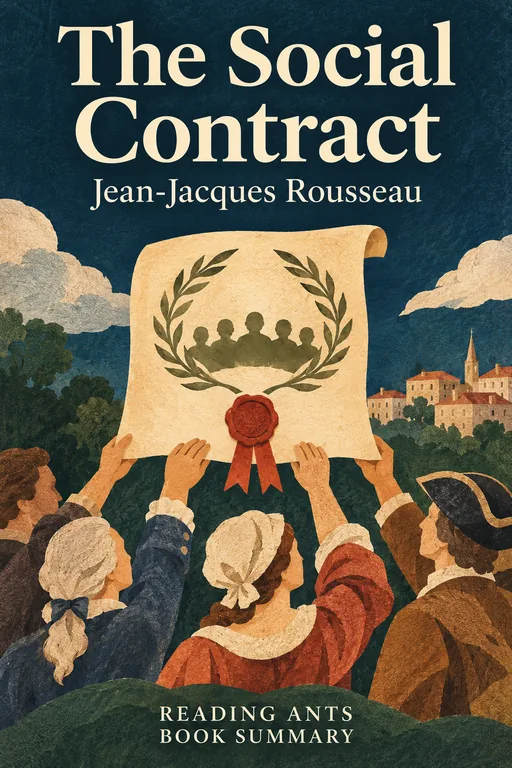
The Social Contract
Original title: Du Contrat social
Rousseau asks how people can live together under laws and still be free, and argues that legitimate government rests on an agreement in which citizens obey only the "general will" that they make together.
Overview
The Social Contract, in French Du contrat social, was published in 1762 by Jean-Jacques Rousseau, a philosopher and writer born in Geneva who lived in France. It is a short book, which sets out the principles of political right. Rousseau wanted to find a form of society in which people could have the benefits of living together without losing their liberty. He was strongly critical of the inequality and the corruption of the societies of his day. The book was banned in France and in Geneva, but became a source of inspiration to people in the French Revolution and to later democratic thinkers.
Full Summary
1. The problem of freedom and authority
The idea: Rousseau begins by pointing out that people appear to be born free, but are everywhere subject to rules and rulers. He asks what could make this legitimate. Force alone cannot create a right, since might does not make right. Nor can slavery or the sale of one’s freedom be legitimate, since no person can rightfully give up the freedom that makes them human. Any legitimate authority must rest on a real agreement.
In real life: A rule imposed only by threats does not feel like a real obligation, but one that people have agreed to does.
2. The social contract
The idea: Rousseau proposes that the basic problem is to find a form of association that protects every member, and in which each person, while uniting with all, still obeys only himself and remains as free as before. The solution is a contract in which everyone gives themselves completely to the community, and in return receives equal rights. Since all give themselves equally, no one has an interest in making conditions burdensome for others.
In real life: A club where everyone has an equal vote, and everyone follows the rules they have helped to make, is a small model.
3. The general will
The idea: A key concept of the book is the general will, which is different from the will of all. The general will aims at the common good, while the will of all is the sum of private interests. When citizens vote on a law, they should ask not what they want for themselves, but what is best for the community. Obeying the general will, Rousseau says, is freedom, since it is obeying a law that we have given ourselves.
In real life: When a class votes on a rule that is fair to everyone, even those who lose the vote may accept it as their own.
4. Sovereignty and law
The idea: According to Rousseau, sovereignty belongs to the people, and cannot be given away or divided. The people make laws, while the government is only an agent, whom they can appoint and dismiss. He criticizes representative government, and says that the English, who think they are free, are free only during the election of members of parliament. He believes that, in a good state, citizens should take part directly in lawmaking, as far as possible, which is easier in a small state.
In real life: A neighborhood meeting where residents decide together has more direct control than one where decisions are made by distant officials.
5. Government, citizens and equality
The idea: Rousseau discusses forms of government, such as monarchy, aristocracy and democracy, and says that each suits different conditions. He insists on the need for relative equality, saying that no citizen should be so rich as to be able to buy another, and no one so poor as to be forced to sell himself. He also describes the role of a wise lawgiver, who gives a people its laws at the start, and says that laws must fit the character of the people.
In real life: A game where some players start with all of the money is not fair, and tends to break down.
6. Civil religion and the limits of tolerance
The idea: In the final chapters, Rousseau argues that a state needs a civil religion, a simple set of beliefs that support citizenship, such as belief in a mighty and good god, a life to come in which the just are rewarded and the wicked punished, and the sanctity of the social contract and the laws, along with a ban on intolerance. Those who do not accept these beliefs could be banished, not for their opinions, but because they could not be good citizens. This section has been controversial, since it seems to allow limits on freedom of belief.
In real life: A community may need some shared values, but where to draw the line is a delicate question.
Why It Matters
The Social Contract is one of the most influential works of political philosophy. Its principle that political authority comes from the consent of the governed, and that the people are sovereign, inspired revolutionaries in France and elsewhere. Its ideas helped inspire political reforms and revolutions in Europe, especially in France. The concept of the general will has been used and debated by democrats, socialists and critics. Rousseau’s emphasis on equality, participation and the common good remains central to discussions about democracy, citizenship and the relation between the individual and the community. He also influenced later thinkers such as Kant, who acknowledged his debt to Rousseau.
Key Takeaways
- Legitimate authority rests on consent. Force alone cannot make a right.
- Freedom means obeying laws we make ourselves. Participation is key.
- The common good differs from private interests. The general will seeks the former.
- Sovereignty belongs to the people. Governments serve them.
- Equality supports freedom. Extreme inequality undermines it.
What We Can Learn
You can use Rousseau’s ideas to think about the groups that you belong to. Ask who makes the rules, whether they are fair and whether everyone has a say. When you vote, in school or in the community, try to think of the common good, not only your own interest. Consider how much inequality a community can bear while remaining free. And read the book critically, noticing both its inspiring ideals and its dangers, as when a claim to speak for the general will is used to silence dissent.
Criticism and Counterpoints
Critics have charged that the idea of the general will can be dangerous, since a leader or party might claim to know what the people truly want, and force dissenters to conform. Rousseau’s phrase that people can be forced to be free is often cited as an example. Others say that his picture of direct democracy is not practical in large modern states. Some feminists note that his views on women’s role were limiting. Others find that his account is vague about how the general will is to be discovered. Still, the book’s questions endure.
Who Should Read It
This book is for readers who are interested in democracy, politics and philosophy. It is short, but its ideas are demanding, and the style is sometimes obscure. Many people find it easier to read after a summary or alongside works by Hobbes and Locke.
Want the whole book?
A summary is a taste, not the meal. Here is where to find the full book.
You reached the end 🎉
Nicely done. Mark this one as read, and we will suggest what to read next.
Read this next
Leviathan
Thomas Hobbes
Thomas Hobbes argues that without a strong government people would live in constant fear and conflict, and that they should therefore agree to give up some of their freedom to a sovereign power that keeps the peace.
🕊️ Philosophy & Religion
The Wealth of Nations
Adam Smith
A nation's true wealth is not its stock of gold but the goods and services its people produce, and that wealth grows fastest when people specialize, trade freely and compete, with government providing justice, defense and public goods.
💰 Money & Economics
Democracy in America
Alexis de Tocqueville
After touring the United States in the 1830s, the young Frenchman Alexis de Tocqueville wrote a penetrating study of American democracy, praising its energy and liberty, and warning about its dangers, such as the tyranny of the majority and a retreat into private life.
⚖️ Politics & Society
A Vindication of the Rights of Woman
Mary Wollstonecraft
Mary Wollstonecraft argues that women are not naturally inferior to men, but appear so because they are denied a proper education, and that society would benefit if women were given the chance to develop their reason and independence.
⚖️ Politics & Society
Common Sense
Thomas Paine
In a short, fiery pamphlet written in plain language, Thomas Paine argued in early 1776 that the American colonies should declare independence from Britain, and that monarchy itself was an unreasonable form of government.
⚖️ Politics & Society
The Art of War
Sun Tzu
The greatest victory is the one won without fighting, achieved through careful planning, knowing both yourself and your opponent, and using deception, flexibility and timing.
🕊️ Philosophy & ReligionWant something different?
Pick another topic and we will show you three books to start with.