 Reading Ants
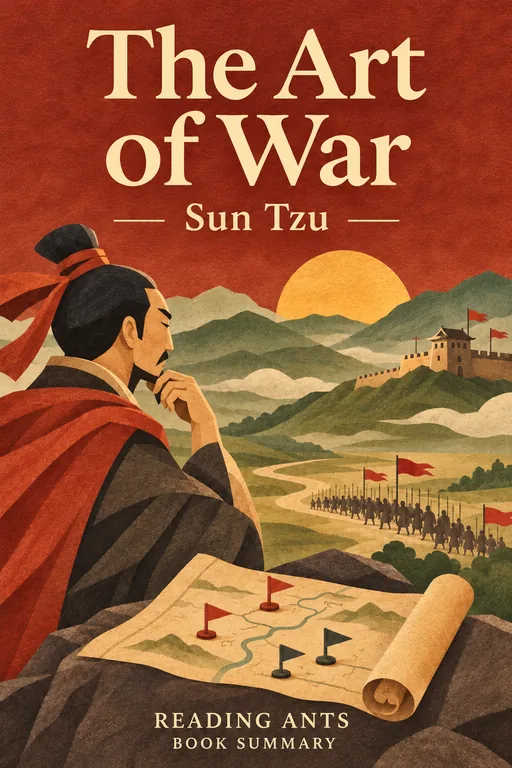
The Art of War
Original title: 孙子兵法
The greatest victory is the one won without fighting, achieved through careful planning, knowing both yourself and your opponent, and using deception, flexibility and timing.
Overview
The Art of War is an ancient Chinese guide to military strategy, traditionally credited to Sun Tzu (“Master Sun”), a general believed to have lived around 500 BCE. Scholars think the text as we know it may have been assembled somewhat later, during China’s Warring States period, when rival kingdoms fought constantly. The book is short, only thirteen brief chapters, and is written in compact, poetic statements rather than long explanations. It covers planning, the cost of war, attacking with strategy, terrain, spies and more. Although it was written for generals, its ideas about competition, preparation and avoiding unnecessary conflict have made it popular with business leaders, athletes, politicians and anyone facing a challenge.
Full Summary
1. Win before you fight
The idea: Sun Tzu says war is a matter of life and death for a nation, so it must be studied carefully. Before any battle, a wise leader compares both sides on five factors: moral unity between ruler and people, weather and seasons, terrain, the quality of the commander, and organization and discipline. The side that calculates better wins before the battle begins. Rushing into war without planning invites disaster.
In real life: Before applying for a job, a well-prepared candidate researches the company, the role and the competition. Much of the “battle” of the interview is won in preparation.
2. The best victory needs no battle
The idea: The highest form of skill is not winning a hundred battles, but defeating the enemy without fighting at all. Sun Tzu ranks strategies: best is to defeat the enemy’s plans; next, to break up their alliances; then to attack their army; and worst of all, to besiege walled cities. Long wars drain a country’s wealth and people, so speed and efficiency matter.
From the book: Sun Tzu stresses how costly campaigns are: armies need huge supplies, raise prices and exhaust the population. He concludes that no country has ever benefited from a long war.
In real life: A company that builds a product customers love, so that competitors can’t keep up, wins more surely than one that fights endless price wars that hurt everyone’s profits.
3. Know yourself and your enemy
The idea: Sun Tzu’s most famous teaching is that if you know your enemy and know yourself, you need not fear the result of a hundred battles. If you know yourself but not the enemy, you will win some and lose some. If you know neither, you will lose every time. Accurate information is therefore precious, which is why he devotes a whole chapter to the use of spies.
In real life: A tennis player who studies an opponent’s weak backhand, and is honest about their own weak serve, can plan a smarter match than one who simply plays hard.
4. All warfare is based on deception
The idea: A skilled general hides his true strength and intentions. When able to attack, he appears unable; when near, he seems far away. He lures enemies with bait, attacks where they are unprepared, and appears where he is not expected. Surprise multiplies the power of a small force.
In real life: In a football match, a team may send attacks down one side of the field to draw defenders over, and then switch the ball quickly to the open side.
5. Be like water
The idea: Sun Tzu compares an army to water, which has no fixed shape and flows around obstacles toward low ground. Likewise, a good strategy avoids the enemy’s strong points and strikes at weak ones, changing according to the situation. He also explains the mix of “ordinary” and “extraordinary” forces: direct moves that hold the enemy’s attention and surprise moves that win the battle. Their combinations, like musical notes or colors, are endless.
In real life: A small business can’t compete head-on with a giant supermarket, but it can win by serving customers the big store ignores, such as with local products, personal service or late opening hours.
6. Use terrain, timing and momentum
The idea: Several chapters describe types of ground, from narrow passes to open plains, and how to use each one. Timing matters as much as position: a skilled leader builds up momentum like a rock rolling down a mountain, or a crossbow drawn tight and released at the right moment. Sun Tzu also observes that soldiers fight hardest when they have no escape, so a wise general leaves an enemy a way to retreat rather than forcing them into desperate resistance.
In real life: In a tough negotiation, leaving the other side a way to save face often leads to an agreement faster than backing them into a corner.
7. The leader’s character
The idea: A great general is wise, trustworthy, humane, courageous and strict. He must not let anger or pride drive decisions, because an army destroyed cannot be brought back. Sun Tzu also says a commander in the field may sometimes disobey the ruler’s orders if they would lead to defeat, because the general understands the actual situation.
Traditional story (from a later biography, not the text itself): A well-known anecdote in ancient Chinese history tells how Sun Tzu demonstrated his methods to a king by drilling the palace women as soldiers. When they laughed at his orders, he held their leaders responsible and had them executed, after which the rest obeyed perfectly. The story is often included with the text to show his belief in clear orders and strict discipline.
In real life: A team captain who loses their temper with the referee often makes worse decisions. Staying calm under pressure is a key skill in any leader.
Why It Matters
The Art of War is the most famous work of military strategy in the world and one of the most influential books from ancient China. For more than two thousand years it has been studied by generals and rulers in China, Japan, Korea and Vietnam, and since it was first translated into European languages in the eighteenth century it has influenced military thinking in the West as well.
Today it is read far beyond the military. Business schools, sports coaches, lawyers and politicians quote its lines about preparation, competition and strategy. Its short, memorable sayings have become part of popular culture, appearing in films, television shows and leadership books.
Key Takeaways
- Avoid fighting when you can. The best victory is won through strategy rather than battle.
- Preparation decides outcomes. Careful planning and comparison of strengths come before action.
- Knowledge is power. Know yourself and your opponent honestly.
- Flexibility beats rigidity. Adapt like water to changing conditions.
- Leaders must stay calm. Anger and pride lead to costly mistakes, and a lost army cannot be brought back.
What We Can Learn
Although written for war, the book’s lessons apply to everyday challenges. Before a big exam, match or project, take time to assess your strengths, weaknesses and the obstacles ahead, then plan accordingly.
It also teaches that not every conflict is worth fighting. Many arguments with friends, family or coworkers are like long wars: they cost a lot and nobody truly wins. Finding a solution where no one needs to “fight” is often the smartest strategy.
Finally, Sun Tzu reminds us to stay flexible. Plans should be firm in goals but adaptable in methods. When something isn’t working, change your approach rather than pushing harder in the same direction.
Criticism and Counterpoints
Some critics argue that the book’s popularity in business and self-help has turned it into a source of vague slogans, taken out of context and applied to situations, like office politics or dating, that have little to do with war. Its emphasis on deception also worries some readers, who point out that trickery that works in warfare can damage trust in friendships, teams and business relationships.
Scholars also debate whether Sun Tzu was a single historical person, or whether the text was written and edited by several authors over time. Because the original is very compact, translations differ widely, so readers may want to compare more than one version.
Who Should Read It
This short book suits anyone interested in strategy, history, leadership or Chinese philosophy. Students, athletes, managers and entrepreneurs often find it useful. Readers looking for detailed battle history may be disappointed, since the text consists of general principles rather than stories.
Want the whole book?
A summary is a taste, not the meal. Here is where to find the full book.
You reached the end 🎉
Nicely done. Mark this one as read, and we will suggest what to read next.
Read this next
The Prince
Niccolo Machiavelli
A Renaissance diplomat advises rulers to judge their actions by results rather than morality, arguing that a successful leader must sometimes be cunning and ruthless to win and keep power.
⚖️ Politics & Society
The Book of Five Rings
Miyamoto Musashi
Miyamoto Musashi, a famous Japanese swordsman, writes at the end of his life a guide to the way of strategy, in which he explains how to win in single combat and in battle, and how to master any art through discipline and awareness.
🕊️ Philosophy & Religion
On War
Carl von Clausewitz
Prussian officer Carl von Clausewitz argues that war is a continuation of politics by other means, that it is dominated by chance, friction and moral forces, and that it can never be reduced to a simple formula.
⚖️ Politics & Society
Tao Te Ching
Laozi
The deepest wisdom is to live in harmony with the Tao, the natural way of the universe, by being humble, gentle and simple, and by acting without force.
🕊️ Philosophy & Religion
The 48 Laws of Power
Robert Greene
Robert Greene distills lessons from history's courtiers, generals, con artists and rulers into 48 laws about how power is gained and kept, in a book that both guides and warns.
🌱 Self-Improvement
Meditations
Marcus Aurelius
The private notebook of a Roman emperor, reminding himself daily to accept what he cannot control, to act with justice and kindness, and to remember that life is short.
🕊️ Philosophy & ReligionWant something different?
Pick another topic and we will show you three books to start with.