 Reading Ants
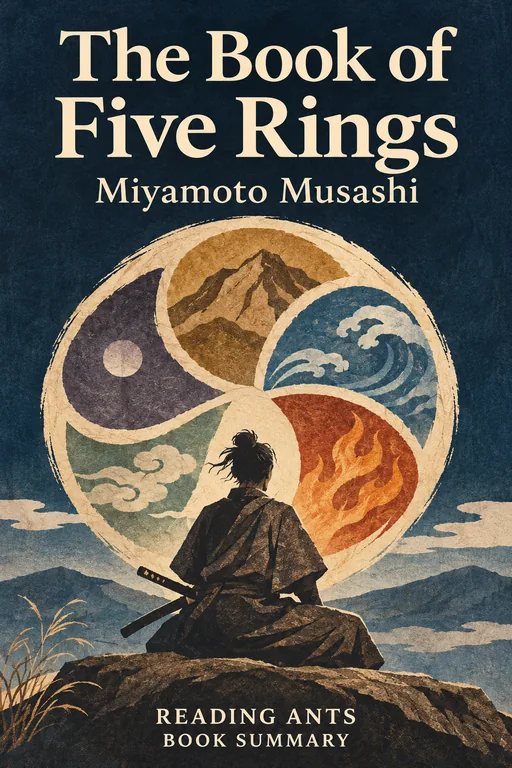
The Book of Five Rings
Original title: 五輪書
Miyamoto Musashi, a famous Japanese swordsman, writes at the end of his life a guide to the way of strategy, in which he explains how to win in single combat and in battle, and how to master any art through discipline and awareness.
Overview
The Book of Five Rings, or Gorin no Sho, was written between about 1643 and 1645 by Miyamoto Musashi, a samurai, born around 1584, who was famous for winning many duels, and who taught a school that used two swords. In his last years, he retired to a cave near Kumamoto, in southern Japan, and wrote this work for a student. The book has five sections, named after the five elements in Buddhist thought: Earth, Water, Fire, Wind and Void. Each deals with a different aspect of strategy. It is short, direct and practical, and has become one of the best-known works on martial arts and strategy.
Full Summary
1. The Book of Earth: the way and the foundation
The idea: Musashi begins with an overview. He says that strategy is the craft of the warrior, and that a samurai should be skilled in letters as well as in martial arts. He compares the commander to a master carpenter, who must know the tools, the materials and the plan. He introduces his own school, which uses two swords, and says that one should train with a sword in each hand, in order to be flexible. He stresses that real skill comes from daily training over many years.
In real life: A craftsperson knows that skill is built through steady practice, not shortcuts.
2. The Book of Water: technique and the mind like water
The idea: The second book describes the fundamentals of his art: how to stand, to hold the sword, to look and to move. He advises a calm mind, and a body that is relaxed but ready. Like water, which takes the shape of any container, the fighter should adapt to the opponent and the situation. He recommends not clinging to a single method, and says that the best technique is the one that works. He also advises practicing until the movements are natural.
In real life: A flexible player who adapts to the other team’s style is often more effective than one who has only a single plan.
3. The Book of Fire: the heat of battle
The idea: The third book is about actual combat, whether between two people or in war. Musashi talks about timing, the use of surprise, controlling the initiative and taking advantage of the opponent’s rhythm. He suggests ways to unsettle the enemy, to see the opponent’s state of mind, and to press an advantage. He also says that the principles of single combat apply to large-scale battle, and that the strategist must understand the situation as a whole.
In real life: In a debate or a game, noticing the other side’s rhythm gives you a chance to change the pace.
4. The Book of Wind: other schools
The idea: In the fourth book, Musashi examines other schools of swordsmanship, and says that some give too much importance to flashy technique, or a fixed form, or a long sword. He argues that it is wrong to rely on one style or one weapon, and that a warrior should know the strengths and weaknesses of various methods. The book is openly critical of rival schools, and Musashi finds fault with many of their habits, such as fancy footwork, fixed stances, staring at one spot, and secret teachings. He says that understanding other schools is part of understanding one’s own way.
In real life: Knowing about different approaches helps you to avoid becoming stuck in one way of doing things.
5. Perception and attention
The idea: Throughout the book, Musashi stresses the importance of perception: seeing the big picture and the small details, and being aware of what is happening, not only what appears. He advises to have two kinds of seeing: a broad, steady gaze that takes in everything, and a closer look at details. He wants the mind to be calm and stable in action, without fear or excitement, and to keep it from fixing on any one thing.
In real life: A good driver watches the whole road and also checks the mirror, without staring at one point.
6. The Book of Void: freedom of mind
The idea: The last book is the shortest, and it deals with the Void, the state in which the mind is free of confusion and doubt, and sees things as they are. For Musashi, this is not emptiness in a negative sense but a clear, open awareness that comes from long practice. He warns that mistaking whatever you do not understand for the Void is itself a kind of confusion. The path to clear awareness is steady daily training, honest self-examination and an upright, true heart, and Musashi says that the Void then holds wisdom, principle and the Way.
In real life: When you are completely absorbed in a task you love, time seems to disappear, and you act without hesitation.
Why It Matters
The Book of Five Rings has been read for centuries in Japan and, since the twentieth century, in many other countries. It has been used as a guide to martial arts, and by business leaders, athletes and writers as a source of ideas on strategy, discipline and focus. It is often paired with Sun Tzu’s The Art of War as a classic of strategic thought. The book offers a rare first-hand account from a master of a demanding discipline, and its emphasis on practice, adaptability and awareness applies to many fields. It also gives a window into the world of the samurai in the early seventeenth century.
Key Takeaways
- Practice every day. Skill comes from long, steady training.
- Be flexible. Adapt to the situation, like water.
- Perceive widely. See both the whole and the details.
- Do not rely on one method. Learn from many approaches.
- Cultivate a clear mind. Calm awareness allows swift action.
What We Can Learn
You can apply Musashi’s teachings to any craft or sport: train regularly, study your own errors and adjust. Try to see the big picture and the details at the same time, in a game or in a project. Be open to learning from other styles, and avoid thinking that your way is the only one. Practice calming your mind before a challenge. And remember that Musashi’s context was one of deadly combat, so use the lessons of discipline and clear thinking in peaceful ways, without taking the violence as a model.
Criticism and Counterpoints
Historians note that the book was written for a small group of students, and that there is debate about how much of the legendary life of Musashi is true, as many stories about him were added later. Some scholars question the claims of numerous undefeated duels. Others say that the book’s lessons on business and life are often taken out of context, and that its original purpose was to teach sword fighting to samurai. Translations vary, and some modern versions add interpretations. Critics also remind us that the glorification of the warrior can overlook the human cost of violence.
Who Should Read It
This book is for readers interested in martial arts, Japanese culture, strategy and self-discipline. It is short and can be read in an afternoon, though the ideas reward re-reading. Those who want a broader view of strategy may combine it with The Art of War, and those who dislike discussion of fighting may prefer other books on mastery.
Want the whole book?
A summary is a taste, not the meal. Here is where to find the full book.
You reached the end 🎉
Nicely done. Mark this one as read, and we will suggest what to read next.
Read this next
The Art of War
Sun Tzu
The greatest victory is the one won without fighting, achieved through careful planning, knowing both yourself and your opponent, and using deception, flexibility and timing.
🕊️ Philosophy & Religion
Zhuangzi
Zhuangzi
A witty collection of stories, jokes and arguments from ancient China that invites readers to loosen their fixed ideas, to follow the natural way of things and to find freedom in changing with the world.
🕊️ Philosophy & Religion
Zen Mind, Beginner's Mind
Shunryu Suzuki
In simple, direct talks, the Japanese Zen teacher Shunryu Suzuki explains that the heart of Zen practice is to sit quietly, breathe and approach each moment with the openness of a beginner.
🕊️ Philosophy & Religion
Tao Te Ching
Laozi
The deepest wisdom is to live in harmony with the Tao, the natural way of the universe, by being humble, gentle and simple, and by acting without force.
🕊️ Philosophy & Religion
On War
Carl von Clausewitz
Prussian officer Carl von Clausewitz argues that war is a continuation of politics by other means, that it is dominated by chance, friction and moral forces, and that it can never be reduced to a simple formula.
⚖️ Politics & Society
Meditations
Marcus Aurelius
The private notebook of a Roman emperor, reminding himself daily to accept what he cannot control, to act with justice and kindness, and to remember that life is short.
🕊️ Philosophy & ReligionWant something different?
Pick another topic and we will show you three books to start with.