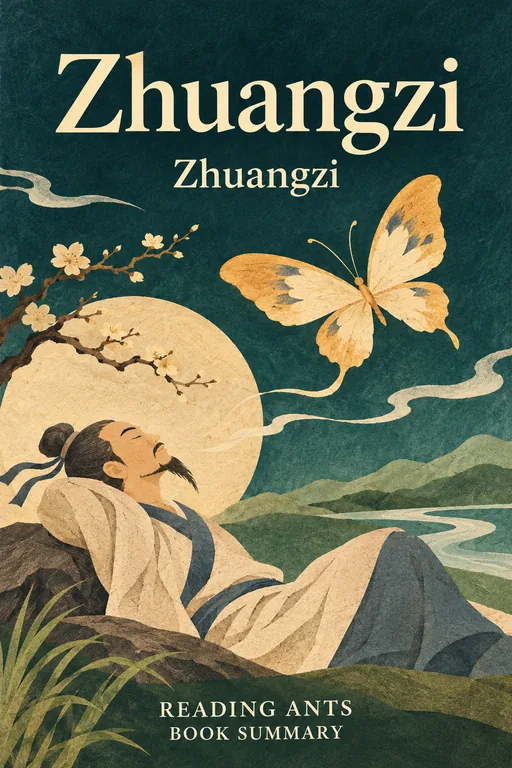
Zhuangzi
Original title: 莊子
A witty collection of stories, jokes and arguments from ancient China that invites readers to loosen their fixed ideas, to follow the natural way of things and to find freedom in changing with the world.
Overview
The Zhuangzi is a classic of Daoism, named after its main author, Zhuang Zhou, who lived in China around the fourth century BCE, during the Warring States period. Much about his life is unknown. The book is made up of thirty-three chapters, of which the first seven, known as the Inner Chapters, are usually attributed to him, and the rest to followers. Unlike the short, cryptic Tao Te Ching, the Zhuangzi is playful and imaginative, full of fables, dialogues and fantastic creatures. It questions the certainty of human knowledge and the values of ambition and fame.
Full Summary
1. Free and easy wandering
The idea: The book opens with a story of a huge fish that turns into a bird of enormous size, which flies thousands of miles, while small creatures laugh at it, saying that they are content with their own short flights. Zhuangzi uses the story to say that perspective depends on size and experience, and that it is a mistake to judge the freedom of the great by the standards of the small. The ideal is to wander freely, without being tied to fame or usefulness.
In real life: A person with a narrow view may not understand why another would take a risk.
2. The relativity of views
The idea: In the second chapter, Zhuangzi argues that debates over right and wrong, which divide schools of thought, are often endless, because each side starts with its own position. A thing may seem good from one angle and bad from another. He suggests that the wise person sees the whole, without taking sides, and finds a “pivot” that lets him respond to each situation as it arises. The idea is not to give up thought, but to hold it lightly.
In real life: Two friends may argue endlessly about which season is best, though each has reasons.
3. The butterfly dream
The idea: In one of the most famous passages, Zhuangzi says that he dreamed that he was a butterfly, flitting about, happy and unaware of being Zhuangzi. Suddenly he woke, and found that he was himself. But he could not tell whether he was Zhuangzi who had dreamed he was a butterfly, or a butterfly dreaming that he was Zhuangzi. The story points to the uncertainty of what we take as real, and to the way that things change into one another.
In real life: Waking from a vivid dream and feeling for a moment unsure where you are is a taste of this puzzle.
4. Cook Ding and the natural way
The idea: A cook is carving an ox for a ruler, and moves with such ease that his work seems like a dance. He explains that he no longer sees the whole animal, but follows the natural openings in the joints, so that his knife never grows dull. The ruler says that he has learned how to nourish life. The story teaches that skill comes from going with the grain of things, and not forcing, and that wisdom is a kind of attuned practice.
In real life: A musician who has practiced for years can play without thinking about each note.
5. The usefulness of the useless
The idea: Several stories show that what seems useless may be the key to survival. A carpenter passes by a huge sacred tree without a glance, because its wood is good for nothing: a boat made of it would sink and a coffin would rot. That is why it has lived to a great age. By contrast, fruit trees are stripped and their branches broken. Zhuangzi suggests that being useful to others can be a danger, and that there is a freedom in being unnoticed. He also notes that a thing’s use depends on how it is looked at.
In real life: A person who is not pressured by others’ expectations may have more room to live peacefully.
6. Death, change and acceptance
The idea: When Zhuangzi’s wife dies, a friend finds him sitting and drumming on a bowl, singing. Zhuangzi explains that at first he grieved, but then he reflected that she had come from the universe, and returned to it, like the passage of the seasons. To weep would show that he did not understand. He treats life and death as phases of change. This calm acceptance is a theme throughout the book, though the stories also show his feelings.
In real life: Seeing the cycle of seasons can help us to accept endings as part of life.
Why It Matters
The Zhuangzi is one of the great works of world literature and philosophy. It has influenced Chinese art, poetry and thought for over two thousand years, and shaped the development of Chan, or Zen, Buddhism. Its humor, imagination and boldness are unusual among philosophical texts, and the stories, such as the butterfly dream and Cook Ding, are widely known. For modern readers, it offers a refreshing challenge to fixed ideas, and an encouragement to live with ease and curiosity. It has also been studied for its insights into language, knowledge and the self, in comparison with Western philosophy.
Key Takeaways
- Perspective shapes judgment. What seems large or small depends on the viewpoint.
- Hold ideas lightly. Rigid positions lead to endless disputes.
- Skill follows nature. Mastery comes from working with the grain of things.
- Usefulness can be a trap. Being unremarkable can be a form of freedom.
- Change is natural. Life and death are part of the same process.
What We Can Learn
When you are caught up in an argument, try to imagine how the situation looks to the other person, or from a larger scale. Practice doing a task with full attention, until it flows. Allow yourself to enjoy things that have no obvious use, such as wandering outdoors, art or play. When you face a loss, remember the cycle of change, while allowing yourself to feel sorrow. And enjoy the humor of the stories: they invite you to smile at your own seriousness.
Criticism and Counterpoints
Some critics say that the book’s relativism, the idea that right and wrong depend on perspective, can undermine moral commitment, and that its focus on personal freedom seems to overlook social responsibility. Others note that the text has multiple authors and styles, and it is difficult to know which parts reflect Zhuangzi himself. Translation is also hard, and different versions can give a very different sense. Critics from the Confucian tradition, which stressed public duty, have often seen its attitude as a retreat from public life. Supporters say that its humor and open-mindedness are a needed corrective to dogmatism.
Who Should Read It
This book is for readers who enjoy philosophy that is playful, odd and thought-provoking, and for those interested in Chinese culture. It can be read in any order, one story at a time. Those who prefer systematic argument may find it elusive, but many find it a delight.
Want the whole book?
A summary is a taste, not the meal. Here is where to find the full book.
You reached the end 🎉
Nicely done. Mark this one as read, and we will suggest what to read next.
Read this next
Tao Te Ching
Laozi
The deepest wisdom is to live in harmony with the Tao, the natural way of the universe, by being humble, gentle and simple, and by acting without force.
🕊️ Philosophy & Religion
The Upanishads
Various
A collection of ancient Indian texts, composed over several centuries, which explore the nature of reality and the self, and teach that the innermost self of each person is one with the ultimate reality behind the universe.
🕊️ Philosophy & Religion
The Analects
Confucius
A good life and a good society are built on personal virtue: being kind, respectful and honest, learning constantly, honoring family, and leading others by example rather than by force.
🕊️ Philosophy & Religion
Zen Mind, Beginner's Mind
Shunryu Suzuki
In simple, direct talks, the Japanese Zen teacher Shunryu Suzuki explains that the heart of Zen practice is to sit quietly, breathe and approach each moment with the openness of a beginner.
🕊️ Philosophy & Religion
The Book of Five Rings
Miyamoto Musashi
Miyamoto Musashi, a famous Japanese swordsman, writes at the end of his life a guide to the way of strategy, in which he explains how to win in single combat and in battle, and how to master any art through discipline and awareness.
🕊️ Philosophy & Religion
The Art of War
Sun Tzu
The greatest victory is the one won without fighting, achieved through careful planning, knowing both yourself and your opponent, and using deception, flexibility and timing.
🕊️ Philosophy & ReligionWant something different?
Pick another topic and we will show you three books to start with.