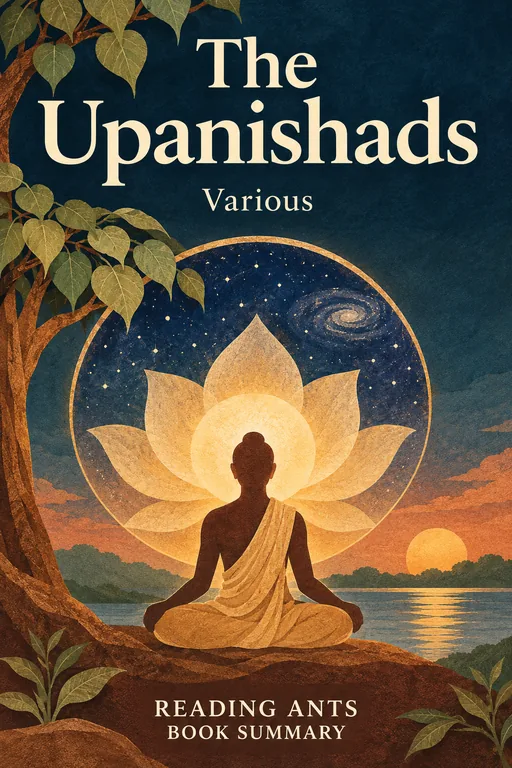
The Upanishads
Original title: उपनिषद्
A collection of ancient Indian texts, composed over several centuries, which explore the nature of reality and the self, and teach that the innermost self of each person is one with the ultimate reality behind the universe.
Overview
The Upanishads are a group of Sanskrit texts that form the final part of the Vedas, the oldest scriptures of Hinduism, and so are sometimes called Vedanta, which means “the end of the Vedas.” They were composed over several centuries, roughly in the first millennium BCE. About a dozen, including the Brihadaranyaka, Chandogya, Katha and Mandukya, are generally considered principal. Their authors are mostly unknown, and they take the form of dialogues, poems and short stories, in which teachers answer the questions of students. Their questions are: What is the self? What is ultimate reality? How can one find freedom?
Full Summary
1. Brahman: the one reality
The idea: The Upanishads teach that behind the changing world of appearances there is one ultimate reality, called Brahman. It is infinite, beyond description, and it is the source and ground of everything. Some of the texts approach it by saying what it is not, since words cannot fully express it. A famous method, found in the Brihadaranyaka Upanishad, is “not this, not this,” a way of setting aside every limited description to point to what is beyond.
In real life: Imagine the ocean behind all the waves: each wave looks separate, but all are water.
2. Atman: the self within
The idea: The central teaching is that the innermost self of a person, called Atman, is not the body or the personality, but pure awareness, and that this self is identical with Brahman. In the Chandogya Upanishad, a father tells his son, who has come home from years of study swollen with pride, that the subtle essence behind everything is also who he is, using the phrase “that you are.” The goal of life is to realize this identity, and so to overcome the sense of being a separate and limited individual.
In real life: When you feel part of something larger than yourself, such as a great piece of music, you may have a hint of this idea.
3. Stories that teach
The idea: Many of the teachings are given through stories. In the Katha Upanishad, a young boy named Nachiketa visits Death, who grants him three wishes. For the third, he asks what happens after death. Death tries to put him off with offers of wealth, long life and pleasures, but the boy refuses them, and Death, impressed, teaches him about the self that does not die. In the Chandogya Upanishad, a father has his son dissolve salt in water, and shows that it is present in every drop, though not visible, as a way to explain how the invisible reality is in all things.
In real life: A good example or story can make a difficult idea clear.
4. Illusion, karma and rebirth
The idea: The texts introduce concepts that became central in Indian thought: that people go through a cycle of birth, death and rebirth, shaped by their actions, or karma, and that this cycle can be escaped through knowledge, a release called moksha. Ignorance of the true self leads people to cling to desires and fears, and to mistake the transient for the real. The world of appearances is described as misleading (maya), hiding the deeper reality.
In real life: A person who chases after one thing after another, but is never satisfied, may be missing something deeper.
5. States of consciousness and the sacred syllable
The idea: The Mandukya Upanishad, a very short text, describes four states of consciousness: waking, dreaming, deep sleep and a fourth state that is the pure awareness underlying all the others. It connects these with the sacred sound Om. The texts also emphasize meditation, in which one turns attention inward, and finds the self. A teacher is often needed to guide the student.
In real life: Sitting quietly, and watching thoughts come and go, can show that there is an observer behind them.
6. Knowledge, ethics and freedom
The idea: The Upanishads do not only call for knowledge, but also for a life of self-control, truthfulness and compassion. They teach that the wise see all beings in the Self and the Self in all beings, and so are free from hatred. The one who has realized the unity of all things is said to be free from fear and sorrow. Freedom, in this view, is not an escape from the world, but a deep peace within it.
In real life: Recognizing that others share your basic feelings can make it easier to treat them kindly.
Why It Matters
The Upanishads are among the most important philosophical and spiritual texts in world history. They shaped Hinduism, and influenced Buddhism, Jainism and many later traditions. Their ideas of the unity of self and ultimate reality, and of liberation through knowledge, have inspired thinkers such as Shankara in India and, after translation into European languages, philosophers like Schopenhauer. In modern times, leaders such as Mahatma Gandhi and writers of many backgrounds have drawn on them. The texts continue to be studied by scholars and read by those seeking spiritual insight, and they offer a window into the thought of ancient India.
Key Takeaways
- One reality underlies everything. Brahman is the ultimate ground of being.
- The self is more than the body. Atman is pure awareness.
- Knowledge liberates. Understanding the true self brings freedom.
- Actions have consequences. Karma shapes the cycle of rebirth.
- Unity inspires compassion. Seeing oneself in others reduces hatred.
What We Can Learn
Even if you do not share the beliefs of the Upanishads, you can use their questions as a prompt for reflection. Ask yourself who you are beneath your roles and moods. Try a few minutes of quiet attention to your breath and thoughts. Notice the difference between what you want in the moment and what lasts. Practice seeing the shared humanity of people around you. And approach these texts with respect, remembering that they come from a living tradition, and that translations vary.
Criticism and Counterpoints
Scholars point out that the Upanishads are a diverse collection from different periods and authors, and that they do not present a single, consistent philosophy, so that later schools, such as the nondualist and the dualist, interpreted them in different ways. Some critics say that the stress on withdrawal from the world and on liberation could lead to neglect of social responsibilities. Others point out that some passages reflect the hierarchical society of their time, including caste distinctions, which modern readers may find troubling. Translations also differ, and the meaning of some terms is debated.
Who Should Read It
This book is for readers interested in philosophy, religion and Indian culture. It is not a continuous story, so it is best read in selections, with a good translation and an introduction. Those who want a more accessible, narrative entry to Indian thought might begin with the Bhagavad Gita and then read the Upanishads.
Want the whole book?
A summary is a taste, not the meal. Here is where to find the full book.
You reached the end 🎉
Nicely done. Mark this one as read, and we will suggest what to read next.
Read this next
The Bhagavad Gita
Vyasa
On the eve of a great battle, the warrior Arjuna despairs, and the god Krishna, serving as his charioteer, teaches him about duty, the soul, selfless action and devotion.
🕊️ Philosophy & Religion
The Dhammapada
Buddhist tradition
This short collection of verses attributed to the Buddha teaches that happiness and suffering come from the mind, and that kindness, self-discipline and mindfulness lead to peace.
🕊️ Philosophy & Religion
Tao Te Ching
Laozi
The deepest wisdom is to live in harmony with the Tao, the natural way of the universe, by being humble, gentle and simple, and by acting without force.
🕊️ Philosophy & Religion
Zhuangzi
Zhuangzi
A witty collection of stories, jokes and arguments from ancient China that invites readers to loosen their fixed ideas, to follow the natural way of things and to find freedom in changing with the world.
🕊️ Philosophy & Religion
Autobiography of a Yogi
Paramahansa Yogananda
Paramahansa Yogananda, an Indian yoga master who taught in the United States, tells the story of his spiritual search, from a boyhood in India to the founding of his organization in the West, and describes the saints and teachers he met along the way.
🕊️ Philosophy & Religion
The Art of War
Sun Tzu
The greatest victory is the one won without fighting, achieved through careful planning, knowing both yourself and your opponent, and using deception, flexibility and timing.
🕊️ Philosophy & ReligionWant something different?
Pick another topic and we will show you three books to start with.