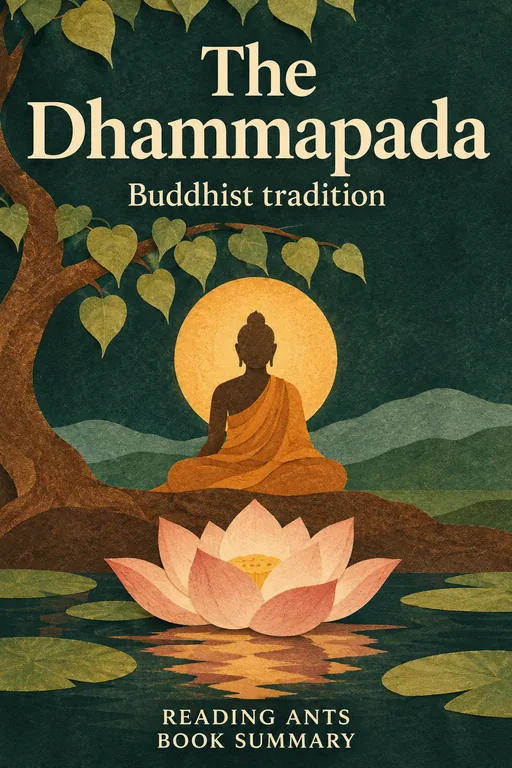
The Dhammapada
Original title: Dhammapada
This short collection of verses attributed to the Buddha teaches that happiness and suffering come from the mind, and that kindness, self-discipline and mindfulness lead to peace.
Overview
The Dhammapada, often translated as “Path of Dharma” or “Path of Truth,” is one of the best-loved texts in Buddhism. It contains 423 verses in the Pali language, organized into twenty-six short chapters, and is part of the Pali Canon, the scriptures of the Theravada tradition. The verses are traditionally attributed to the Buddha, who lived in northern India around the fifth century BC, though they were collected and arranged by later followers, possibly in the third century BC. They are short, memorable sayings, often with vivid images such as the lotus, the flame and the well-trained horse, and they cover ethics, mental training and the way to freedom from suffering.
Full Summary
1. The mind comes first
The idea: The opening verses state that our experiences are shaped by the mind. If a person speaks or acts with a pure mind, happiness follows like a shadow that never leaves. If with a corrupt mind, suffering follows, as a wheel follows the ox. This sets the central theme of the book: mental habits create our world, so training the mind is the key to well-being.
In real life: A person who dwells on resentment tends to feel miserable, even if nothing bad is happening around them.
2. Overcoming hatred and anger
The idea: The Dhammapada teaches that hatred is never ended by hatred; it is ended by loving-kindness. This is called an ancient law. The verses urge readers to conquer anger by gentleness, evil by good, stinginess by giving and falsehood by truth. They also point out that those who hold onto grievances keep themselves in turmoil, while those who let go find peace.
In real life: Answering an insult with calm often ends the argument faster than answering with another insult.
3. Care, mindfulness and self-discipline
The idea: Many verses stress heedfulness or mindfulness, being awake and attentive in each moment. The heedful, the text says, do not die, while the heedless are like the dead. A person should guard the mind as one guards a city, and should train it as a skilled archer straightens an arrow. Self-mastery is considered greater than victory over others in battle.
In real life: Paying close attention to what we are doing, instead of acting on autopilot, helps us avoid mistakes and regrets.
4. The fool and the wise
The idea: The book contrasts the fool, who is careless and clings to pleasures, with the wise, who are calm, humble and willing to learn. The wise person is compared to a deep, clear lake, undisturbed by praise or blame, and like a solid rock that is not shaken by wind. Good company and good teachers are valued, because associating with the wise is a path to wisdom.
In real life: Spending time with people who encourage our best qualities can shape who we become.
5. Deeds and their results
The idea: The text teaches the law of karma: actions have consequences. Wrong deeds eventually bring suffering, and good deeds bring happiness, though the results may not show up at once. The verses encourage doing good, even in small amounts, like drops of water that eventually fill a jar. They also remind readers that life is short and that no one can escape death, which gives urgency to living well.
In real life: Small regular acts of kindness add up to a character and a life that others trust.
6. Freedom from craving and the path to nirvana
The idea: Several chapters analyze the cause of suffering: craving and attachment. Pleasures give only brief satisfaction and then leave us wanting more. The way out is the Noble Eightfold Path, which includes right understanding, right intention, right speech, right action, right livelihood, right effort, right mindfulness and right concentration. The final chapters describe the person who has reached nirvana, free from fear, desire and hatred, and the one who is truly holy because of purity of conduct, not birth or dress.
In real life: We often find that getting what we wanted does not bring lasting satisfaction, which supports the book’s teaching about craving.
Why It Matters
The Dhammapada is among the most read and translated Buddhist texts, and for many people it serves as the best short introduction to Buddhist ethics and psychology. It is memorized by monks and nuns, chanted in ceremonies and cited by modern teachers such as the Dalai Lama and Thich Nhat Hanh. Its verses have been translated into dozens of languages.
Its influence goes beyond religion. The focus on mindfulness, compassion and training the mind has shaped modern practices of meditation and therapies that borrow from Buddhism, and its sayings are regularly shared as inspiration.
Key Takeaways
- The mind shapes experience. Thoughts and intentions create happiness or suffering.
- Hatred can only be ended by kindness. Answering anger with anger makes more of it.
- Be mindful. Careful attention to the present protects us from mistakes.
- Choose your company. Wise friends help us become wiser.
- Craving causes suffering. Letting go of grasping brings peace.
What We Can Learn
The Dhammapada offers a simple, practical idea: we have more influence over our own happiness than we think. By noticing our thoughts and choosing kindness over anger, we may change how we feel and how others treat us.
It also teaches patience. Good habits grow slowly, and the verses encourage steady effort rather than quick results, which is useful in study, work and relationships.
Finally, it encourages humility. The text reminds us that life is short and that wealth and status do not bring lasting peace, which can help us focus on what truly matters, such as honesty, generosity and care for others.
Criticism and Counterpoints
Because the Dhammapada is a collection of brief verses, it does not give detailed arguments, and its ideas can seem to be repeated or too general without context. Different Buddhist traditions interpret it in different ways, and some of its teachings, such as rebirth and nirvana, depend on religious beliefs that not all readers share.
Scholars point out that its date and authorship are uncertain, so it cannot be treated as a record of the Buddha’s exact words. Some critics also feel that its strong emphasis on renunciation and detachment may not suit people who want to engage with worldly responsibilities, though others read it as guidance for balanced living. Translations vary widely.
Who Should Read It
This book suits readers from about age ten and up, including people of all beliefs. The verses are brief and can be read one at a time. A translation with notes helps explain unfamiliar terms.
Want the whole book?
A summary is a taste, not the meal. Here is where to find the full book.
You reached the end 🎉
Nicely done. Mark this one as read, and we will suggest what to read next.
Read this next
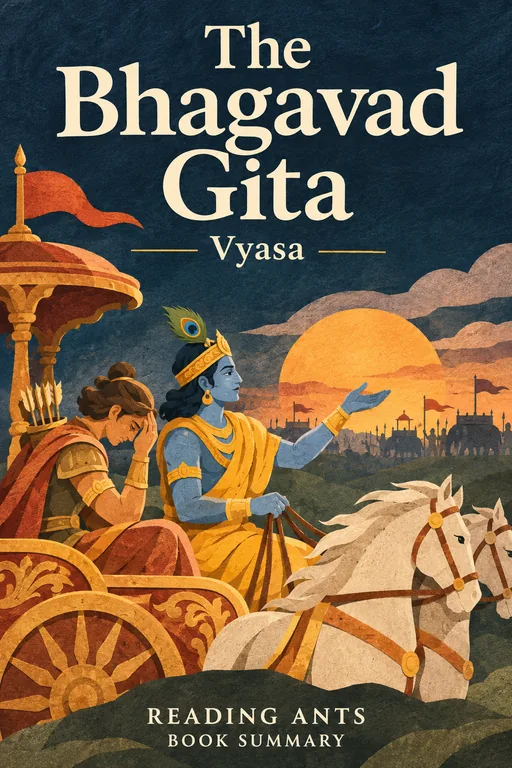
The Bhagavad Gita
Vyasa
On the eve of a great battle, the warrior Arjuna despairs, and the god Krishna, serving as his charioteer, teaches him about duty, the soul, selfless action and devotion.
🕊️ Philosophy & Religion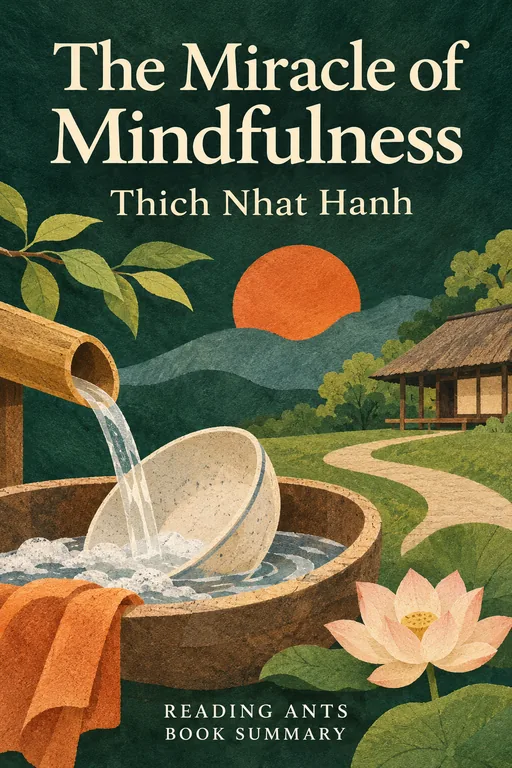
The Miracle of Mindfulness
Thich Nhat Hanh
Thich Nhat Hanh shows, through simple practices like washing dishes, breathing and walking, how paying full attention to the present moment can bring calm, joy and a deeper connection to life.
🕊️ Philosophy & Religion
Tao Te Ching
Laozi
The deepest wisdom is to live in harmony with the Tao, the natural way of the universe, by being humble, gentle and simple, and by acting without force.
🕊️ Philosophy & Religion
Meditations
Marcus Aurelius
The private notebook of a Roman emperor, reminding himself daily to accept what he cannot control, to act with justice and kindness, and to remember that life is short.
🕊️ Philosophy & ReligionThe Art of Happiness
Dalai Lama and Howard C. Cutler
In conversations with the American psychiatrist Howard Cutler, the Dalai Lama explains that happiness is the purpose of life, and that it can be trained through compassion, a calm mind and a change in the way we think about suffering and others.
🌱 Self-Improvement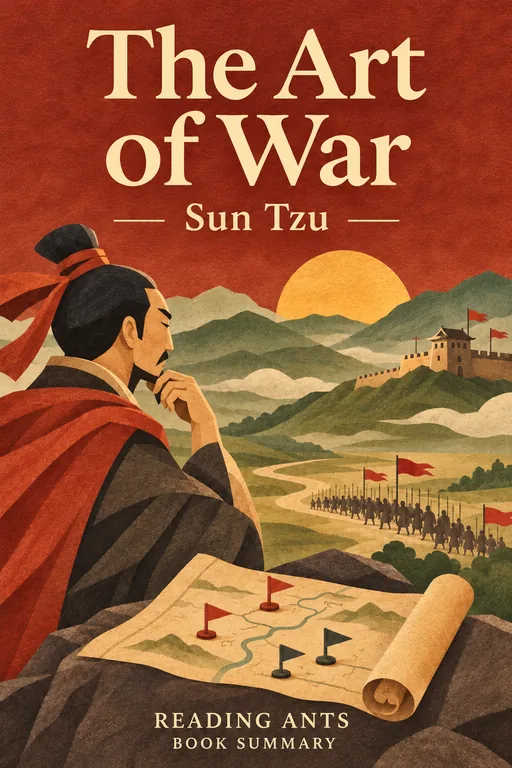
The Art of War
Sun Tzu
The greatest victory is the one won without fighting, achieved through careful planning, knowing both yourself and your opponent, and using deception, flexibility and timing.
🕊️ Philosophy & ReligionWant something different?
Pick another topic and we will show you three books to start with.