 Reading Ants
The Bhagavad Gita
Original title: भगवद्गीता
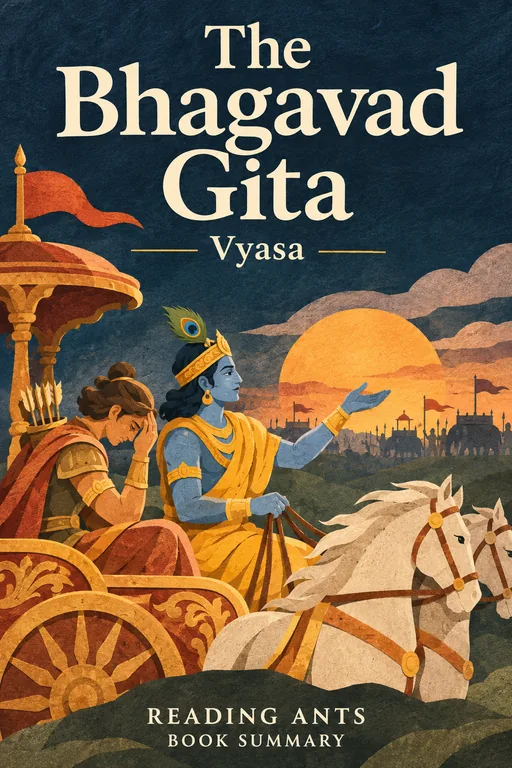
On the eve of a great battle, the warrior Arjuna despairs, and the god Krishna, serving as his charioteer, teaches him about duty, the soul, selfless action and devotion.
Overview
The Bhagavad Gita, meaning “Song of the Lord,” is a Sanskrit text of about 700 verses in eighteen chapters. It is part of the Mahabharata, one of the two great Indian epics, and is traditionally credited to the sage Vyasa, though it was probably composed by unknown authors over time, in about the last few centuries BC. It is set at the start of a war between two branches of a royal family, the Pandavas and the Kauravas, on the field of Kurukshetra. The text takes the form of a conversation between the warrior Arjuna and Krishna, who is revealed to be a form of the divine. It is among the most important works in Hindu thought and has been read and commented on for over two thousand years.
Full Summary
1. Arjuna’s despair
The idea: The poem begins as two armies stand ready. Arjuna, a skilled archer on the side of the Pandavas, asks Krishna to drive his chariot between the armies, and sees relatives, teachers and friends on the other side. Overcome with grief and doubt, he lowers his bow and says he cannot fight, since he fears the harm of killing his own kin. He feels that victory would bring no joy. This moral crisis is the starting point for the teaching.
In real life: Everyone sometimes faces a duty that conflicts with deep feelings, and the Gita begins by taking that struggle seriously.
2. The eternal self
The idea: Krishna begins by teaching that the real self, the atman, is eternal and cannot be killed, even when the body dies, just as a person changes worn-out clothes for new ones. He tells Arjuna that grieving over what is impermanent is misplaced, and that a warrior has a duty, or dharma, to fight a just war. He introduces the idea of acting with a steady mind, balanced in success and failure, pleasure and pain.
In real life: Remembering that outcomes are uncertain can help us focus on doing our part well.
3. The path of action
The idea: Arjuna asks why Krishna urges action if knowledge is higher. Krishna explains karma yoga, the discipline of action: we cannot avoid acting, so we should act without attachment to results, offering the fruits of work to the divine. Such action does not bind us. A person who works for duty, not for reward or praise, finds freedom and peace. This teaching, to focus on the effort and let go of the outcome, is one of the best known in the text.
In real life: A student who studies for understanding, not only for a grade, may feel less anxious and learn more.
4. Knowledge and devotion
The idea: Krishna describes other paths to the divine: jnana yoga, the path of knowledge, which sees through illusion to the true self, and bhakti yoga, the path of loving devotion. He says that those who love and trust him fully are especially dear to him. He explains that people have different natures, so different paths suit different people, but all can lead to the same goal. Meditation and self-discipline are also discussed.
In real life: Some people find meaning through study, others through service or prayer, and the Gita welcomes more than one way.
5. The cosmic form
The idea: In the eleventh chapter, Arjuna asks to see Krishna’s true form. Krishna grants him divine sight, and Arjuna beholds a vast, overwhelming vision containing the entire universe, with beauty and terror, creation and destruction. Awestruck and trembling, Arjuna begs Krishna to return to his gentle form. The scene conveys that the divine is beyond ordinary understanding.
In real life: Moments of awe, whether looking at the stars or a great landscape, can remind us of how small and how connected we are.
6. The qualities of a wise person and the conclusion
The idea: The later chapters describe the three gunas, qualities of nature, goodness, passion and ignorance, which influence thought and action. They also describe the character of a wise person: calm, compassionate, free from envy and steady in mind. In the last chapter, Krishna sums up the teaching and tells Arjuna to act as he sees fit. Arjuna says that his doubts are gone and that he will act according to Krishna’s word.
In real life: Knowing which of our impulses come from calm or from restlessness helps us decide how to act.
Why It Matters
The Bhagavad Gita is one of the most widely read sacred texts in the world and a cornerstone of Hindu philosophy. It has been interpreted by countless teachers and thinkers, from medieval commentators such as Shankara and Ramanuja to modern figures like Mahatma Gandhi, who called it his “spiritual dictionary” and treated its message as one of nonviolent action.
It has also influenced many outside India, including Western writers such as Thoreau and Emerson, and scientists such as J. Robert Oppenheimer, who studied Sanskrit to read it. Its discussion of duty, action and inner peace continues to speak to readers of many backgrounds.
Key Takeaways
- Do your duty. Act according to your role and responsibilities.
- Let go of results. Focus on effort, not on reward.
- The self is deeper than the body. The soul endures.
- Many paths exist. Action, knowledge and devotion can all lead to growth.
- Seek balance. A steady mind treats success and failure alike.
What We Can Learn
The Gita teaches that anxiety about outcomes can weigh us down. By putting our attention on doing our best in the present, we may find more focus and calm, whether we are studying, working or caring for others.
It also shows that doubt is part of the path. Arjuna, a great warrior, falls into despair, and the text treats his questions with respect, which reminds us that asking hard questions is not a weakness.
Finally, it invites us to think about the unity of life. The Gita encourages seeing the same spirit in all beings, and this can inspire kindness and humility.
Criticism and Counterpoints
The Gita has been debated for centuries. Some readers wonder how a text that persuades a man to fight can be read as a teaching of peace, and interpretations differ: some see the war as a literal duty, others, such as Gandhi, as a symbol of the inner struggle between good and evil. Critics also note that the text’s defense of duty tied to one’s social class, or varna, has been used to justify the caste system, which many reject today.
Translations differ a lot, and some terms cannot be rendered precisely into English. Scholars also disagree about when and how the text was composed. For these reasons, readers often benefit from using more than one translation and a commentary.
Who Should Read It
This book suits older teenagers and adults interested in philosophy, religion and ethics. It is short, but its ideas are deep, so it is best read slowly. A translation with notes is useful, and readers of any faith or none can benefit from its reflections.
Want the whole book?
A summary is a taste, not the meal. Here is where to find the full book.
You reached the end 🎉
Nicely done. Mark this one as read, and we will suggest what to read next.
Read this next
The Story of My Experiments with Truth
Mohandas K. Gandhi
Mohandas Gandhi recounts his early life and his experiments in honesty, nonviolence and self-discipline, from a shy boy in India to a lawyer in South Africa and the leader of a movement.
👤 Real Lives
The Dhammapada
Buddhist tradition
This short collection of verses attributed to the Buddha teaches that happiness and suffering come from the mind, and that kindness, self-discipline and mindfulness lead to peace.
🕊️ Philosophy & Religion
Meditations
Marcus Aurelius
The private notebook of a Roman emperor, reminding himself daily to accept what he cannot control, to act with justice and kindness, and to remember that life is short.
🕊️ Philosophy & Religion
The Upanishads
Various
A collection of ancient Indian texts, composed over several centuries, which explore the nature of reality and the self, and teach that the innermost self of each person is one with the ultimate reality behind the universe.
🕊️ Philosophy & Religion
The Ramayana
Valmiki
The virtuous prince Rama is exiled from his kingdom, and when his beloved wife Sita is kidnapped by the demon king Ravana, he rescues her with the help of his loyal brother and an army of monkeys, with the devoted Hanuman as its great hero.
🎭 Epics, Drama & Poetry
The Art of War
Sun Tzu
The greatest victory is the one won without fighting, achieved through careful planning, knowing both yourself and your opponent, and using deception, flexibility and timing.
🕊️ Philosophy & ReligionWant something different?
Pick another topic and we will show you three books to start with.