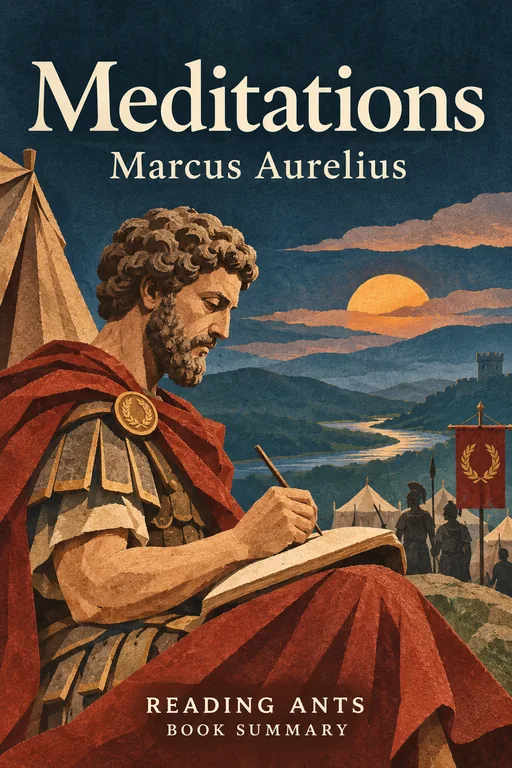
Meditations
Original title: Τα εις εαυτόν
The private notebook of a Roman emperor, reminding himself daily to accept what he cannot control, to act with justice and kindness, and to remember that life is short.
Overview
Marcus Aurelius ruled the Roman Empire from 161 to 180 CE, during years of war, plague and political trouble. He was also a student of Stoicism, a Greek philosophy that teaches that we cannot control events, only our judgments and actions, and that the good life is one of virtue. Meditations was never meant to be published. It is a collection of personal notes, written in Greek, often while he was on military campaigns along the Danube frontier. In short passages, he encourages himself to stay calm, be patient with difficult people, do his duty and face death without fear. Its honesty and practical wisdom have made it one of the most loved books of philosophy ever written.
Full Summary
1. Gratitude for those who shaped you
The idea: The first of the book’s twelve sections is a list of thanks. Marcus records what he learned from his grandfather, mother, teachers and adoptive father, the emperor Antoninus Pius: modesty, self-control, patience, love of hard work, and the habit of listening to anyone who has something useful to say. He reminds himself that his character was built by many people.
In real life: Writing a short list of what we learned from parents, teachers or friends, such as patience from a grandparent or curiosity from a teacher, helps us appreciate them and see the kind of person we want to be.
2. Control your judgments, not events
The idea: The core of Stoicism is that some things are up to us (our opinions, choices and actions) and most things are not (other people, health, fame, the weather). Marcus repeatedly reminds himself that events themselves don’t disturb us; our judgments about them do. If he removes the judgment “I have been harmed,” the harm disappears.
In real life: Missing a bus is just an event. Telling yourself “my whole day is ruined” is what makes you upset. Choosing a calmer view, like “I’ll use the wait to read,” changes how you feel.
3. Expect difficult people, and be kind anyway
The idea: Marcus begins one section by reminding himself that today he will meet people who are rude, ungrateful, arrogant and dishonest. They act this way because they do not understand what is truly good. Since all humans share the same reason and nature, they are his relatives, and he was made to work with them, not against them. Anger only harms himself.
In real life: Before a busy day at school or work, remind yourself that someone will probably be annoying. When it happens, you are prepared to respond with patience instead of being caught off guard.
4. The obstacle becomes the way
The idea: Marcus writes that what stands in the way of our action can itself become a path forward. Every obstacle is a chance to practice a virtue: patience, courage, kindness or wisdom. Fire turns whatever is thrown into it into flame and light. In the same way, a strong mind turns setbacks into fuel.
In real life: If your team loses its best player to injury, that setback can push others to step up, develop new skills and play together better than before.
5. Do your duty
The idea: Marcus scolds himself for wanting to stay in bed. He asks whether he was born to lie under the blankets and keep warm, or to do the work of a human being. He urges himself to do each task as if it were the last of his life: carefully, sincerely and without complaint, without chasing praise or reward.
In real life: On mornings when you’d rather stay in bed, ask yourself what you are getting up for: helping your family, learning something, earning a living. Remembering the purpose makes it easier to start.
6. Life is short, so live well now
The idea: Marcus often reflects on death and impermanence. Emperors, philosophers and whole cities have vanished; soon he too will be forgotten. This is not meant to be depressing but freeing: fame doesn’t matter, and the present moment is the only time we truly have. He also practices the “view from above,” imagining the earth from high in the sky to see how small our worries are.
In real life: When a small embarrassment, like a mistake in a class presentation, feels huge, ask whether anyone will remember it in five years. Usually, nobody will.
7. Live in harmony with nature
The idea: The Stoics believed the universe is ordered by a rational principle, and that everything happens as part of a larger whole. Marcus encourages himself to accept change, loss and death as natural, like the ripening and falling of fruit, and to live according to his nature as a rational, social being by acting justly and helping others.
In real life: Seasons change, people grow up and move away, and things wear out. Accepting this as part of life, instead of fighting it, helps us handle change more gracefully.
Why It Matters
Meditations is one of the most important works of ancient philosophy and one of the few personal writings to survive from a Roman emperor. It offers a rare view into the mind of the most powerful man in the world of his time, struggling with the same doubts, temptations and fears as everyone else.
The book has been read for centuries by leaders, soldiers, writers and ordinary people seeking calm in hard times. In recent years it has become hugely popular again, driven by a revival of Stoicism in self-help books such as Ryan Holiday’s The Obstacle Is the Way. Its ideas also influenced modern cognitive behavioral therapy, which, like Stoicism, teaches that our thoughts about events shape our emotions.
Key Takeaways
- Our judgments create our distress. Events are neutral; our opinions make them painful.
- Focus on what you control. Your choices and actions are yours; most else is not.
- Obstacles are opportunities. Every difficulty is a chance to practice virtue.
- Be patient with others. Difficult people are fellow humans who don’t know better.
- Life is short. Remembering death helps us live well in the present.
What We Can Learn
Marcus’s notes show the value of daily reflection. Try spending a few minutes each evening writing about what went well, what upset you, and how you could respond better tomorrow. It is a simple habit that can bring calm and clarity.
When something goes wrong, pause and separate the event from your judgment of it. Ask: Is this within my control? If yes, act; if not, let it go.
Finally, the book reminds us that being powerful, popular or successful doesn’t free anyone from the need for patience and humility. Kindness to others, honest work and gratitude are within everyone’s reach, whether emperor or student.
Criticism and Counterpoints
Some readers find Meditations repetitive and unstructured, because it is a private notebook rather than a planned book. Its constant focus on death and on accepting fate can feel gloomy or passive to some, and critics argue that Stoic acceptance might discourage people from fighting injustice.
Historians also point out a contrast between Marcus’s ideals and his actions: his reign included harsh wars, persecution of Christians in some provinces, and the choice of his son Commodus, a notoriously bad ruler, as his successor. Supporters reply that the book shows a man honestly trying, and often failing, to live up to high ideals.
Who Should Read It
This book is for teens and adults seeking practical wisdom for stressful times, and for anyone curious about philosophy or ancient Rome. It is best read slowly, a few passages at a time. A modern translation, such as Gregory Hays’s, makes it much more readable.
Want the whole book?
A summary is a taste, not the meal. Here is where to find the full book.
You reached the end 🎉
Nicely done. Mark this one as read, and we will suggest what to read next.
Read this next
Letters from a Stoic
Seneca
In friendly letters to a younger friend, the Roman Stoic Seneca offers practical advice on how to use time well, face death, handle wealth and misfortune, and train the mind to find peace.
🕊️ Philosophy & Religion
Enchiridion
Epictetus
Epictetus, a former slave turned Stoic teacher, offers a short handbook of advice on staying calm and free by focusing on what we can control, and accepting what we cannot.
🕊️ Philosophy & ReligionThe Daily Stoic
Ryan Holiday and Stephen Hanselman
Ryan Holiday and Stephen Hanselman offer 366 short daily readings, drawn from Stoic philosophers such as Marcus Aurelius, Seneca and Epictetus, with brief commentary, to help readers to practice wisdom, resilience and self-control.
🌱 Self-ImprovementThe Obstacle Is the Way
Ryan Holiday
Ryan Holiday uses the Stoic philosophy of Marcus Aurelius and others, with stories of famous people, to argue that the obstacles in our path can be turned into advantages, if we respond to them with the right perception, action and will.
🌱 Self-Improvement
Man's Search for Meaning
Viktor E. Frankl
A psychiatrist who survived the Nazi concentration camps explains that even in the worst suffering, people can choose their attitude, and that finding a reason to live is what gives us the strength to endure.
👤 Real Lives
The Art of War
Sun Tzu
The greatest victory is the one won without fighting, achieved through careful planning, knowing both yourself and your opponent, and using deception, flexibility and timing.
🕊️ Philosophy & ReligionWant something different?
Pick another topic and we will show you three books to start with.