 Reading Ants
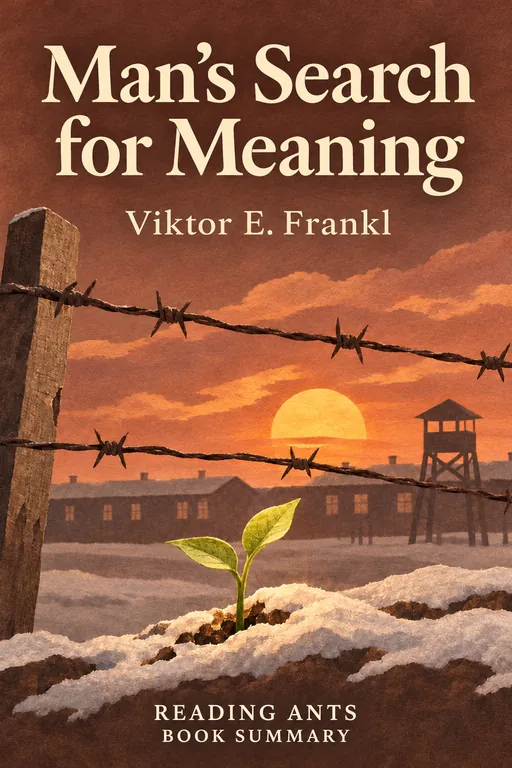
Man's Search for Meaning
Original title: … trotzdem Ja zum Leben sagen
A psychiatrist who survived the Nazi concentration camps explains that even in the worst suffering, people can choose their attitude, and that finding a reason to live is what gives us the strength to endure.
Overview
Viktor Frankl was a Jewish psychiatrist in Vienna when, in 1942, he and his family were deported by the Nazis. Over the next three years he was held in several concentration camps, including Auschwitz. His parents, his brother and his young wife all died. Man’s Search for Meaning has two parts. The first describes daily life in the camps, not as a history of horrors but as a study of how ordinary prisoners coped mentally and why some kept their humanity while others gave up. The second part introduces logotherapy, the school of psychotherapy Frankl founded, which says that our main drive in life is not pleasure or power but the search for meaning. Written in just a few days after the war, this short book has helped millions of readers through grief, illness and despair.
Full Summary
1. Life in the camps
The idea: Frankl describes three psychological stages that prisoners went through. First came shock on arrival: the loss of every possession, even hair and names, which were replaced with numbers. Next came apathy: emotions shut down as a kind of protection, so that prisoners stopped reacting to death and cruelty around them. The third stage, after liberation, brought strange numbness, bitterness and disillusionment before people slowly learned to feel joy again.
From the book: On arrival at Auschwitz, Frankl tried to save the manuscript of his life’s work, hidden in his coat. It was taken from him and destroyed. He describes this as the moment he had to let go of his whole former life.
In real life: People going through a severe crisis, such as a sudden loss or illness, often describe similar stages: shock, numbness, and later a slow return of feeling.
2. The last human freedom
The idea: The camps stripped prisoners of everything: family, health, possessions, dignity. Yet Frankl saw that one thing could never be taken away: the freedom to choose one’s attitude in any set of circumstances. Some prisoners comforted others or gave away their last piece of bread. This proved, he argues, that how we respond to suffering is ultimately our own decision.
In real life: We cannot control a traffic jam, an unfair teacher or bad news from a doctor. We can control whether we respond with bitterness or with patience and courage.
3. Love and beauty kept people alive
The idea: Even in the camps, inner life could be rich. Frankl survived long, freezing marches by holding a conversation in his mind with his wife, though he didn’t know whether she was alive. He realized that love is the highest goal a person can aspire to, and that love reaches beyond the physical presence of a loved one. Prisoners also found strength in moments of beauty, such as a sunset seen through a barred window, and in humor, which Frankl calls a weapon of the soul.
In real life: During hard times, holding a picture of the people we love in our mind, or noticing small beauties like music or a walk outside, can give real strength.
4. Those with a “why” survive the “how”
The idea: Frankl observed that the prisoners most likely to survive were often not the physically strongest but those who had something to live for: a child waiting for them, a task to finish, a book to write. Frankl himself was determined to rewrite his lost manuscript. Prisoners who lost all hope in the future often gave up and died soon after. He borrows an idea from Nietzsche: someone who has a reason to live can bear almost any hardship.
From the book: Frankl notes that in the camp, the death rate rose sharply in the week between Christmas 1944 and New Year 1945. He explains it by the fact that many prisoners had hoped to be home by Christmas, and when that hope was crushed, their resistance collapsed.
In real life: Students who know why they are studying, for example to become a nurse, usually cope better with exam stress than students who see no point in it.
5. Logotherapy: the will to meaning
The idea: In the second part, Frankl explains logotherapy (from the Greek word logos, meaning “meaning”). Freud believed our main drive was pleasure; Alfred Adler believed it was power. Frankl argues that our deepest drive is the will to meaning. When people can’t find meaning, they fall into an “existential vacuum,” a feeling of emptiness that may show up as boredom, depression, addiction or aggression.
In real life: Many people notice a low mood on Sunday evenings when the busy week stops and they face the question of what their life is really about. Frankl called this the Sunday neurosis.
6. Three ways to find meaning
The idea: Frankl says meaning cannot be invented; it is discovered. We find it in three ways: by creating a work or doing a deed; by experiencing something such as goodness, truth or beauty, or by loving another person; and by the attitude we take toward unavoidable suffering. Suffering is not necessary for meaning, but when it can’t be avoided, facing it with courage can itself be meaningful.
From the book: Frankl describes an elderly doctor who was deeply depressed after his wife died. Frankl asked what would have happened if he had died first. The man said his wife would have suffered terribly. Frankl pointed out that by surviving her, he had spared her that suffering. His grief now had a meaning, and he left calmer.
In real life: A person who cannot work because of illness can still find meaning by being a source of warmth for their family, or by sharing what they have learned.
7. Tragic optimism
The idea: In a later essay added to the book, Frankl describes “tragic optimism”: saying yes to life despite pain, guilt and death. Pain can be turned into achievement, guilt into a chance to change for the better, and the shortness of life into a reason to act responsibly. He also suggests that happiness can’t be chased directly. It comes as a side effect of devoting yourself to a cause or a person.
In real life: People who focus only on “being happy” often feel restless, while those absorbed in a purpose, like raising a family, building something or helping others, often find happiness along the way.
Why It Matters
Man’s Search for Meaning is one of the most influential books of the twentieth century. It has sold millions of copies and been translated into dozens of languages, and readers in surveys have ranked it among the books that most changed their lives. It is widely read by people facing grief, illness, depression and hardship.
Frankl’s logotherapy became known as the “third Viennese school” of psychotherapy, after those of Freud and Adler, and it influenced later fields such as existential therapy, positive psychology and meaning-centered therapy for cancer patients. Because it is both a firsthand account of the Holocaust and a practical philosophy of life, the book is taught in history, psychology and philosophy classes alike.
Key Takeaways
- Attitude is the last freedom. Even when everything else is taken, we can choose how to respond.
- Meaning sustains life. A reason to live helps people endure almost anything.
- Meaning comes from work, love and courage. It is found in what we give, what we experience and how we face suffering.
- Happiness follows purpose. It comes from living for something beyond ourselves, not from chasing it.
- Suffering is not pointless if we give it meaning. How we bear it can become an achievement.
What We Can Learn
Frankl’s ideas are practical. When life feels empty, ask not “What do I want from life?” but “What is life asking of me?” There is usually a task, a person or a responsibility waiting for us.
In hard moments, remember the space between what happens and how we respond. Taking a breath before reacting, and choosing a calm or kind response, is a daily version of Frankl’s freedom.
Finally, invest in meaning, not only in comfort. Build relationships, create things, help others, and treat setbacks as chances to grow. Many readers find it helpful to write down what they are living for right now, and to look at that list when things get hard.
Criticism and Counterpoints
Some critics, including other Holocaust survivors and historians, have worried that the book’s message, that meaning helps people survive, could suggest that those who died lacked the will to live. In reality, survival in the camps depended overwhelmingly on luck, timing and the decisions of the guards, a point Frankl himself acknowledges when he says the best of them did not return.
Scholars have also debated details of Frankl’s own time in the camps, noting that he spent only a few days at Auschwitz before being transferred. Others find logotherapy more a philosophy of life than a tested scientific treatment. Nonetheless, the book’s central message has proven deeply helpful to readers around the world.
Who Should Read It
This short book is for anyone searching for purpose, especially people dealing with grief, illness or a difficult period. It is suitable for mature teens and adults. The descriptions of camp life are restrained but still painful to read.
Want the whole book?
A summary is a taste, not the meal. Here is where to find the full book.
You reached the end 🎉
Nicely done. Mark this one as read, and we will suggest what to read next.
Read this next

Night
Elie Wiesel
Elie Wiesel tells, in short and searing pages, how as a teenager he was taken from his hometown of Sighet to Auschwitz and Buchenwald, lost his family and watched his faith and childhood break apart.
👤 Real Lives
The Diary of a Young Girl
Anne Frank
A Jewish teenage girl hiding from the Nazis in a secret apartment in Amsterdam records two years of fear, family quarrels, first love and big dreams in a diary that became one of the most famous books in the world.
👤 Real Lives
If This Is a Man
Primo Levi
Primo Levi, an Italian Jewish chemist, describes with clarity and restraint his eleven months as a prisoner in the Auschwitz camp, and asks what it means to remain human when everything is taken from you.
👤 Real Lives
The Courage to Be Disliked
Ichiro Kishimi and Fumitake Koga
In a dialogue between a philosopher and a skeptical young man, this book introduces the psychology of Alfred Adler and argues that we can be free from our past, from others' expectations and from the need for approval, by choosing how we live.
🌱 Self-Improvement
Meditations
Marcus Aurelius
The private notebook of a Roman emperor, reminding himself daily to accept what he cannot control, to act with justice and kindness, and to remember that life is short.
🕊️ Philosophy & Religion
Long Walk to Freedom
Nelson Mandela
Nelson Mandela tells his own story, from a village childhood to twenty-seven years in prison to becoming South Africa's first democratically elected president, and shows how patience, courage and forgiveness helped end apartheid.
👤 Real LivesWant something different?
Pick another topic and we will show you three books to start with.