 Reading Ants
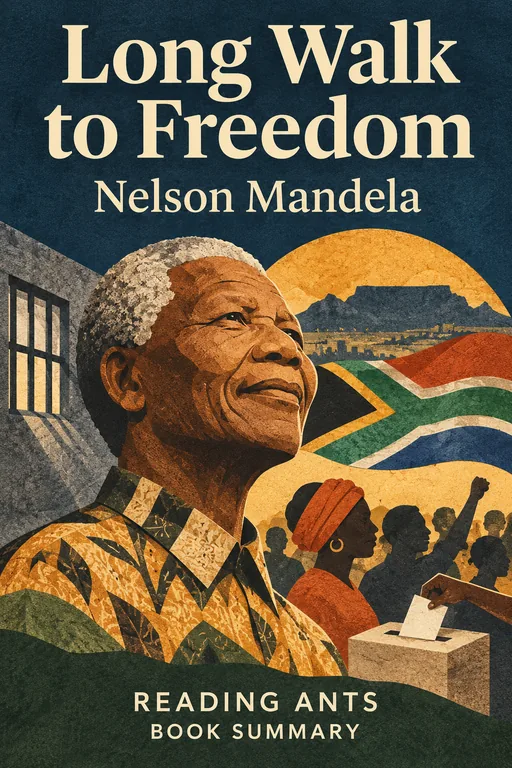
Long Walk to Freedom
Nelson Mandela tells his own story, from a village childhood to twenty-seven years in prison to becoming South Africa's first democratically elected president, and shows how patience, courage and forgiveness helped end apartheid.
Overview
Long Walk to Freedom is the autobiography of Nelson Mandela, the South African leader who became one of the most admired people in the world. Much of it was written secretly while he was a prisoner on Robben Island, and it was completed after his release and published in 1994. Mandela describes growing up in a rural village, becoming a lawyer in Johannesburg, and joining the struggle against apartheid, the system of laws that separated people by race and denied Black South Africans basic rights. He explains why he turned to armed resistance, describes his long years in prison, and tells how he negotiated an end to apartheid. Honest about his mistakes and sacrifices, the book is an inspiring story of how one person helped transform a nation.
Full Summary
A Village Childhood
Mandela was born in 1918 in the small village of Mvezo in the Transkei region of South Africa, into a family connected to the royal house of the Thembu people. His birth name was Rolihlahla, which can mean “troublemaker.” On his first day at school, a teacher gave him the English name Nelson, as was the custom.
When his father died, young Mandela was sent to live with the regent of the Thembu people, who raised him as his own son. Watching the regent hold meetings where everyone could speak and the leader listened before deciding, Mandela learned lessons about leadership that he never forgot: a leader should be like a shepherd who guides from behind.
Johannesburg and the ANC
Mandela studied at mission schools and at the University College of Fort Hare, where he was suspended for joining a student protest. When the regent arranged a marriage for him, he ran away to Johannesburg. There he met Walter Sisulu, who helped him find work at a law firm and became his lifelong friend and political mentor. Mandela studied law and saw daily the injustice of laws that controlled where Black people could live, work and travel.
In 1944 he helped found the Youth League of the African National Congress (ANC), which pushed for stronger action against racial discrimination. After the National Party came to power in 1948 and introduced apartheid, Mandela became a leading organizer of peaceful protests, including the Defiance Campaign of 1952. He and Oliver Tambo opened the first Black law firm in South Africa.
From Protest to Armed Struggle
The government responded with harsh repression. Mandela was banned from meetings and, with 155 others, charged with treason in a trial that lasted more than four years before all were acquitted. In 1960, police killed sixty-nine peaceful protesters at Sharpeville, and the ANC was banned.
Mandela concluded that peaceful protest alone could not defeat a government that answered with bullets. In 1961, he helped found Umkhonto we Sizwe (“Spear of the Nation”), the ANC’s armed wing, which began a campaign of sabotage against government buildings and infrastructure, aiming to avoid loss of life. He lived underground, traveled secretly through Africa to seek support and receive military training, and became known as the “Black Pimpernel” for escaping capture.
The Rivonia Trial
In 1962, Mandela was arrested. While serving a five-year sentence, he and other ANC leaders were put on trial for sabotage in the Rivonia Trial and faced the possibility of the death penalty. In his famous statement from the dock, Mandela explained the reasons for their struggle and declared that he had fought against both white domination and Black domination. He said he cherished the ideal of a democratic and free society where all people live together in harmony, an ideal for which he was prepared to die. In 1964, he and several others were sentenced to life in prison.
Robben Island
Mandela spent eighteen years in harsh conditions on Robben Island, a prison off the coast near Cape Town. He slept on the floor of a tiny cell, broke rocks in a lime quarry under the glaring sun, which damaged his eyes, and was allowed few letters and visits. He was not permitted to attend the funerals of his mother or his eldest son, who died in a car accident.
Yet the prisoners turned the island into a kind of university, teaching each other history, politics and languages. Mandela studied Afrikaans, the language of his jailers, to understand them better, and he insisted on being treated with dignity. Over time, he won the respect of some guards, which taught him that even opponents could change.
Negotiating Freedom
In 1982, Mandela was moved to Pollsmoor Prison near Cape Town, and later to a house on the grounds of another prison. Around the world, a campaign to free him grew, and international sanctions pressured the South African government. Mandela took a risky step: without first consulting his colleagues, he began secret talks with government officials, believing negotiation was the only way to avoid a bloodbath.
In 1990, President F. W. de Klerk lifted the ban on the ANC and released Mandela after twenty-seven years in prison. Millions watched as he walked out of prison, fist raised, with his wife Winnie at his side.
A New South Africa
The following years were filled with difficult negotiations and outbreaks of violence that threatened to derail the transition. Mandela’s marriage to Winnie also fell apart, a personal pain he describes frankly. In 1993, Mandela and de Klerk shared the Nobel Peace Prize. In April 1994, in South Africa’s first election open to all races, millions of people voted, many for the first time, and the ANC won. Mandela was inaugurated as president.
He ends his story by reflecting that he has climbed a great hill only to discover that there are many more hills to climb. Freedom, he writes, is not just casting off one’s chains but living in a way that respects and enhances the freedom of others. His long walk is not yet ended.
Why It Matters
Long Walk to Freedom is one of the most important political autobiographies of the twentieth century. It tells, from the inside, the story of the struggle against apartheid, one of the great human rights movements in history. It has been translated into many languages and was adapted into the 2013 film Mandela: Long Walk to Freedom.
Mandela’s example of forgiveness and reconciliation after decades of injustice has inspired leaders and activists around the world. His decision to work with his former enemies to build a peaceful, democratic South Africa is seen as one of the most remarkable acts of statesmanship in modern history. The United Nations now marks Nelson Mandela International Day on his birthday, July 18.
Key Takeaways
- Freedom requires sacrifice. Mandela gave up his family life and liberty for his cause.
- Patience is a form of strength. Twenty-seven years in prison did not break his resolve.
- Understand your opponents. Learning Afrikaans and respecting guards helped him negotiate.
- Reconciliation can heal a nation. Forgiveness made a peaceful transition possible.
- Leaders listen. Mandela learned to lead from behind, letting others speak first.
What We Can Learn
Mandela’s story teaches that dignity can be kept even in the hardest circumstances. Standing up for ourselves calmly and respectfully, even when treated unfairly, can win the respect of others.
It also shows the power of understanding people we disagree with. By learning his jailers’ language and history, Mandela found ways to talk with them. In our own conflicts, trying to see the other side can open doors to solutions.
Finally, his life reminds us that forgiveness is not weakness. Mandela chose not to seek revenge after his release, because he knew that hatred would keep South Africa imprisoned. Letting go of bitterness can free us to build something better.
Criticism and Counterpoints
As an autobiography, the book naturally presents events from Mandela’s point of view. Some historians note that it is careful in its portrayal of the ANC’s allies and of internal disputes within the movement, and that it says relatively little about controversial issues such as the ANC’s links with the South African Communist Party or abuses in ANC camps in exile.
Others have pointed out that the book was written with help from editors and was completed while Mandela was a political leader, so it may present an idealized picture. Some critics of his presidency later argued that the economic inequality of apartheid remained largely in place. Still, most readers find the book honest, humble and deeply moving.
Who Should Read It
This book is valuable for teenagers and adults interested in history, human rights, leadership and politics. It is long, so younger readers may prefer an abridged or illustrated edition. Anyone who wants to understand South Africa or the power of perseverance should read it.
Want the whole book?
A summary is a taste, not the meal. Here is where to find the full book.
You reached the end 🎉
Nicely done. Mark this one as read, and we will suggest what to read next.
Read this next
The Autobiography of Malcolm X
Malcolm X and Alex Haley
Malcolm X tells, with the help of the writer Alex Haley, how he moved from a troubled childhood and a life of crime to leadership in the Nation of Islam, and then to a broader view of race and faith before his death.
👤 Real Lives
The Story of My Experiments with Truth
Mohandas K. Gandhi
Mohandas Gandhi recounts his early life and his experiments in honesty, nonviolence and self-discipline, from a shy boy in India to a lawyer in South Africa and the leader of a movement.
👤 Real Lives
Cry, the Beloved Country
Alan Paton
A rural Zulu priest travels to Johannesburg to find his lost son and sister, and discovers that his son has murdered a white man, a tragedy that draws two grieving fathers from opposite sides of South Africa's racial divide into an uneasy bond.
📜 Classics
Born a Crime
Trevor Noah
Trevor Noah, the comedian, recounts growing up in South Africa as the child of a Black mother and a white father at a time when their relationship was a crime, and pays tribute to the mother who raised him.
👤 Real Lives
Man's Search for Meaning
Viktor E. Frankl
A psychiatrist who survived the Nazi concentration camps explains that even in the worst suffering, people can choose their attitude, and that finding a reason to live is what gives us the strength to endure.
👤 Real Lives
The Diary of a Young Girl
Anne Frank
A Jewish teenage girl hiding from the Nazis in a secret apartment in Amsterdam records two years of fear, family quarrels, first love and big dreams in a diary that became one of the most famous books in the world.
👤 Real LivesWant something different?
Pick another topic and we will show you three books to start with.