 Reading Ants
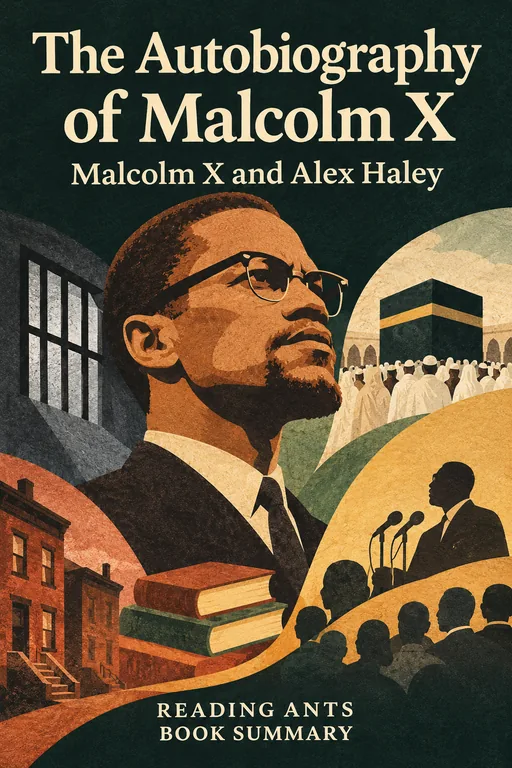
The Autobiography of Malcolm X
Malcolm X tells, with the help of the writer Alex Haley, how he moved from a troubled childhood and a life of crime to leadership in the Nation of Islam, and then to a broader view of race and faith before his death.
Overview
The Autobiography of Malcolm X was published in 1965, a few months after Malcolm X was assassinated. It was written by the journalist Alex Haley, based on many interviews with Malcolm X conducted in the early 1960s. Malcolm X was born Malcolm Little in 1925 and became one of the most powerful and controversial figures in the American civil rights era. The book is the story of a series of transformations: from a child facing racism, to a street hustler, to a prisoner who educated himself, to a spokesman for the Nation of Islam, and finally to a man who changed his thinking after a pilgrimage to Mecca. It remains one of the most influential American autobiographies.
Full Summary
1. Childhood and loss
Malcolm is born in Omaha, Nebraska, the son of Earl Little, a Baptist preacher and supporter of the Black nationalist leader Marcus Garvey, and Louise. The family faces threats from white racists and moves several times. Malcolm recalls the violence of his early years, including the death of his father in 1931, which the family believed was a murder made to look like an accident. Without his father, the family struggles, and his mother eventually suffers a breakdown and is placed in a state hospital. The children are split among foster homes.
2. A promising student discouraged
Malcolm does well in school in Michigan, and is popular and clever. But when he tells a favorite teacher that he wants to be a lawyer, the teacher says that this is not a realistic goal for a Black person and suggests carpentry. The moment, which Malcolm describes as a turning point, leaves him bitter. He moves to Boston to live with his half-sister Ella, his father’s daughter from an earlier marriage, and starts to explore the city’s nightlife, leaving school behind.
3. Boston, Harlem and crime
Malcolm falls into the world of nightclubs, dance halls and street life, and he straightens his hair with a painful chemical process, a practice he later regrets as a sign of self-hatred. He moves to Harlem in New York, where he becomes involved in hustling, gambling, drugs and burglary and earns the nickname “Detroit Red.” He eventually returns to Boston, and in 1946, when he is about twenty, he is arrested and sentenced to prison for burglary.
4. Prison and conversion
In prison, Malcolm reads widely, copying out the dictionary to improve his vocabulary and spending hours in the library. His brothers and sisters write to him about the Nation of Islam, a religious and political movement led by Elijah Muhammad that taught about Black pride and self-reliance. Malcolm embraces the teachings, gives up smoking, drinking and crime and sees the experience as a rebirth. After being released in 1952, he drops his “slave name” and takes the name Malcolm X.
5. Minister and public figure
Malcolm becomes a gifted speaker and organizer, helping to grow the Nation of Islam into a nationally known organization. He preaches racial separation and criticizes the white power structure and the mainstream civil rights movement for its approach of integration and nonviolence. He gains fame, and fear, among white Americans and respect among many Black listeners. But tensions rise within the Nation, partly because he learns of problems in the leadership and feels distanced from Elijah Muhammad. In 1964, he leaves the organization.
6. Pilgrimage and a change of view
Following his split, Malcolm makes a pilgrimage to Mecca, known as the Hajj, and travels through Africa and the Middle East. He is struck by the sight of Muslims of all races praying together and begins to reconsider his view that all white people were enemies. He takes the name El-Hajj Malik El-Shabazz and founds a new organization, the Organization of Afro-American Unity. He continues to criticize racism but speaks more of human rights and of working with others.
7. Final days
In the final chapters, Malcolm talks about the threats against his life and his sense that his time is short. Haley’s epilogue, written after Malcolm’s death, describes how Malcolm’s family home in Queens was firebombed in February 1965 and how, a week later, on February 21, Malcolm was shot and killed while about to speak at the Audubon Ballroom in Harlem. Three men were convicted at the time; doubts about the case have persisted, and in 2021 two of the convictions were set aside. The epilogue also reflects on Haley’s relationship with Malcolm and on the man he came to know.
Why It Matters
The Autobiography of Malcolm X has been read by millions and is regularly listed among the most important nonfiction books of the twentieth century. It had a deep impact on the Black Power movement and on how Americans think about race, identity and self-transformation. Spike Lee’s 1992 film about Malcolm X further spread its story.
The book also shows the power of self-education. Malcolm’s account of learning to read and write while in prison is one of the best-known descriptions of how reading can change a life.
Key Takeaways
- People can change. Malcolm changed several times in his life.
- Self-education is powerful. Prison reading opened his mind.
- Racism shapes lives. Early discouragement pushed him toward crime.
- Identity matters. Names and pride are tied to dignity.
- Honesty requires courage. He admitted his own mistakes openly and in print.
What We Can Learn
The book teaches that one’s circumstances, though important, do not decide everything. Malcolm turned a troubled start into a life of purpose, in part by disciplined learning, and readers may be encouraged by the thought that they, too, can grow.
It also shows the value of changing one’s mind when new evidence appears. After his pilgrimage, Malcolm changed some of his views, and being willing to rethink is a mark of intellectual honesty.
Finally, it invites us to understand how the experience of discrimination affects people, and to reflect on how words and opportunities from teachers and others can open or close doors.
Criticism and Counterpoints
Because the book was shaped with Haley, scholars have debated how much came from Malcolm and how much from the writer, who has been accused of shaping the narrative, and who wrote the epilogue after Malcolm’s death. Some details, such as parts of Malcolm’s criminal past and his accounts of family events, have been questioned by biographers, who found some exaggerations.
Critics have also pointed to his earlier statements about white people and about separation, which many found divisive, and to the Nation of Islam’s teachings. Others point out that his later views changed. Readers should treat it as a personal account and compare it with biographies, such as Manning Marable’s.
Who Should Read It
This book suits mature teenagers and adults, especially those interested in American history and civil rights. It contains strong language about race, scenes of crime and some disturbing events. It is long but absorbing, and it often leads to rich discussions.
Want the whole book?
A summary is a taste, not the meal. Here is where to find the full book.
You reached the end 🎉
Nicely done. Mark this one as read, and we will suggest what to read next.
Read this next
Narrative of the Life of Frederick Douglass
Frederick Douglass
Frederick Douglass tells how he was born into slavery, taught himself to read, resisted a brutal master and escaped to freedom, showing that literacy and courage are weapons against injustice.
👤 Real Lives
I Know Why the Caged Bird Sings
Maya Angelou
Maya Angelou tells of her childhood and youth in the segregated South and in California, a story of pain, silence and discovery in which words and books help her find her voice.
👤 Real Lives
Between the World and Me
Ta-Nehisi Coates
In a letter to his teenage son, Ta-Nehisi Coates describes what it means to live in a Black body in America, and reflects on fear, history and the struggle to be free.
⚖️ Politics & Society
The Fire Next Time
James Baldwin
Through a letter to his nephew and a longer essay about religion and race, James Baldwin tells white and Black Americans the truth about racism and urges them to face it with love and courage before it destroys the country.
⚖️ Politics & Society
Long Walk to Freedom
Nelson Mandela
Nelson Mandela tells his own story, from a village childhood to twenty-seven years in prison to becoming South Africa's first democratically elected president, and shows how patience, courage and forgiveness helped end apartheid.
👤 Real Lives
Man's Search for Meaning
Viktor E. Frankl
A psychiatrist who survived the Nazi concentration camps explains that even in the worst suffering, people can choose their attitude, and that finding a reason to live is what gives us the strength to endure.
👤 Real LivesWant something different?
Pick another topic and we will show you three books to start with.