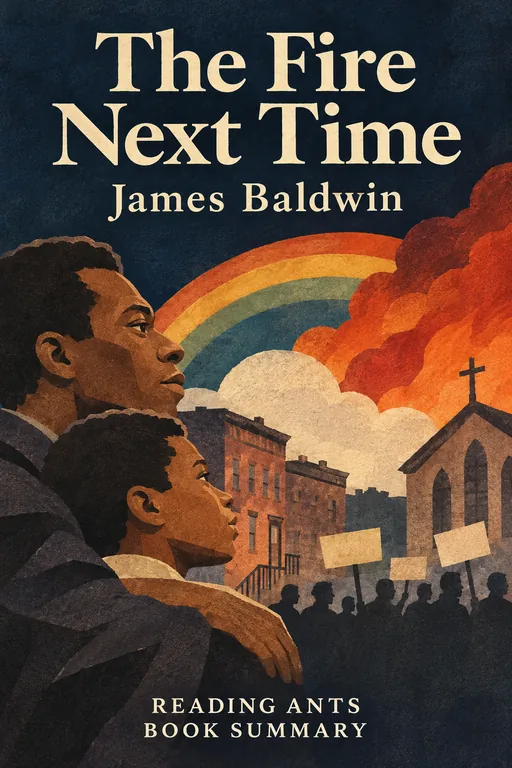
The Fire Next Time
Through a letter to his nephew and a longer essay about religion and race, James Baldwin tells white and Black Americans the truth about racism and urges them to face it with love and courage before it destroys the country.
Overview
The Fire Next Time is a short book of two essays by the American writer James Baldwin, published in 1963, a hundred years after the Emancipation Proclamation. The first essay, “My Dungeon Shook,” is a letter to his fifteen-year-old nephew and namesake, James. The second, longer essay, “Down at the Cross,” tells of Baldwin’s youth in Harlem, his teenage years as a preacher, his loss of faith and his meeting with Elijah Muhammad, leader of the Nation of Islam. The title comes from the African-American spiritual “Got a Home in That Rock” (also known as “God Gave Noah the Rainbow Sign”), whose couplet recalls God’s rainbow promise after the flood and warns that the next time will be fire. The book appeared at the height of the civil rights movement and became a bestseller.
Full Summary
1. A letter to his nephew
The idea: In the first essay, Baldwin writes to his nephew on the centennial of emancipation. He tells him that the country has told Black people that they are inferior, and that this is a lie. He warns that the world will try to make him believe it, and that the danger is to accept it. Baldwin says the boy comes from a line of strong people, and that he must keep both his anger and his love. He adds that the white people who do not know the truth are also trapped, as they are living in ignorance, and that Black people must help them to see.
In real life: Many families still pass down stories and advice to help young people face unfair treatment with their heads high.
2. Growing up in Harlem and the church
The idea: In the second essay, Baldwin recalls growing up in Harlem, where poverty and danger were everywhere, and where he saw friends and neighbors destroyed by drugs, crime and despair. At fourteen, afraid of the streets, he turned to the church and became a young minister in a storefront congregation. He describes the intense emotion and music of the service, but also finds that the church did not live up to its teachings, since it preached love but taught hatred and fear of others.
In real life: Many people look to faith or community for safety when the world around them is hostile.
3. Losing faith and finding words
The idea: As he grows older, Baldwin comes to see that Christianity, as practiced by many white Americans, had been used to justify slavery and segregation, and that the Black church had its own limits. After three years, he leaves the pulpit, deciding that his faith could not hold, and turns to writing. He reflects that being a Black child in America means learning that the world does not value you, and that this leads either to bitterness or to a hard-won understanding.
In real life: Questioning the beliefs we were raised with can be painful, but it can also lead to a more honest way of living.
4. Meeting Elijah Muhammad
The idea: Baldwin describes being invited to dinner at the Chicago home of Elijah Muhammad, the leader of the Nation of Islam. The movement preached that white people were devils and that Black people should separate from them. Baldwin understands why the message appeals to those who have been hurt, but he cannot accept it, because he does not believe that whole groups can be damned by color. He sees in the movement a mirror image of white supremacy.
In real life: Hatred can seem a natural response to injustice, but Baldwin warns that it can make us like the people we oppose.
5. The cost of white innocence
The idea: Baldwin also speaks directly about white Americans. He says that many of them live in a kind of innocence, refusing to face the history of slavery and the present reality of racism, and that this refusal damages them as well as Black people. He argues that the problem is not just personal prejudice but a whole system built on denial. Until Americans can accept their past, he says, they cannot change.
In real life: Learning the full history of one’s country, including painful chapters, is a first step toward fixing present problems.
6. Love and the warning
The idea: Baldwin ends with a call for a kind of love that is not sentimental but tough and honest, the love that insists on seeing and changing. He says that the “relatively conscious” among whites and Blacks must act like lovers, trying to make each other free, and in this way help to end the racial nightmare and change the history of the country. If not, he warns, the consequences could be disastrous, and the fire next time will come.
In real life: Real friendship sometimes means telling a hard truth to someone you care about.
Why It Matters
The Fire Next Time is one of the most celebrated works of American nonfiction. It brought Baldwin to national prominence and made him one of the leading voices of the civil rights era. It was widely read at the time and is again widely read today, especially during moments of public debate about race and policing.
Baldwin’s blend of personal story, religious language and moral argument set a standard for later writers on race in America, including Ta-Nehisi Coates, whose book Between the World and Me was often compared to it.
Key Takeaways
- Truth matters. Baldwin refuses to sugarcoat the reality of racism.
- Racism harms everyone. It damages those who deny it and those who suffer it.
- Hate is a trap. Answering hatred with hatred keeps the cycle going.
- Love can be fierce. It means insisting on honesty and change.
- Face history. A nation must reckon with its past.
What We Can Learn
The book teaches us to listen to personal testimony, which can bring home truths that statistics sometimes cannot. Baldwin’s account of growing up in Harlem helps readers feel what it was like.
It also encourages honest self-examination. His criticisms of the church and of white innocence challenge readers to ask what comforting beliefs they hold that may hide something uncomfortable.
Finally, it shows that anger and love can exist together. Baldwin’s message is not to give up on one’s anger but to direct it toward building something better.
Criticism and Counterpoints
Some critics have argued that Baldwin’s religious framing and his emphasis on love are too idealistic, and that they do not offer concrete political strategies. Others said his portrait of the Nation of Islam was too sympathetic or too dismissive. Some Black writers and activists in the era found his hopeful tone out of step with growing militancy.
Later critics have also noted that the book speaks mainly of the experience of Black men, with less attention to Black women, and that its language about gender and sexuality reflects its time. Despite such points, scholars regard it as a classic work of moral and literary power.
Who Should Read It
This book suits teenagers and adults. It is short but dense, and it deals frankly with racism, religion and violence. It is a good book for discussion with a teacher or parent and for readers interested in American history.
Want the whole book?
A summary is a taste, not the meal. Here is where to find the full book.
You reached the end 🎉
Nicely done. Mark this one as read, and we will suggest what to read next.
Read this next
Between the World and Me
Ta-Nehisi Coates
In a letter to his teenage son, Ta-Nehisi Coates describes what it means to live in a Black body in America, and reflects on fear, history and the struggle to be free.
⚖️ Politics & Society
The Autobiography of Malcolm X
Malcolm X and Alex Haley
Malcolm X tells, with the help of the writer Alex Haley, how he moved from a troubled childhood and a life of crime to leadership in the Nation of Islam, and then to a broader view of race and faith before his death.
👤 Real Lives
Letter from Birmingham Jail
Martin Luther King Jr.
Writing from a jail cell in 1963, Martin Luther King Jr. explains why nonviolent protest against segregation cannot wait, and answers critics who told him to be patient.
⚖️ Politics & Society
I Know Why the Caged Bird Sings
Maya Angelou
Maya Angelou tells of her childhood and youth in the segregated South and in California, a story of pain, silence and discovery in which words and books help her find her voice.
👤 Real Lives
The Prince
Niccolo Machiavelli
A Renaissance diplomat advises rulers to judge their actions by results rather than morality, arguing that a successful leader must sometimes be cunning and ruthless to win and keep power.
⚖️ Politics & Society
The Communist Manifesto
Karl Marx and Friedrich Engels
Marx and Engels declare that all history is the history of class struggle, that capitalism has created a working class that will overthrow it, and that communism will end class divisions.
⚖️ Politics & SocietyWant something different?
Pick another topic and we will show you three books to start with.