 Reading Ants
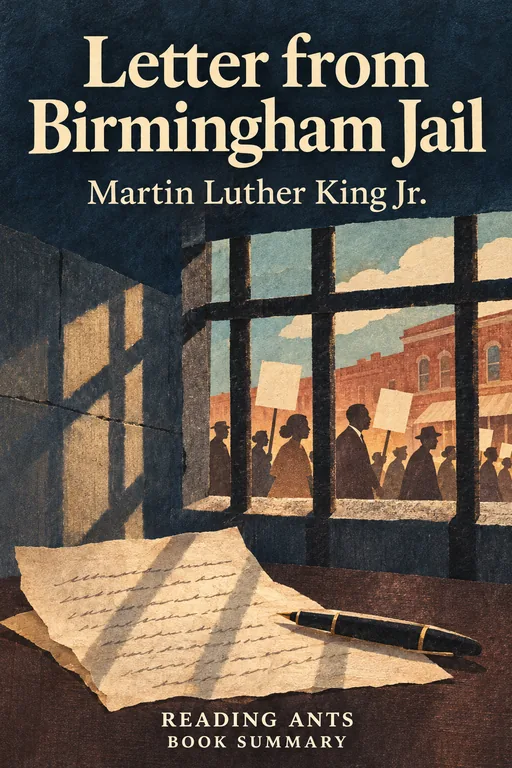
Letter from Birmingham Jail
Writing from a jail cell in 1963, Martin Luther King Jr. explains why nonviolent protest against segregation cannot wait, and answers critics who told him to be patient.
Overview
The Letter from Birmingham Jail is an open letter written by Martin Luther King Jr. on April 16, 1963, after he was arrested in Birmingham, Alabama, for taking part in a nonviolent protest against racial segregation. While he was in jail, he read a statement published in a local newspaper by eight white clergymen, who called his demonstrations “unwise and untimely” and urged Black citizens to wait for the courts and negotiations. King wrote his reply in the margins of the newspaper and on scraps of paper, which were smuggled out and later typed. The letter was published widely and became one of the most important documents of the civil rights movement. It is longer than a typical letter, about twenty pages in a book edition, but it is written in a clear, moving style.
Full Summary
1. Why he is in Birmingham
The idea: King begins by answering the charge that he is an “outsider.” He explains that he is president of the Southern Christian Leadership Conference, which has affiliates in many places, and that he was invited by the local branch to take part in the campaign. He adds that he is in Birmingham because injustice is there, and that anyone who cares about justice cannot be an outsider anywhere in the country. Just as the apostle Paul carried his message far from home, he feels compelled to come.
In real life: Problems in one community often connect to larger issues, and people from elsewhere may have good reasons to help.
2. The four steps of nonviolent action
The idea: King explains how the campaign follows four basic steps: collecting the facts to determine whether injustice exists, negotiation, self-purification and direct action. He says that Birmingham had been thoroughly segregated and had a record of unsolved bombings of Black homes and churches. Attempts to negotiate with city leaders had produced promises that were broken. Therefore, the group decided to use peaceful protest to create a crisis that would force the community to face the issue.
In real life: Protests such as sit-ins and marches aim to draw attention to a problem that people might otherwise avoid.
3. Why waiting is not an answer
The idea: King answers the call to be patient. He says that freedom is never given voluntarily by the oppressor, and that it must be demanded by the oppressed. He points out that “wait” has almost always meant “never” for Black Americans, and that the delay of justice is, in effect, the denial of justice. He describes how the harm of segregation feels, such as having to explain to a young daughter why she cannot go to an amusement park, and the pain of seeing hurt in her eyes.
In real life: Delayed action can have real costs when people’s schooling, safety and dignity are at stake.
4. Just and unjust laws
The idea: King is asked how he can urge people to break some laws and obey others. He answers that there are two types of laws: just and unjust. A just law fits with moral law and the law of God, while an unjust law is out of harmony with it, such as laws that damage human personality. Drawing on thinkers like St. Augustine and St. Thomas Aquinas, he says that an unjust law is no law at all. Anyone who breaks an unjust law should do so openly, lovingly and with willingness to accept the penalty.
In real life: This idea of civil disobedience, openly breaking an unfair rule and accepting the consequences, has been used by many protest movements.
5. Disappointment with moderates and the church
The idea: King expresses disappointment with white moderates, who, he says, are more devoted to order than to justice and who prefer a negative peace, the absence of tension, to a positive peace, the presence of justice. He is also disappointed with white church leaders who stayed silent or told Black people to be patient. He had hoped they would be allies, but many had remained on the sidelines. He questions what kind of God they worship, and says that the real church has always been a force for change.
In real life: Silence in the face of injustice can feel safe but may also support it.
6. Extremism, hope and a closing appeal
The idea: King notes that he was called an extremist and says he was disappointed at first, but then reflected that Jesus, Amos, Lincoln and others were extremists for love and justice. He asks what kind of extremist one will be. He says he hopes that the future will bring understanding and that the South’s real heroes are the courageous people who face jail and abuse for freedom. He ends by asking to be forgiven if he overstated anything and by saying that he hopes to meet his readers as brothers.
In real life: What counts is not whether we are called radical, but whether our cause is just.
Why It Matters
The Letter from Birmingham Jail is considered one of the great texts of American political and moral writing, often taught in schools and universities. It helped win support for the civil rights movement among white moderates and religious leaders, and it was influential in building momentum toward the Civil Rights Act of 1964.
It also became a model for the theory and practice of nonviolent resistance, and inspired activists around the world. Its argument about unjust laws is still cited in debates over protest and civil disobedience. Many schools and churches read it aloud each year around the national holiday honoring King, and teachers often use it to show students how to build a strong, respectful argument.
Key Takeaways
- Injustice anywhere matters. We are connected to those in other places.
- Nonviolent action has steps. It involves facts, negotiation, preparation and protest.
- Waiting can mean denying justice. Delay hurts real people.
- Unjust laws can be resisted. Do it openly and accept the consequences.
- Silence is not neutral. Moderates who do nothing can support the status quo.
What We Can Learn
The letter shows how to disagree with respect. King responds to the clergymen politely, takes their points seriously and answers them with careful arguments, which is a model for debating people with whom we disagree.
It also reminds us that moral courage may require discomfort. Protesting, speaking up or helping others can bring risk, and King’s willingness to go to jail shows how seriously he took his commitments.
Finally, it teaches that justice is not only about laws but also about how we treat people each day, and that we all have a part in building a fairer community.
Criticism and Counterpoints
At the time, many white moderates and some Black leaders thought that King’s methods were too confrontational, or that the courts and negotiations should be given more time. Some later critics say that the letter’s emphasis on white moderates lumps together white people with very different views and actions, or that it presents the issues too simply.
The approach of civil disobedience is also debated, because the claim that people may break laws they consider unjust could be used by anyone, including those with harmful aims. King himself saw limits: he said that the person must act openly, nonviolently and accept the penalty. Historians also note that the letter reflects the language and assumptions of its time.
Who Should Read It
This book suits readers from about age ten and up. It is short for a book, about twenty pages in a typical book edition, and can be read in one sitting, though it has long sentences. It is a good choice for classroom discussion about justice and protest.
Want the whole book?
A summary is a taste, not the meal. Here is where to find the full book.
You reached the end 🎉
Nicely done. Mark this one as read, and we will suggest what to read next.
Read this next
The Fire Next Time
James Baldwin
Through a letter to his nephew and a longer essay about religion and race, James Baldwin tells white and Black Americans the truth about racism and urges them to face it with love and courage before it destroys the country.
⚖️ Politics & Society
The Autobiography of Malcolm X
Malcolm X and Alex Haley
Malcolm X tells, with the help of the writer Alex Haley, how he moved from a troubled childhood and a life of crime to leadership in the Nation of Islam, and then to a broader view of race and faith before his death.
👤 Real Lives
Walden
Henry David Thoreau
Henry David Thoreau describes the two years he spent living simply in a small cabin by Walden Pond in Massachusetts, and argues that people should simplify their lives, spend time in nature and think for themselves.
🕊️ Philosophy & Religion
Long Walk to Freedom
Nelson Mandela
Nelson Mandela tells his own story, from a village childhood to twenty-seven years in prison to becoming South Africa's first democratically elected president, and shows how patience, courage and forgiveness helped end apartheid.
👤 Real Lives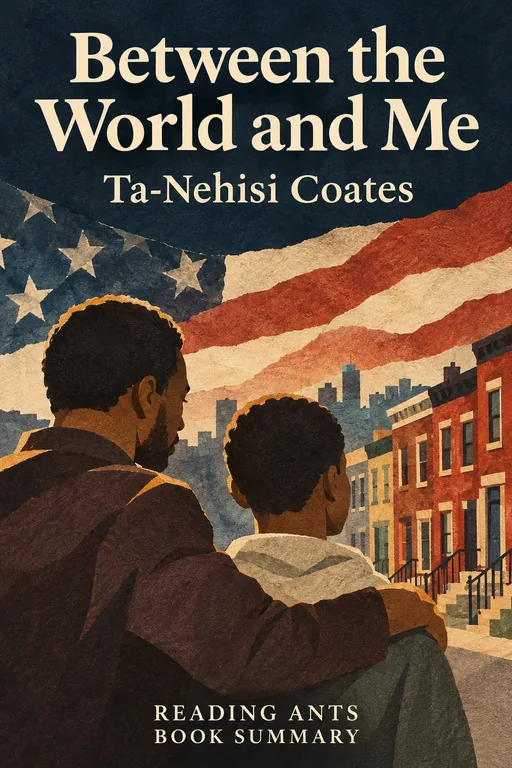
Between the World and Me
Ta-Nehisi Coates
In a letter to his teenage son, Ta-Nehisi Coates describes what it means to live in a Black body in America, and reflects on fear, history and the struggle to be free.
⚖️ Politics & Society
The Prince
Niccolo Machiavelli
A Renaissance diplomat advises rulers to judge their actions by results rather than morality, arguing that a successful leader must sometimes be cunning and ruthless to win and keep power.
⚖️ Politics & SocietyWant something different?
Pick another topic and we will show you three books to start with.