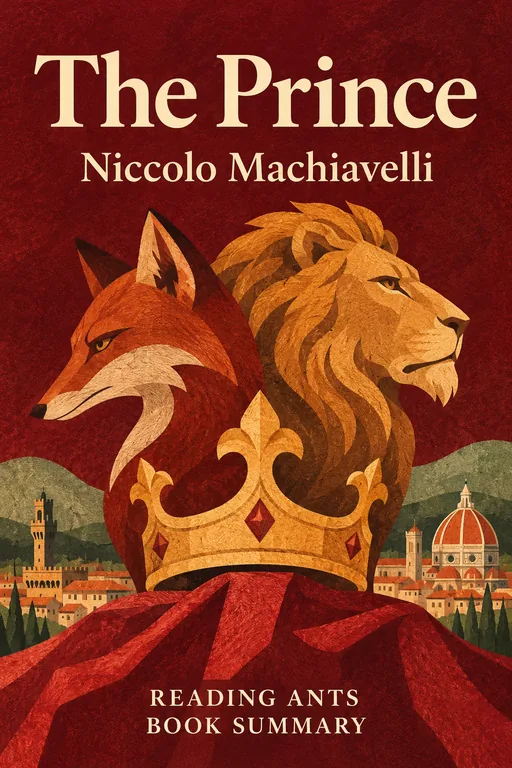
The Prince
Original title: Il principe
A Renaissance diplomat advises rulers to judge their actions by results rather than morality, arguing that a successful leader must sometimes be cunning and ruthless to win and keep power.
Overview
The Prince was written in 1513 by Niccolò Machiavelli, a diplomat and official of the Republic of Florence. When the powerful Medici family returned to rule the city, Machiavelli lost his job, was briefly imprisoned and tortured, and retired to his farm outside Florence. There, hoping to win back favor, he wrote a short handbook for rulers and dedicated it to a member of the Medici family. Unlike earlier books that described how an ideal prince should behave, Machiavelli described how power actually works. The book was published in 1532, after his death, and its shocking frankness made “Machiavellian” a word for cunning and unscrupulous behavior. It is one of the founding works of modern political thought.
Full Summary
1. Different states need different strategies
The idea: Machiavelli begins by sorting states into types: hereditary principalities, which are easy to keep because people are used to the ruling family, and new principalities, which are hard to hold. A ruler who conquers a new territory faces enemies among those he displaced, while his supporters expect rewards he can’t always give. To hold a new land, he advises living there in person or establishing colonies, and either treating the conquered well or crushing them completely, because people take revenge for small injuries but cannot for great ones.
In real life: A new manager who takes over a team inherits old loyalties and resentments. Spending time with the team, rather than ruling from a distance, helps them understand and win people over.
2. Skill matters more than luck
The idea: Machiavelli contrasts rulers who rise through virtù, their own ability, energy and boldness, with those who rise through fortuna, good luck or the help of others. Those who rise by their own ability find it hard to gain power but easy to keep it. Those who rise by luck gain power easily but often lose it, because they have no strong foundations.
From the book: His most famous example is Cesare Borgia, son of Pope Alexander VI, who gained territory thanks to his father’s support. Borgia worked hard to secure his power, for instance by appointing a harsh governor to bring order to a lawless region, then publicly executing that governor to show the people the cruelty wasn’t his own idea. But when his father died suddenly and Borgia himself fell ill, and he then made the mistake of allowing an enemy, Julius II, to be elected pope, his power collapsed.
In real life: Someone who gets a job only because of family connections may struggle to keep it, while someone who earns their position through skill and hard work builds respect that lasts.
3. Cruelty used well or badly
The idea: Machiavelli shockingly argues that cruelty can be “well used” if it is done all at once, out of necessity, to secure the state, and then turned into benefits for the people. Cruelty that continues and increases over time is “badly used” and makes a ruler hated. Benefits, by contrast, should be given little by little, so they are appreciated more.
In real life: Leaders sometimes face unpopular decisions, such as budget cuts. Making necessary changes clearly and at once, then focusing on recovery, often causes less lasting anger than dragging them out bit by bit.
4. Rely on your own army
The idea: A ruler’s power rests on good laws and good arms, and good laws cannot exist without good arms. Machiavelli strongly warns against mercenaries, soldiers who fight only for money, because they are disloyal, cowardly in danger and dangerous in peace. He blames Italy’s weakness on its dependence on hired armies and urges rulers to build forces made up of their own citizens.
In real life: A business that depends entirely on outside contractors for its core work may find them unreliable in a crisis. Building a loyal team of its own makes it stronger.
5. Better to be feared than loved?
The idea: In his most famous chapter, Machiavelli asks whether it is better for a ruler to be loved or feared. Ideally both, he says, but since that is difficult, it is safer to be feared. People are fickle and love can be broken when it is no longer convenient, while fear of punishment holds steady. But a ruler must never be hated. He can avoid hatred by leaving his subjects’ property and families alone.
In real life: A teacher who is only trying to be liked may lose control of a class, while one who is fair but firm earns respect. But a teacher who is cruel or unfair becomes hated, which is worse than either.
6. Be both lion and fox
The idea: Machiavelli argues that a ruler should know how to act like a beast as well as a man. He should be like a fox, to recognize traps, and like a lion, to frighten wolves. A wise ruler need not keep his promises when doing so works against him, because people themselves are not always honest. Above all, he must seem merciful, faithful, humane, honest and religious, even if he sometimes has to act otherwise, because most people judge by appearances and results.
In real life: Politicians are often judged more by their image than their actual policies. Being aware of this helps citizens look past appearances and judge leaders by what they actually do.
7. Fortune and the fate of Italy
The idea: Machiavelli estimates that fortune controls about half of what happens to us, leaving the other half to our own choices. He compares fortune to a violent river: it cannot be stopped when it floods, but wise people build dikes and channels in calm times to limit the damage. He ends with a passionate plea for a strong leader from the Medici family to unite Italy and free it from foreign invaders.
In real life: We can’t prevent every bad event, like illness or a recession, but saving money and building skills in good times are like building dikes. They protect us when trouble comes.
Why It Matters
The Prince is one of the most influential and controversial works of political philosophy ever written. By separating politics from traditional morality and describing how power actually works, Machiavelli is often called the founder of modern political science. The Catholic Church banned the book in the sixteenth century, and his name became a byword for cunning and deceit.
Leaders, revolutionaries and thinkers have studied it for five hundred years. Today it is read in politics, business and leadership courses, and the term “Machiavellian” is even used in psychology to describe a manipulative personality trait. Many scholars note that Machiavelli also wrote Discourses on Livy, a long defense of republics, which suggests his own views were more complex than The Prince alone implies.
Key Takeaways
- Politics has its own rules. Machiavelli judges actions by their results for the state, not by private morality.
- Ability beats luck. Power built on one’s own skill lasts longer than power gained by fortune.
- Fear is safer than love, but hatred is fatal. Firmness keeps order; cruelty without limits destroys a ruler.
- Appearances matter. People judge leaders by how they seem and what they achieve.
- Prepare for fortune. Wise planning in good times limits damage in bad times.
What We Can Learn
Reading The Prince helps us understand how power works, which makes us harder to fool. When leaders talk about high ideals, it is useful to ask what they are actually doing and what they gain from it.
Some of Machiavelli’s advice is practical in everyday life: plan ahead, build your own skills rather than relying on luck, and act decisively when hard decisions are needed. His image of building dikes against fortune is a reminder to prepare for difficult times.
At the same time, the book invites reflection on ethics. Most of us don’t want to live by deception and fear. Thinking about where Machiavelli’s advice is wise and where it is wrong helps us clarify our own values about leadership and fairness.
Criticism and Counterpoints
Critics for centuries have condemned The Prince as a handbook for tyrants that encourages lying, cruelty and manipulation. Others argue that this reading misses the context: Machiavelli was describing the brutal politics of his time, when Italy was divided and repeatedly invaded, not recommending evil for its own sake.
Some scholars even suggest the book may contain irony, or that it was meant to expose how rulers behave. Modern readers may also find its examples, drawn from Renaissance Italy and ancient history, hard to follow without background, and its comparison of fortune to a woman who must be beaten is clearly offensive today.
Who Should Read It
This short book suits teens and adults interested in politics, history, leadership or philosophy. It is best read with some background on Renaissance Italy. Readers looking for inspiring leadership advice may find its cold realism uncomfortable, which is part of its value.
Want the whole book?
A summary is a taste, not the meal. Here is where to find the full book.
You reached the end 🎉
Nicely done. Mark this one as read, and we will suggest what to read next.
Read this next
The Art of War
Sun Tzu
The greatest victory is the one won without fighting, achieved through careful planning, knowing both yourself and your opponent, and using deception, flexibility and timing.
🕊️ Philosophy & Religion
The 48 Laws of Power
Robert Greene
Robert Greene distills lessons from history's courtiers, generals, con artists and rulers into 48 laws about how power is gained and kept, in a book that both guides and warns.
🌱 Self-Improvement
Leviathan
Thomas Hobbes
Thomas Hobbes argues that without a strong government people would live in constant fear and conflict, and that they should therefore agree to give up some of their freedom to a sovereign power that keeps the peace.
🕊️ Philosophy & Religion
The Republic
Plato
Plato, through the character of Socrates, asks what justice is and imagines an ideal city, arguing that a just person and a just state are ruled by wisdom, with reason guiding the whole.
🕊️ Philosophy & Religion
Meditations
Marcus Aurelius
The private notebook of a Roman emperor, reminding himself daily to accept what he cannot control, to act with justice and kindness, and to remember that life is short.
🕊️ Philosophy & Religion
The Communist Manifesto
Karl Marx and Friedrich Engels
Marx and Engels declare that all history is the history of class struggle, that capitalism has created a working class that will overthrow it, and that communism will end class divisions.
⚖️ Politics & SocietyWant something different?
Pick another topic and we will show you three books to start with.