Leviathan
Thomas Hobbes argues that without a strong government people would live in constant fear and conflict, and that they should therefore agree to give up some of their freedom to a sovereign power that keeps the peace.
Overview
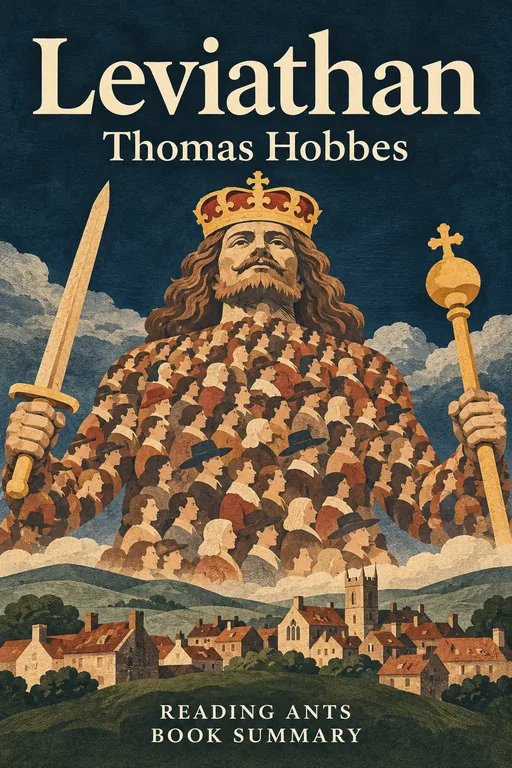
Leviathan was published in 1651 by the English philosopher Thomas Hobbes. He wrote it in exile in France, during the English Civil War, a time when the country was torn by conflict between the king and Parliament, and after the king, Charles I, had been put to death. Hobbes had seen the horrors of civil strife and wanted to find a way to prevent it. The book is a long argument about human nature, the origin of political authority and the duties of rulers and subjects. The title refers to a biblical sea monster, and the cover picture shows a giant king whose body is made of many small people.
Full Summary
1. A materialist view of human nature
The idea: Hobbes begins by describing people as complex machines, moved by appetites and aversions. We seek what we desire and flee what we fear. He says that thought, memory, imagination and reason are results of motion in the body and brain, and that there is no pure free will independent of such causes. People are roughly equal in strength and ability, in that even the weakest can kill the strongest, by cunning or by joining others. This equality leads to competition and distrust.
In real life: When resources are limited and no one is in charge, even friends can end up in competition.
2. The state of nature
The idea: Imagining life without government, which he calls the state of nature, Hobbes says that it would be a war of all against all. There would be no industry, no farming, no arts and no society, because people would live in continual fear and danger of violent death. He gives three causes of conflict: competition, distrust and glory, or the desire for reputation. In such a condition, nothing is unjust, since there is no common power to make and enforce laws.
In real life: A room full of people with no rules and a single prize would soon descend into a struggle.
3. The laws of nature and the social contract
The idea: Reason leads people to seek peace, which Hobbes expresses as laws of nature, such as seeking peace when possible, and being willing to give up some rights when others do the same, and keeping agreements. But words are weak, and promises will not be kept without a power to enforce them. So people covenant with one another to transfer their power to a single person or assembly, called the sovereign, who will protect them. This agreement creates the commonwealth.
In real life: Players in a game agree to follow the rules and to accept a referee, even if sometimes the referee decides against them.
4. The absolute sovereign
The idea: Hobbes argues that the sovereign must have complete authority in order to keep the peace. If the sovereign’s power could be divided or challenged, conflict would return. Subjects must obey in nearly all matters, and cannot rightfully rebel, except when the sovereign threatens their lives, since the purpose of the state is to protect them. The sovereign has the duty to protect the people, to make laws and to provide justice. Hobbes has often been read as supporting absolute monarchy.
In real life: A team captain with clear authority can avoid arguments that tear the team apart.
5. Law, liberty and punishment
The idea: The book discusses how laws are the commands of the sovereign, and that people have liberty where the law is silent. A free person is one who is not hindered from doing what he wants within the limits of the law. Punishment, Hobbes says, is for deterring harm, and not for revenge. He also describes the duties of subjects, including to pay taxes, and the duties of the sovereign to promote the people’s safety and well-being, not only to be obeyed.
In real life: Traffic laws limit what drivers can do, but also make driving safe.
6. Religion and the church
The idea: The later parts of Leviathan are about religion. Hobbes argues that, in a Christian commonwealth, the sovereign must have authority over the church, so that there are not two rival powers. He interprets the Bible to show that Christians should obey their rulers in all matters except those that deny that Jesus is the Christ. His discussion, and his criticism of the claims of the clergy, shocked many, and he was accused of atheism.
In real life: A country with two competing authorities, each claiming the final say, may be at risk of conflict.
Why It Matters
Leviathan is one of the most important works of political philosophy in English. It founded a way of thinking about government that begins with individuals and their interests, and with the idea of a contract, which influenced thinkers such as John Locke and Rousseau, and later liberal and democratic theory, even when they disagreed with his conclusions. Hobbes’s view of the dangers of anarchy and the need for order continues to be used in debates about security, law and the role of the state, for example in discussions about failed states. The book is also a masterpiece of English prose.
Key Takeaways
- Order is a precondition of a good life. Without peace, nothing else can flourish.
- People act from fear and desire. Politics must take human nature into account.
- Authority comes from agreement. The state is created by a contract.
- A strong sovereign prevents conflict. Divided power risks civil war.
- Security is the state’s first duty. Protection of life justifies obedience.
What We Can Learn
Even if you reject Hobbes’s conclusion that the sovereign should be absolute, his argument invites you to think about why we obey rules, and what makes a society peaceful. Notice how fear and distrust can escalate conflicts, and what helps to rebuild trust: clear rules, fair referees, kept promises. Think about the balance between liberty and security, and what you would be willing to give up for safety. And read the arguments of those who disagree, such as Locke and Rousseau, to weigh the answers for yourself.
Criticism and Counterpoints
Many have criticized Hobbes’s pessimistic view of human nature, saying that people are also capable of cooperation, trust and sympathy even without a strong state. His defense of absolute power has been attacked by liberals, who argue that unlimited sovereigns can themselves be the greatest threat to the people. Others note that it is not clear why people would agree to hand so much power to a sovereign, who is not himself bound by the agreement, even though Hobbes allows people to keep the right to resist direct threats to their own lives. Some historians say that his work reflects the fear of civil war of his time. Religious critics were upset by his materialism. Still, his challenge remains important.
Who Should Read It
This book is for readers of philosophy, politics and history who want to read a classic of social contract theory. It is long, and the language of the seventeenth century is demanding, so many people read the first two parts, or a selection. Those who want an easier introduction can start with a summary and then read key chapters.
Want the whole book?
A summary is a taste, not the meal. Here is where to find the full book.
You reached the end 🎉
Nicely done. Mark this one as read, and we will suggest what to read next.
Read this next
The Social Contract
Jean-Jacques Rousseau
Rousseau asks how people can live together under laws and still be free, and argues that legitimate government rests on an agreement in which citizens obey only the "general will" that they make together.
🕊️ Philosophy & Religion
The Prince
Niccolo Machiavelli
A Renaissance diplomat advises rulers to judge their actions by results rather than morality, arguing that a successful leader must sometimes be cunning and ruthless to win and keep power.
⚖️ Politics & Society
The Republic
Plato
Plato, through the character of Socrates, asks what justice is and imagines an ideal city, arguing that a just person and a just state are ruled by wisdom, with reason guiding the whole.
🕊️ Philosophy & Religion
Meditations on First Philosophy
Rene Descartes
Descartes doubts everything that can be doubted, to find a firm foundation for knowledge, and discovers that he exists as a thinking being, from which he tries to rebuild his picture of God, mind and the world.
🕊️ Philosophy & Religion
On Liberty
John Stuart Mill
John Stuart Mill argues that society may limit a person's freedom only to prevent harm to others, and that free thought, free speech and individuality benefit everyone.
🕊️ Philosophy & Religion
The Art of War
Sun Tzu
The greatest victory is the one won without fighting, achieved through careful planning, knowing both yourself and your opponent, and using deception, flexibility and timing.
🕊️ Philosophy & ReligionWant something different?
Pick another topic and we will show you three books to start with.