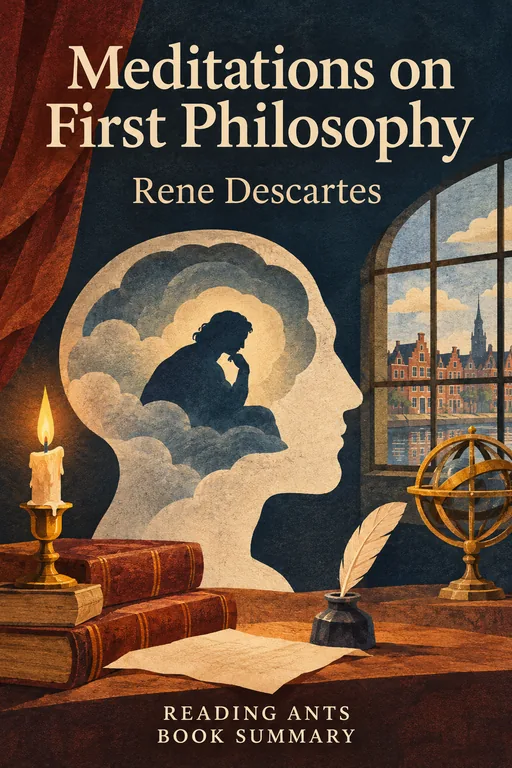
Meditations on First Philosophy
Original title: Meditationes de prima philosophia
Descartes doubts everything that can be doubted, to find a firm foundation for knowledge, and discovers that he exists as a thinking being, from which he tries to rebuild his picture of God, mind and the world.
Overview
Meditations on First Philosophy was published in Latin in 1641 by the French philosopher and mathematician René Descartes, who lived much of his life in the Dutch Republic. The book is written as six meditations, which he imagines being spread over six days, in the first person, so that the reader can follow his thoughts step by step. The work belongs to the beginning of modern philosophy, since it starts from the individual mind and asks what can be known for sure. A set of objections from other thinkers, with Descartes’s replies, was published with it.
Full Summary
1. The method of doubt
The idea: In the first meditation, Descartes decides to clear away all of his former opinions, since many have proved false, and to rebuild knowledge on a firm basis. He will treat as false anything that can be doubted. The senses sometimes deceive us, so they cannot be fully trusted. Even the sense that we are awake might be illusion, since in dreams we have experiences that seem real. He then imagines that a powerful evil being might be deceiving him about everything.
In real life: If you find out that a trusted source was wrong once, you may start to check it more carefully.
2. “I am, I exist”
The idea: In the second meditation, Descartes finds one thing that he cannot doubt: that he exists, since even if he is being deceived, there must be someone who is deceived. The act of thinking proves his existence. This is the famous cogito, often put as “I think, therefore I am.” He then asks what this being is, and concludes that he is a thing that thinks, which doubts, understands, wills and imagines. He is more certain of his mind than of anything physical.
In real life: Even when everything else is uncertain, the fact that you are aware seems undeniable.
3. The wax and the mind
The idea: Still in the second meditation, to show that the mind is better known than the body, Descartes uses the example of a piece of wax. When it is brought near the fire, all of its sensible qualities, such as its smell, color and shape, change, yet we judge that it is still the same wax. This knowledge, he says, comes from understanding by the mind, not from the senses or imagination. So even our knowledge of physical things depends on the mind.
In real life: You recognize a friend after a haircut because you understand who they are, not only how they look.
4. God and truth
The idea: In the third meditation, Descartes argues that he has an idea of a perfect and infinite being, and that this idea could not have come from his own imperfect mind, so God must exist and be its cause. In the fourth meditation he adds that, since God is perfect, God is no deceiver, and so we can trust our clear and distinct perceptions, which are the basis of reliable knowledge.
In real life: If you trust that a good teacher is not trying to trick you, you can rely on what they say.
5. Error and the will
The idea: If God is not a deceiver, why do we make mistakes? Descartes answers that error arises when the will, which is free and unlimited, goes beyond the understanding, which is limited. We err when we affirm what we do not clearly understand. The remedy is to withhold judgment until we see something clearly and distinctly. He thus connects his theory of knowledge with a discipline of thinking. In the fifth meditation he returns to God and offers a second argument: just as the idea of a mountain goes with the idea of a valley, existence cannot be separated from the idea of a perfect being. He also says that the nature of material things, studied in mathematics, can be known clearly.
In real life: Saying “I’m not sure” instead of guessing prevents many errors.
6. Mind, body and the material world
The idea: In the last meditation, Descartes argues that the mind and the body are really distinct: the mind is a thinking, non-extended thing, and the body is extended, non-thinking matter. Yet they are closely united in a person, as sensations of pain and hunger show. He concludes that material things exist, since we have strong inclinations to believe in them, and God would not deceive us. He ends by saying that the doubts of the first days can be set aside, and we can rely on our senses with care.
In real life: You feel pain in your hand as if you were closely joined to your body, yet you also feel that your thoughts are different from your body.
Why It Matters
The Meditations is one of the most influential works in the history of philosophy. Descartes’ starting point, the individual thinking subject, shaped the development of modern thought, and the questions he raised about knowledge, the mind and the relation between mind and body are still debated. His method of systematic doubt has been compared with scientific skepticism. The idea of the cogito has become a symbol of the beginning of modern philosophy. Even those who reject his answers, such as many later philosophers and scientists, acknowledge that they must deal with his questions. The book is a standard text in philosophy courses.
Key Takeaways
- Start with what you cannot doubt. Certainty can be built from a firm base.
- The mind is known first. Awareness is the most certain thing.
- Clear thinking guards against error. Withhold judgment where understanding is lacking.
- Mind and body are distinct. This raises the question of how they interact.
- Doubt can lead to knowledge. Questioning is a method, not an end.
What We Can Learn
You can use Descartes’s method on a small scale: choose a belief, and ask what evidence supports it and whether it could be wrong. Practice withholding judgment until you understand a problem well. Notice the difference between what you perceive and what you infer. And reflect on the puzzle of how the mind and body relate, an issue that connects philosophy to neuroscience and psychology. Be careful, though: doubt is a method for thinking, and does not mean that you should distrust everyone in daily life.
Criticism and Counterpoints
Critics have attacked many aspects of the Meditations. Philosophers have challenged the arguments for God’s existence as circular or invalid, and the so-called Cartesian circle, in which he uses clear and distinct perceptions to prove God, and God to guarantee those perceptions, has been much debated. The claim that mind and body are separate substances leads to the problem of how they could interact. Later thinkers, including empiricists and phenomenologists, questioned the starting point of an isolated mind. Feminist and other critics have argued that the Cartesian split between mind and body devalues the body and emotion.
Who Should Read It
This book is for readers who want to meet one of the founding texts of modern philosophy. It is short and written in a clear, almost conversational style, though the arguments need careful attention. Beginners may like to read it with a guide, and then go on to the objections and replies.
Want the whole book?
A summary is a taste, not the meal. Here is where to find the full book.
You reached the end 🎉
Nicely done. Mark this one as read, and we will suggest what to read next.
Read this next
Critique of Pure Reason
Immanuel Kant
Immanuel Kant argues that our knowledge is shaped by the structures of our own minds, so that we can know the world only as it appears to us, and that reason goes astray when it tries to answer questions beyond possible experience.
🕊️ Philosophy & Religion
Leviathan
Thomas Hobbes
Thomas Hobbes argues that without a strong government people would live in constant fear and conflict, and that they should therefore agree to give up some of their freedom to a sovereign power that keeps the peace.
🕊️ Philosophy & Religion
The Problems of Philosophy
Bertrand Russell
Bertrand Russell gives a short, clear introduction to the big questions of philosophy about reality, knowledge and truth, and argues that the value of philosophy lies in widening our minds, not in giving final answers.
🕊️ Philosophy & Religion
The Republic
Plato
Plato, through the character of Socrates, asks what justice is and imagines an ideal city, arguing that a just person and a just state are ruled by wisdom, with reason guiding the whole.
🕊️ Philosophy & Religion
Apology (The Trial and Death of Socrates)
Plato
Plato's account of the speech that Socrates gave when he was put on trial in Athens in 399 BCE shows a philosopher who refuses to give up questioning, even if it costs him his life.
🕊️ Philosophy & Religion
The Art of War
Sun Tzu
The greatest victory is the one won without fighting, achieved through careful planning, knowing both yourself and your opponent, and using deception, flexibility and timing.
🕊️ Philosophy & ReligionWant something different?
Pick another topic and we will show you three books to start with.