 Reading Ants
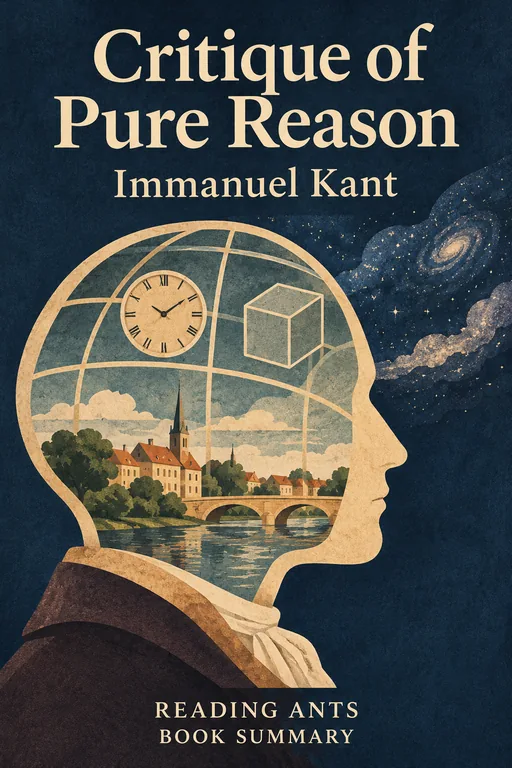
Critique of Pure Reason
Original title: Kritik der reinen Vernunft
Immanuel Kant argues that our knowledge is shaped by the structures of our own minds, so that we can know the world only as it appears to us, and that reason goes astray when it tries to answer questions beyond possible experience.
Overview
Critique of Pure Reason was published in 1781 by Immanuel Kant, a German philosopher who spent nearly all of his life in and around the Prussian city of Königsberg, now Kaliningrad in Russia. A revised second edition appeared in 1787. The book is famous as one of the most important and the most difficult works in the history of philosophy. Kant wanted to resolve a conflict between two schools, rationalists, who held that knowledge comes mainly from reason, and empiricists, who held that it comes from experience. His answer was a new view of how the mind and the world fit together.
Full Summary
1. The question: what can we know?
The idea: Kant begins by noting that reason has been unable to settle questions about God, freedom and the soul, and that philosophy has been a battlefield. He asks whether metaphysics can be a real science, like mathematics and physics. To find out, he proposes to examine reason itself: its sources, its range and its limits. This examination is the meaning of the word “critique.” In a later work, the Prolegomena, he says that he was awakened from a dogmatic sleep by the Scottish thinker David Hume.
In real life: Before trying to win an argument, it can help to ask what kind of evidence could settle it.
2. A priori knowledge and the Copernican turn
The idea: Kant distinguishes knowledge that is independent of experience, called a priori, from knowledge that depends on it. He asks how it is possible to have knowledge that is both informative and necessary, like the truths of arithmetic and the principle that every event has a cause. His solution is a change of perspective, which he compares to that of Copernicus: instead of assuming that our knowledge conforms to objects, suppose that objects conform to the way we are able to know them.
In real life: Kant’s point is not that each person sees the world differently, but that all human experience has the same built-in structure, as every photograph has a frame.
3. Space and time
The idea: In the first major part, Kant argues that space and time are not things that exist independently, nor concepts that we draw from experience, but forms of our intuition, the ways in which our minds organize sensations. Space is the form of our outer experience, and time is the form of our inner experience and so of everything that we can experience, and so geometry and arithmetic apply to the world as we know it. This explains why mathematical truths are necessary and yet apply to experience.
In real life: A camera can only record what fits its frame, and the human mind has a frame that it always uses.
4. The categories of the understanding
The idea: Kant argues that the mind also uses a set of basic concepts, called categories, such as cause and effect, substance and unity, to organize experience into a coherent world. Without these concepts, we would have only a chaos of sensations. We do not learn the categories from experience, but bring them to it. So the order and regularity that we find in nature, such as causation, are in part contributed by our minds.
In real life: When you see a ball roll and hit another, you automatically understand it as cause and effect.
5. Appearances and things in themselves
The idea: A consequence of this view is that we can know things only as they appear to us, in space and time and under the categories, and not as they are in themselves. Kant calls the world as it appears to us the world of phenomena. The idea of things in themselves is closely related to the idea of noumena, objects of pure thought, which he treats as a limiting idea: we can think of them, but cannot know anything about them. This sets limits on knowledge: science can study the world of appearances, but cannot reach beyond.
In real life: A map shows an area as seen from above, but it is not the area itself.
6. The illusions of pure reason
The idea: The last part of the book argues that when reason tries to go beyond the bounds of experience, to answer questions about the universe as a whole, the soul and God, it falls into contradictions and illusions. Kant shows, for example, that one can argue equally well that the world has a beginning in time and that it has none, which he calls an antinomy. He also criticizes the traditional arguments for the existence of God. These questions, he suggests, belong to faith and morality, not to theoretical knowledge.
In real life: Some questions, such as what happened before time, may be beyond the power of any proof.
Why It Matters
Critique of Pure Reason is considered by many to be the most important philosophical work of the modern era. It transformed the debate between rationalism and empiricism, and set the agenda for later philosophy, including German idealism, phenomenology and much of twentieth-century thought. Its central idea, that the mind actively shapes experience, has influenced psychology, science and the study of knowledge. Kant also paved the way for his moral philosophy, in which freedom and duty have a place. Though few philosophers today accept all of his claims, nearly all must respond to him.
Key Takeaways
- The mind shapes experience. We know the world through the structures of our own minds.
- Space, time and causality are conditions of experience. They come from us as well as from the world.
- We know appearances, not things in themselves. There are limits to knowledge.
- Reason can overreach. Speculation beyond experience leads to contradictions.
- Critique is the task of reason. Examining the limits of thought is essential.
What We Can Learn
Kant’s central lesson is humility combined with confidence: we can have reliable knowledge within the world of experience, but we should be careful with claims about ultimate things. When you argue with someone, ask what assumptions each of you brings to the question. Notice how your own mind organizes what you see, and how much of what you take as a fact is shaped by your perspective. Treat difficult philosophical works with patience: it may take several readings and good guides to understand them.
Criticism and Counterpoints
Many readers find the book very hard, due to its dense style and technical terms. Philosophers have raised objections to its main claims: some say that the idea of unknowable things in themselves is incoherent, since we say that they cause our sensations, and cause is a category that applies only within experience. Others argue that developments in physics, such as non-Euclidean geometry and relativity, undermined his view that space and time are fixed forms of intuition. Some say that Kant’s confidence that the mind’s categories are universal overlooks cultural and historical differences. Despite this, the work remains central.
Who Should Read It
This book is for serious readers of philosophy, and for students who want to study one of its landmark works. It is very demanding, and most people benefit from a guide or commentary and from reading it in parts. Those who wish for an easier introduction might begin with a summary or with Kant’s shorter works, and then take on the Critique.
Want the whole book?
A summary is a taste, not the meal. Here is where to find the full book.
You reached the end 🎉
Nicely done. Mark this one as read, and we will suggest what to read next.
Read this next
Meditations on First Philosophy
Rene Descartes
Descartes doubts everything that can be doubted, to find a firm foundation for knowledge, and discovers that he exists as a thinking being, from which he tries to rebuild his picture of God, mind and the world.
🕊️ Philosophy & Religion
The Problems of Philosophy
Bertrand Russell
Bertrand Russell gives a short, clear introduction to the big questions of philosophy about reality, knowledge and truth, and argues that the value of philosophy lies in widening our minds, not in giving final answers.
🕊️ Philosophy & Religion
A History of Western Philosophy
Bertrand Russell
Bertrand Russell traces the story of Western philosophy from the ancient Greeks to the twentieth century, linking each thinker to his social and political world and giving frank, witty opinions about their strengths and weaknesses.
🕊️ Philosophy & Religion
Beyond Good and Evil
Friedrich Nietzsche
Nietzsche challenges the assumptions of earlier philosophers and moralists, argues that our values are shaped by hidden drives and perspectives, and calls for free spirits who dare to question good and evil themselves.
🕊️ Philosophy & Religion
A Theory of Justice
John Rawls
John Rawls argues that the fairest rules for a society are those we would choose without knowing our own place in it: equal basic liberties, and inequalities only when they help the worst off.
🕊️ Philosophy & Religion
The Art of War
Sun Tzu
The greatest victory is the one won without fighting, achieved through careful planning, knowing both yourself and your opponent, and using deception, flexibility and timing.
🕊️ Philosophy & ReligionWant something different?
Pick another topic and we will show you three books to start with.