 Reading Ants
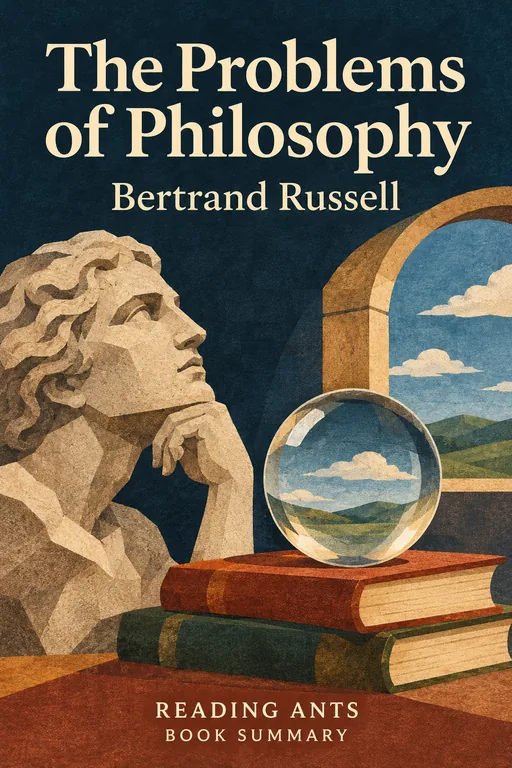
Bertrand Russell gives a short, clear introduction to the big questions of philosophy about reality, knowledge and truth, and argues that the value of philosophy lies in widening our minds, not in giving final answers.
Overview
The Problems of Philosophy was published in 1912 by Bertrand Russell, a British philosopher and mathematician, who later won the Nobel Prize in Literature. He wrote it as a short book for a general audience, and it has remained a popular first book on philosophy. Russell focuses on the theory of knowledge: what can we know, and how do we know it? He discusses the views of earlier philosophers such as Descartes, Berkeley, Hume and Kant, and offers his own judgments. His prose is clear, witty and precise, and the book is short enough to read in a few sittings.
Full Summary
1. Appearance and reality
The idea: Russell starts by asking whether there is any knowledge in the world that is so certain that no reasonable person could doubt it. He considers the table in front of him: its color changes with the light and the angle, and its shape looks different from different positions. What we see are appearances, which are not the same as the real table, if there is one. He distinguishes between sense-data, what we directly experience, such as color and hardness, and the physical object that we believe causes them.
In real life: A coin looks round from above and oval from the side, though we judge it to be round.
2. The existence of matter
The idea: How do we know that there are physical objects at all, and not only our own sensations? Russell says that we cannot prove it, but it is the simplest and most natural hypothesis, since it explains why our sense-data are connected in orderly ways, and why different people have similar experiences. He concludes that, though we cannot be certain, there is good reason to believe in the existence of matter. Later chapters take up the idealists, who think that reality is mental, and he argues against them.
In real life: If a cat seems to appear in different places in the room at different times, it is simplest to think that it is one cat moving, and not many separate cats.
3. Acquaintance and description
The idea: Russell distinguishes two kinds of knowledge of things. Knowledge by acquaintance is direct awareness of something, such as a color or a pain. Knowledge by description is knowledge of something through a description, such as the candidate who will get the most votes in an election, whom we may not yet be able to name. Most of what we know about the world, including physical objects, other people’s minds and much of history, is by description, and depends on building from what we know directly.
In real life: You may know a famous person only through stories and pictures, and not by meeting them.
4. Induction and the problem of the future
The idea: A famous part of the book deals with induction, the reasoning by which we expect that the future will be like the past, such as that the sun will rise tomorrow. Russell notes that this belief cannot be proved by logic, and that to justify it by past experience would be circular. Yet all science and daily life rely on it. He argues that experience can make a prediction probable but never certain, and that we must accept the principle of induction on its own evidence, since without it we would have no reason to expect anything about the future.
In real life: A chicken that has been fed every day may expect to be fed tomorrow, and yet one day it may not be.
5. Truth and knowledge
The idea: In the later chapters, Russell discusses how we can have knowledge that is independent of experience, such as in mathematics, and the nature of universals, such as whiteness or justice, which many things can share. He also examines what we mean by truth, and says that a belief is true if it corresponds to a fact. He explores how we distinguish knowledge from error and from probable opinion, and notes that many of our beliefs are held with different degrees of certainty.
In real life: When you say that it is true that the Earth goes around the Sun, you mean that it is a fact that corresponds to what you say.
6. The value of philosophy
The idea: The last chapter is among the most quoted. Russell asks whether philosophy has any value, since it seems to give so few definite answers. He replies that its value lies in the questions themselves: they enlarge our sense of what is possible, free us from narrow prejudice and habit, and encourage us to see the world and ourselves in a wider context. A mind trained by philosophy, he says, will be more open, more generous and more at peace.
In real life: Learning about a distant country makes your own habits look less like the only way.
Why It Matters
The Problems of Philosophy has been in print for more than a century, and it has introduced countless readers to philosophy. It is praised for its clarity and economy, and for the way that it presents difficult problems without technical jargon. Russell’s treatment of knowledge by acquaintance and by description, and his discussion of induction, influenced later philosophy. The final chapter is often cited as a defense of the study of philosophy as a liberal art. The book is still used in classrooms as a starting point, and as an example of how to write about complex ideas for a general audience.
Key Takeaways
- Appearance is not the same as reality. What we perceive may differ from how things are.
- Much knowledge is indirect. We know most things by description.
- Induction cannot be proved but is reasonable. Science depends on assuming that nature is regular.
- Truth means correspondence. A true belief matches the facts.
- Philosophy broadens the mind. Its value is in the questions and the freedom they give.
What We Can Learn
Russell encourages us to be curious about things we take for granted, and to be willing to think about questions that have no easy answer. When you hold a belief, ask what it rests on, whether directly known or inferred. Be wary of both dogmatism and complete skepticism. Notice how habit and prejudice limit your view, and try to expand it by reading widely. Use philosophy as a way to train your mind, as an athlete trains the body. The book shows that it is a worthwhile adventure.
Criticism and Counterpoints
Some philosophers say that the book is out of date, since it reflects Russell’s views in 1912, which he later revised, and that some of his claims about sense-data and acquaintance are now rejected. Others point out that it covers only epistemology and metaphysics and leaves out ethics and politics. Critics of his treatment of induction say that it does not fully answer the problem. Some find the book too simple, and others still too abstract. As a brief introduction, though, it has few rivals.
Who Should Read It
This book is for beginners in philosophy, students and general readers who like clear writing. It is short and can be read in an afternoon. Those who want a survey of the whole of philosophy, including ethics and politics, may find Russell’s History of Western Philosophy a good next step.
Want the whole book?
A summary is a taste, not the meal. Here is where to find the full book.
You reached the end 🎉
Nicely done. Mark this one as read, and we will suggest what to read next.
Read this next
A History of Western Philosophy
Bertrand Russell
Bertrand Russell traces the story of Western philosophy from the ancient Greeks to the twentieth century, linking each thinker to his social and political world and giving frank, witty opinions about their strengths and weaknesses.
🕊️ Philosophy & Religion
Meditations on First Philosophy
Rene Descartes
Descartes doubts everything that can be doubted, to find a firm foundation for knowledge, and discovers that he exists as a thinking being, from which he tries to rebuild his picture of God, mind and the world.
🕊️ Philosophy & Religion
Critique of Pure Reason
Immanuel Kant
Immanuel Kant argues that our knowledge is shaped by the structures of our own minds, so that we can know the world only as it appears to us, and that reason goes astray when it tries to answer questions beyond possible experience.
🕊️ Philosophy & Religion
Apology (The Trial and Death of Socrates)
Plato
Plato's account of the speech that Socrates gave when he was put on trial in Athens in 399 BCE shows a philosopher who refuses to give up questioning, even if it costs him his life.
🕊️ Philosophy & Religion
Beyond Good and Evil
Friedrich Nietzsche
Nietzsche challenges the assumptions of earlier philosophers and moralists, argues that our values are shaped by hidden drives and perspectives, and calls for free spirits who dare to question good and evil themselves.
🕊️ Philosophy & Religion
The Art of War
Sun Tzu
The greatest victory is the one won without fighting, achieved through careful planning, knowing both yourself and your opponent, and using deception, flexibility and timing.
🕊️ Philosophy & ReligionWant something different?
Pick another topic and we will show you three books to start with.