 Reading Ants
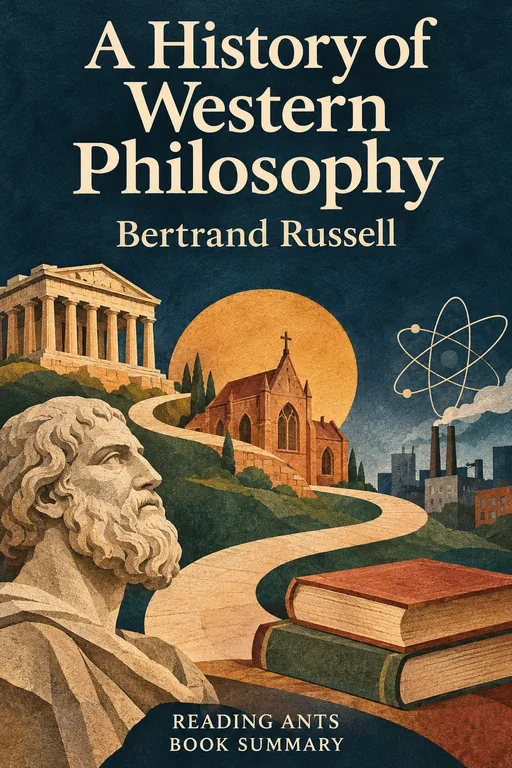
Bertrand Russell traces the story of Western philosophy from the ancient Greeks to the twentieth century, linking each thinker to his social and political world and giving frank, witty opinions about their strengths and weaknesses.
Overview
A History of Western Philosophy was published in 1945 by Bertrand Russell, a British philosopher, mathematician and writer. He began it while living in the United States during the Second World War, where he gave lectures that formed the basis of the book. It is a long work, divided into three parts: Ancient Philosophy, Catholic Philosophy and Modern Philosophy. Russell does not treat philosophy as a closed discipline, but shows how ideas grow out of the conditions of their time, and how they influence society. It became a bestseller, and he said that the book helped to support him financially.
Full Summary
1. The Greeks and the birth of Western philosophy
The idea: Russell opens with the question of why philosophy began in Greece in the sixth century BCE. He describes the early thinkers, such as Thales, who proposed that all is water, and Pythagoras, who combined mathematics and mysticism. He gives space to Socrates, Plato and Aristotle. Russell appreciates Plato’s imagination, but is critical of his authoritarian politics, and sees Aristotle as brilliant but, in some respects, a block to later science.
In real life: The habit of asking “what is everything made of?” was a bold step into thinking in a new way.
2. After Aristotle: Stoics, Epicureans and Rome
The idea: The next chapters describe how, after the fall of the independent Greek city-states, philosophy turned toward personal conduct. Russell discusses the Stoics, who taught acceptance of fate, the Epicureans, who sought peace of mind, and the skeptics. He explains how Rome, which was more interested in law and organization than speculation, adopted these ideas. He ends with Plotinus, who combined Plato’s thought with mysticism, and prepared the way for Christian philosophy.
In real life: In unstable times, people often seek inner calm.
3. The Church and the Middle Ages
The idea: In the second part, Russell describes the rise of Christianity and the thought of figures such as Augustine and, later, Thomas Aquinas. He shows how the Church preserved learning during a time of political collapse, and how medieval philosophers worked within the limits of faith. He admires some of the achievements, but suggests that theology limited free inquiry. He also discusses the Franciscans and the role of Arab scholars who preserved Greek writings.
In real life: A strong institution can protect knowledge and also restrict what questions can be asked.
4. The Renaissance, science and the rise of the individual
The idea: The third part starts with the revival of learning in the Renaissance, and the scientific revolution of Copernicus, Kepler, Galileo and Newton, which changed the way people saw the world. Russell stresses the importance of scientific method, and the growth of individualism. He then discusses Descartes, whom he calls the founder of modern philosophy, and the English empiricists Locke, Berkeley and Hume, who tried to ground knowledge in experience.
In real life: Learning to test ideas by experiment changed human understanding.
5. Kant, Hegel, the Romantics and Marx
The idea: Russell gives an account of the German philosophers Kant and Hegel, with much more skepticism toward the latter, whom he considers confused and dangerous. He describes the Romantic movement and its effect on politics, with separate chapters on Rousseau and on Byron, and the thinkers of the nineteenth century, including Bentham, Marx and Nietzsche. He is critical of tendencies that glorify the state or irrational feelings, and writes with irony.
In real life: Ideas that sound beautiful in theory can be harmful when applied in politics.
6. The twentieth century and the case for clear thinking
The idea: The final chapters cover the thinkers of Russell’s own age, including Bergson, William James and John Dewey, and his own school of logical analysis. He argues that philosophy should be allied with science, and should aim to clarify, not to console. He closes by saying that the habit of careful, impartial truthfulness that this method teaches could lessen fanaticism and increase sympathy and mutual understanding. For Russell, the value of the history of philosophy is that it teaches us to see our own beliefs in a wider context.
In real life: Reading about how thinkers disagreed in the past may make you more open about your own certainties.
Why It Matters
Russell’s History of Western Philosophy is one of the most widely read general histories of philosophy, and has introduced several generations of readers to the subject. Its strengths are the author’s clear and lively prose, his sense of humor and his effort to place ideas in their social setting. Russell was awarded the Nobel Prize in Literature in 1950, and though it was not given for this book alone, it was cited as an example of his style. The book is not neutral, and its sharp opinions have provoked debate, but they also make it enjoyable. It remains a good companion for those who want a story of the major ideas.
Key Takeaways
- Philosophy grows from its times. Ideas reflect social and political conditions.
- Thinkers answer one another. Philosophy is a long conversation.
- Science changed thought. The scientific method transformed understanding.
- Clarity is a virtue. Russell values plain and precise thinking.
- Beware of dogma. Skepticism and tolerance are important.
What We Can Learn
The book invites you to read about the history of ideas, and to ask how what people believed was connected to the world around them. It encourages you to be skeptical about grand claims, and to prefer clear, evidence-based reasoning. You can use it to find thinkers who interest you and then read their own works. It also shows how humor and plain language can make hard subjects accessible. Remember that this is one person’s opinionated tour, and compare it with other histories.
Criticism and Counterpoints
Scholars say that Russell’s treatment is often unfair or uneven, since he dismisses or misunderstands some thinkers, such as Hegel, and leaves out whole areas, including non-Western philosophy and, among modern thinkers, Heidegger. His personal and political views, including his dislike of religion and of certain forms of idealism, color his judgment. The historian of philosophy Frederick Copleston called it lively but said that its treatment of several philosophers was inadequate and misleading. As a result, it is best used as an enjoyable and stimulating introduction, not as a reliable authority.
Who Should Read It
This book is for readers who want an engaging overview of philosophy’s story, from the Greeks to the modern age. It is long, but can be read in sections and has a gripping style. Those who want a neutral reference should consult an encyclopedia, and those who want to study particular philosophers should read their works directly.
Want the whole book?
A summary is a taste, not the meal. Here is where to find the full book.
You reached the end 🎉
Nicely done. Mark this one as read, and we will suggest what to read next.
Read this next
The Problems of Philosophy
Bertrand Russell
Bertrand Russell gives a short, clear introduction to the big questions of philosophy about reality, knowledge and truth, and argues that the value of philosophy lies in widening our minds, not in giving final answers.
🕊️ Philosophy & Religion
Critique of Pure Reason
Immanuel Kant
Immanuel Kant argues that our knowledge is shaped by the structures of our own minds, so that we can know the world only as it appears to us, and that reason goes astray when it tries to answer questions beyond possible experience.
🕊️ Philosophy & Religion
Meditations on First Philosophy
Rene Descartes
Descartes doubts everything that can be doubted, to find a firm foundation for knowledge, and discovers that he exists as a thinking being, from which he tries to rebuild his picture of God, mind and the world.
🕊️ Philosophy & Religion
Beyond Good and Evil
Friedrich Nietzsche
Nietzsche challenges the assumptions of earlier philosophers and moralists, argues that our values are shaped by hidden drives and perspectives, and calls for free spirits who dare to question good and evil themselves.
🕊️ Philosophy & Religion
The Story of Philosophy
Will Durant
Will Durant introduces the major Western philosophers through lively biographies, showing how each thinker's life and times shaped ideas that are still worth asking about.
🕊️ Philosophy & Religion
The Art of War
Sun Tzu
The greatest victory is the one won without fighting, achieved through careful planning, knowing both yourself and your opponent, and using deception, flexibility and timing.
🕊️ Philosophy & ReligionWant something different?
Pick another topic and we will show you three books to start with.