 Reading Ants
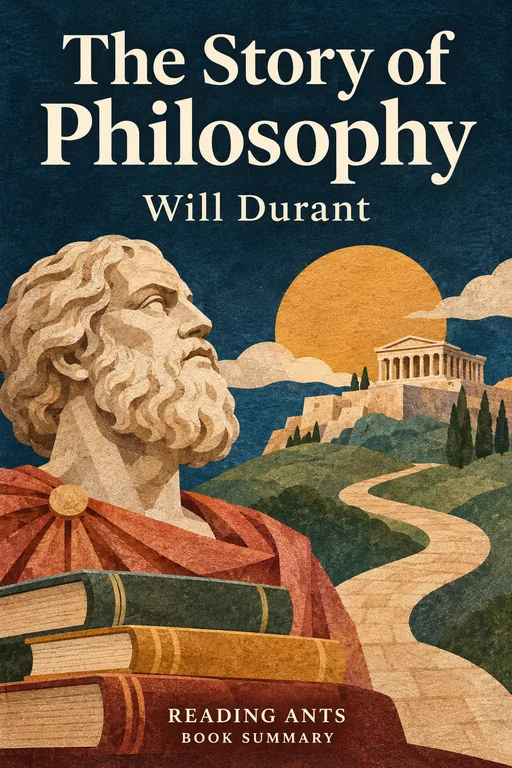
Will Durant introduces the major Western philosophers through lively biographies, showing how each thinker's life and times shaped ideas that are still worth asking about.
Overview
The Story of Philosophy was written by the American historian and writer Will Durant and published in 1926. It began as a series of small booklets written for a working-class readership and grew into one of the best-selling philosophy books of the twentieth century. Durant believed that philosophy was not a dry subject for specialists but a way to understand life, and he told it through the stories of great thinkers, from Plato and Aristotle to Nietzsche, and on to modern thinkers including Santayana, Bergson, Croce, Russell, William James and John Dewey. Each chapter combines a short biography with a readable summary of the person’s main ideas, and it asks what we can learn from them.
Full Summary
1. Plato and Aristotle: Reason and the good life
The idea: Durant begins with the Greeks. Plato, a student of Socrates, argued that true knowledge lies in unchanging ideas, or Forms, and that a just society should be ruled by the wise, as described in The Republic. Aristotle, Plato’s student, was more down to earth: he studied nature, logic and ethics, and taught that happiness comes from using our reason to live a balanced life of virtue. Durant presents Aristotle as the great organizer of knowledge, who influenced thought for centuries.
In real life: The difference between Plato and Aristotle still appears when people argue about whether ideals or experience should guide us.
2. Bacon, Spinoza and Voltaire: Science, reason and tolerance
The idea: Francis Bacon, in the English Renaissance, argued that knowledge should be built through careful observation and experiment, laying the groundwork for modern science. Baruch Spinoza, a Dutch Jewish philosopher expelled from his community, taught that God and nature are one and that freedom comes from understanding necessity and controlling our emotions through reason. Voltaire, the witty French writer, used satire to fight intolerance and superstition and to promote free speech and reason.
In real life: Bacon’s idea of testing beliefs against evidence is the basis of science classes today.
3. Kant and Schopenhauer: The limits of knowledge and the will
The idea: Immanuel Kant argued that our minds shape the world we experience, so we can know things only as they appear to us, not as they are in themselves. He also taught that morality rests on duty and rational principles that we should be willing to apply to everyone. Arthur Schopenhauer, who admired Kant but had a gloomier view, claimed that the world is driven by a blind will that causes endless striving and suffering, and that relief comes through art, compassion and denial of the will.
In real life: Kant’s idea that we should act only on rules we would accept everywhere underlies many debates about fairness.
4. Spencer and Nietzsche: Evolution and the will to power
The idea: Herbert Spencer applied the idea of evolution to society, thinking that progress comes through competition and adaptation, and so influencing the “survival of the fittest” way of thinking. Friedrich Nietzsche attacked traditional morality and religion, which he thought encouraged weakness, and called for individuals to create their own values and become stronger. Durant is fascinated by Nietzsche’s passion and style, though he treats the ideas with some caution.
In real life: Arguments about whether people should compete or cooperate often echo the contrast between Spencer and others.
5. The lives behind the ideas
The idea: A distinctive feature of the book is that it presents each philosopher as a living person. Durant describes Bacon’s rise and fall in politics, Spinoza’s quiet life of grinding lenses, Voltaire’s exile and sharp tongue, Kant’s strict daily routine and Nietzsche’s loneliness and illness. The point is that philosophies are not abstract machines but responses to real struggles, and that understanding the person helps understand the idea.
In real life: Learning about the hardships a writer lived through often makes their ideas feel more urgent and concrete.
6. Why philosophy still matters
The idea: Durant argues throughout that philosophy is about seeking wisdom, which means seeing life as a whole and asking about the purpose of our actions. Science, he says, deals with what we can measure, while philosophy considers what we should aim for. He compares science to the soldiers who take the territory and philosophy to the explorers who seek new ground to be taken over. In the later chapters, he turns to modern thinkers and expresses hope that philosophy can help guide a changing world.
In real life: Questions about what is a good life or a fair society cannot be answered by data alone, and that is where philosophy comes in.
Why It Matters
The Story of Philosophy helped bring philosophy to a wide public at a time when it was largely confined to universities. It sold millions of copies and was translated into many languages, and Durant went on to write the huge series The Story of Civilization with his wife Ariel, one volume of which, Rousseau and Revolution, won a Pulitzer Prize.
The book proved that serious ideas could be presented in a clear, engaging style. It remains a popular first step for readers who want a guided tour of the main figures of Western philosophy, and it inspired many later introductions.
Key Takeaways
- Philosophy comes from life. Each thinker’s ideas grew out of their own struggles.
- Different answers to big questions. Plato, Aristotle, Kant and Nietzsche disagree.
- Reason and evidence matter. Bacon and Spinoza show the value of careful thought.
- Philosophy asks what is worthwhile. Science alone cannot decide our goals.
- Stories help understanding. Biographies make ideas easier to remember.
What We Can Learn
The book shows that great ideas are often the result of ordinary human difficulties, such as illness, exile or loneliness. This can encourage us to think of our own problems as possible starting points for thought.
It also teaches us to compare views. By reading different philosophers side by side, we see that smart people can disagree, and we can practice weighing arguments instead of simply picking a side.
Finally, it encourages curiosity about questions we usually ignore, such as what makes a life good or what we owe to others. Spending time on such questions can sharpen our judgment.
Criticism and Counterpoints
Professional philosophers have often criticized the book for oversimplifying and for choosing only a handful of European men, leaving out women, non-Western traditions and many important figures. Some of its judgments, for example about particular thinkers, reflect Durant’s own tastes and the views of his time, and some details are outdated.
Others point out that it gives more attention to biography and style than to detailed arguments, so readers may get a general impression rather than a firm grasp of the ideas. For a fuller picture, readers can pair it with other introductions. Still, as a friendly gateway, it has been widely appreciated.
Who Should Read It
This book suits teenagers and adults who are new to philosophy. It is long but easy to follow, and each chapter can be read on its own. Readers who want broader coverage will want to follow it with books on non-Western and modern philosophy.
Want the whole book?
A summary is a taste, not the meal. Here is where to find the full book.
You reached the end 🎉
Nicely done. Mark this one as read, and we will suggest what to read next.
Read this next
The Republic
Plato
Plato, through the character of Socrates, asks what justice is and imagines an ideal city, arguing that a just person and a just state are ruled by wisdom, with reason guiding the whole.
🕊️ Philosophy & Religion
Nicomachean Ethics
Aristotle
Aristotle argues that the best human life is one of flourishing, achieved by building good character through habit, finding the balance between extremes, using practical wisdom and cultivating friendship.
🕊️ Philosophy & Religion
Sophie's World
Jostein Gaarder
A fourteen-year-old girl receives mysterious letters from a philosopher, and learns the history of Western thought while she begins to suspect that her own world is not what it seems.
🌍 World Literature
A History of Western Philosophy
Bertrand Russell
Bertrand Russell traces the story of Western philosophy from the ancient Greeks to the twentieth century, linking each thinker to his social and political world and giving frank, witty opinions about their strengths and weaknesses.
🕊️ Philosophy & Religion
Thus Spoke Zarathustra
Friedrich Nietzsche
In poetic speeches given by a wandering prophet named Zarathustra, Nietzsche announces the death of the old religious worldview and urges humans to create new values and overcome themselves.
🕊️ Philosophy & Religion
The Art of War
Sun Tzu
The greatest victory is the one won without fighting, achieved through careful planning, knowing both yourself and your opponent, and using deception, flexibility and timing.
🕊️ Philosophy & ReligionWant something different?
Pick another topic and we will show you three books to start with.