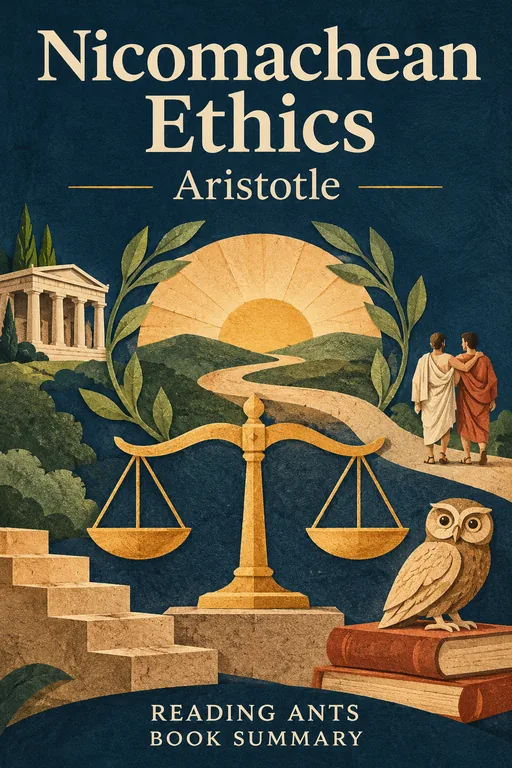
Nicomachean Ethics
Original title: Ηθικά Νικομάχεια
Aristotle argues that the best human life is one of flourishing, achieved by building good character through habit, finding the balance between extremes, using practical wisdom and cultivating friendship.
Overview
Nicomachean Ethics is a work by the Greek philosopher Aristotle, written in the fourth century BC, probably from lecture notes connected with his school in Athens, the Lyceum, which he founded around 335 BC. The title is usually thought to come from his son, Nicomachus, who may have edited it. It has ten books and asks a simple question: what is the good life, and how do we live it? Unlike his teacher Plato, who looked to eternal Forms, Aristotle starts from ordinary human experience. His answer is that happiness, or eudaimonia, means flourishing, and that it comes from acting in accordance with virtue over a whole lifetime.
Full Summary
1. The goal of human life
The idea: Aristotle begins by noting that every action aims at some good, and that these goods are arranged in a chain: we do some things for the sake of others. There must be a highest good that we want for its own sake, and nearly everyone calls it eudaimonia, often translated as happiness or flourishing. To find what it is, he asks about the human function: just as a good flute-player plays well, a good human uses reason well. So the good life is a life of activity of the soul in accordance with virtue, lasting a complete life.
In real life: Rather than asking “What will make me feel good now?”, Aristotle asks, “What kind of life is worth living?”
2. Virtue comes from habit
The idea: Virtues of character, such as courage and generosity, are not given by nature or learned only by lessons; they are formed by habit. We become just by doing just acts, and brave by doing brave acts. Because of this, upbringing matters a great deal, and the right habits formed early can make a lasting difference. He adds that real virtue involves finding pleasure in doing the right thing, not only doing it with effort.
In real life: A person who practices honesty in small matters will find it easier to be honest in a hard situation.
3. The doctrine of the mean
The idea: A key idea is that virtue is a mean between two extremes, an excess and a deficiency. Courage lies between cowardice and recklessness, generosity between stinginess and wastefulness, and good temper between irritability and apathy. The mean is not a fixed middle point but depends on the person and the situation, and finding it takes judgment. Aristotle admits that not every action or feeling has a mean; some, such as murder, are always wrong.
In real life: Eating is good, but eating too little or too much harms you, and the right amount differs for each person.
4. Choice, responsibility and the many virtues
The idea: Aristotle discusses when actions are voluntary and when we can be praised or blamed: we are responsible for what we do knowingly and by choice, and not for what is forced or done in genuine ignorance, though ignorance caused by carelessness or drunkenness can still be blamed. He then examines specific virtues, such as courage, temperance, generosity, magnificence, proper pride, good temper, truthfulness, wit and friendliness, and justice, which he treats at length, distinguishing fairness in sharing goods and in correcting wrongs.
In real life: We forgive someone who acts under real compulsion differently from someone who acts out of carelessness.
5. Intellectual virtue and practical wisdom
The idea: Besides virtues of character, there are virtues of thought. The most important for action is practical wisdom (phronesis), the ability to see what to do in a particular situation, in a way that is guided by good values. Without practical wisdom, a person with good intentions may still act badly; without good character, cleverness is merely cunning. Aristotle also discusses scientific knowledge, craft and philosophical wisdom.
In real life: Knowing that honesty is good doesn’t tell you how to deliver bad news kindly, and that skill is practical wisdom.
6. Self-control, pleasure and friendship
The idea: The book discusses weakness of will, where someone knows what is right but does not do it, and the nature of pleasure, which he sees as completing an activity. He then devotes two books to friendship, which he calls necessary for a good life. He distinguishes friendships based on usefulness, on pleasure and on shared goodness, and he argues that the last is the deepest and most lasting. Friends help us become better and share our lives.
In real life: A friend who tells us the truth helps us grow, while a friend only for convenience may fade when it’s no longer useful.
7. Contemplation and the highest life
The idea: In the final book, Aristotle returns to happiness. He argues that the highest form is contemplation, the activity of reason in seeking truth, since it is the best part of us and the most self-sufficient and enduring. The life of moral virtue is happy in a secondary way. He ends by saying that ethics must lead to action and so to good laws and communities, which leads on to his Politics.
In real life: People often find deep satisfaction in absorbing, thoughtful work or study that they care about for its own sake.
Why It Matters
Nicomachean Ethics is one of the founding works of Western moral philosophy. Its emphasis on character, habit and flourishing created the tradition known as virtue ethics, which has had a revival in modern philosophy and which stands alongside the other main approaches, which focus on rules or on consequences. Medieval thinkers, including Thomas Aquinas and Islamic and Jewish philosophers, built on it.
Its practical advice about habit, friendship and balance continues to be influential in education, psychology and everyday thinking about how to live. Modern research on character strengths and well-being often echoes it, and many teachers still use its ideas when they talk with students about what kind of person they want to become.
Key Takeaways
- Aim at flourishing. The goal is a good life as a whole.
- Character grows through habit. Practice shapes who we become.
- Seek the mean. Virtue lies between extremes.
- Practical wisdom is vital. Good judgment guides action.
- Friendship matters. A good life needs good friends who help us improve.
What We Can Learn
The book shows that being good is a matter of practice, not just of knowing. If we want to become more patient or generous, we need to act in those ways repeatedly until they become natural.
It also encourages balance. Many of our troubles come from going too far in one direction, such as working too much or too little, and thinking about the mean helps us adjust.
Finally, it reminds us of the importance of friendship and good communities. Aristotle thought that no one could be truly happy alone, and modern research on well-being often agrees.
Criticism and Counterpoints
Critics point out that the mean is vague, since it does not tell us exactly what to do in a given case, and that the book’s view of virtue depends on the values of a particular society. Aristotle’s views on women, slaves and foreigners, which treat them as inferior, are rejected by modern readers.
Some argue that his emphasis on the contemplative life seems at odds with his stress on practical virtue, and scholars have long debated how the two fit together. The text is also compressed and sometimes unclear, since it likely derives from lecture notes. Even so, its core ideas remain a rich resource.
Who Should Read It
This book suits older teenagers and adults who like philosophy or want to think about character and happiness. The text is dense, so a good translation with notes or a study guide is helpful. Some sections, such as those on friendship, are easy to enjoy on their own.
Want the whole book?
A summary is a taste, not the meal. Here is where to find the full book.
You reached the end 🎉
Nicely done. Mark this one as read, and we will suggest what to read next.
Read this next
The Republic
Plato
Plato, through the character of Socrates, asks what justice is and imagines an ideal city, arguing that a just person and a just state are ruled by wisdom, with reason guiding the whole.
🕊️ Philosophy & Religion
Meditations
Marcus Aurelius
The private notebook of a Roman emperor, reminding himself daily to accept what he cannot control, to act with justice and kindness, and to remember that life is short.
🕊️ Philosophy & Religion
Letters from a Stoic
Seneca
In friendly letters to a younger friend, the Roman Stoic Seneca offers practical advice on how to use time well, face death, handle wealth and misfortune, and train the mind to find peace.
🕊️ Philosophy & Religion
The Art of Happiness
Dalai Lama and Howard C. Cutler
In conversations with the American psychiatrist Howard Cutler, the Dalai Lama explains that happiness is the purpose of life, and that it can be trained through compassion, a calm mind and a change in the way we think about suffering and others.
🌱 Self-Improvement
The Art of War
Sun Tzu
The greatest victory is the one won without fighting, achieved through careful planning, knowing both yourself and your opponent, and using deception, flexibility and timing.
🕊️ Philosophy & Religion
Tao Te Ching
Laozi
The deepest wisdom is to live in harmony with the Tao, the natural way of the universe, by being humble, gentle and simple, and by acting without force.
🕊️ Philosophy & ReligionWant something different?
Pick another topic and we will show you three books to start with.