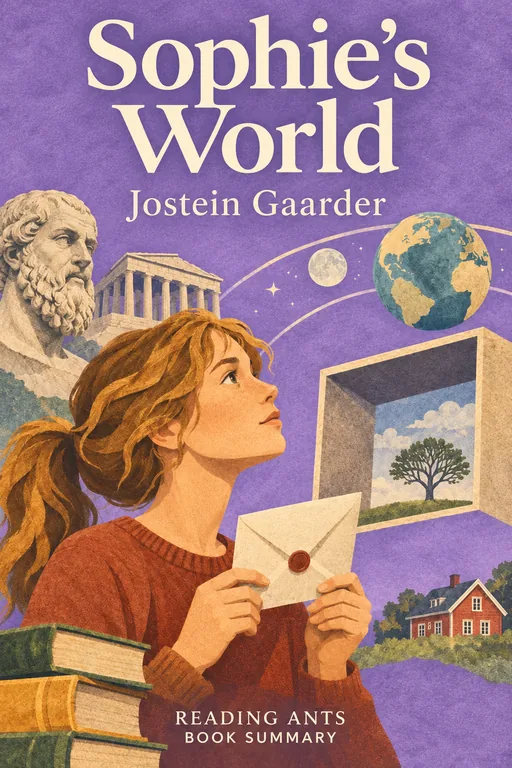
Sophie's World
Original title: Sofies verden
A fourteen-year-old girl receives mysterious letters from a philosopher, and learns the history of Western thought while she begins to suspect that her own world is not what it seems.
Overview
Sophie’s World is a novel by the Norwegian writer Jostein Gaarder, published in 1991. It combines a mystery story with a lively history of philosophy, from the ancient Greeks to modern times. It is set in Norway at about the time it was written, and it was an international bestseller, translated into dozens of languages. It tells the story of Sophie Amundsen, who is given a set of philosophical lessons by a mysterious teacher. The book asks big questions, such as “Who are you?” and “Where does the world come from?”
Main Characters
- Sophie Amundsen: a bright, curious fourteen-year-old girl.
- Alberto Knox: a mysterious philosopher who becomes Sophie’s teacher.
- Hilde Moller Knag: a girl who turns fifteen, and who is connected to Sophie in a surprising way.
- Hilde’s father, Albert Knag: a Norwegian major who is serving abroad.
- Sophie’s mother: a practical woman who does not know what Sophie is doing.
Full Summary
Who Are You?
Sophie returns from school one day to find an unsigned note in her mailbox with a single question: “Who are you?” Soon after, another one arrives: “Where does the world come from?” Sophie, who has never thought about such questions before, is intrigued. She also finds a postcard addressed to someone called Hilde, which seems to be sent to her by mistake.
Soon, she receives a thick envelope containing the first lesson of a course on philosophy. The sender is a mysterious teacher, who sends her new lessons on a regular basis.
The Early Philosophers
The lessons begin with the myths of the ancient world, and then the first Greek philosophers, who tried to explain nature without gods. Sophie learns about thinkers such as Thales, who thought that water was the basic substance, and Democritus, who imagined that the world was made of tiny particles, and about Socrates, who taught by asking questions.
Then comes Plato, who believed in a world of perfect ideas behind the things we see, and Aristotle, who focused on the natural world and on logic. Sophie meets her teacher, Alberto Knox, in person, and they discuss the lessons.
From Faith to Reason
The course continues through the Middle Ages, when thinkers tried to combine Greek philosophy with Christianity, and then the Renaissance, when people took a new interest in humanity and science. Sophie learns about Descartes, who tried to doubt everything to find something certain, and about Spinoza, Locke, Berkeley and Hume, who asked what we can really know.
Meanwhile, strange things happen. Sophie receives more postcards for Hilde, and she begins to suspect that someone is watching her. A dog called Hermes, who seems to belong to Alberto, brings her letters, and a mirror in Alberto’s house seems to send a message. Her mother grows worried because Sophie spends so much time on her own and does not explain where she goes.
Sophie finds that her lessons give her a new way of looking at everyday things, such as the garden, the cat and the people she meets. She starts to ask questions at school, and she surprises her teachers.
The Modern Age
Alberto teaches Sophie about Kant, who said that our minds shape how we see the world, and about Romanticism and Hegel, who saw history as a process. They also discuss Kierkegaard, Marx, Darwin, Freud and Sartre, who each asked how people should live.
Sophie discovers that she and Alberto are characters in a book written by Hilde’s father, Major Albert Knag, as a birthday present for his daughter. Their whole world is a story, controlled by the major.
The Escape
Alberto and Sophie decide to escape from the book. They plan to move out of the major’s control, by acting in ways he did not plan, and by hiding from his gaze. They stage Sophie’s fifteenth-birthday party in the garden, which turns into a chaotic scene, and, in the confusion, they disappear from the pages of the book. Sophie’s mother and her friends seem unable to see what is happening.
Meanwhile, Hilde has been reading the book on her birthday, and she is moved and a little disturbed by what she finds. She understands that her father has written the story to teach her about the world, but she also feels that Sophie has become a real person.
Hilde then plans a playful revenge on her father, who is returning home from his posting in Lebanon. At the end of the novel, the two are free, and walk around in the real world unseen, as ghostly figures, watching Hilde and her father.
Why It Matters
Sophie’s World was reported to be the best-selling book in the world in 1995, and it is credited with introducing millions of young readers to philosophy. It made the history of ideas clear and fun, using a story to make abstract thinking human. It also showed that serious subjects can be made lively for a wide audience. The book has been adapted into a game and a film, and it is often used in schools to start a discussion about big questions. Many readers say that it was the first time they thought about such matters.
Key Takeaways
- Wonder is the start of philosophy. Asking simple questions can lead far.
- Ideas have a history. Each philosopher built on or reacted to others.
- We can question what we assume. The book teaches us to look at the world with fresh eyes.
- Reality can be mysterious. The story plays with the nature of reality.
- Thinking is a lifelong adventure. Philosophy is open to everyone.
What We Can Learn
The book encourages us to keep asking questions, and not just take the world for granted. A child’s curiosity is a good model: asking “why” can lead to deep ideas. We can also learn to listen to different views, and to be willing to change our minds.
It also shows that the big questions, such as where we come from and how we should live, are everyone’s questions, and not only for experts. Reading philosophy, or even just thinking about these questions with friends, can add depth and meaning to life. Finally, it reminds us to be grateful to be alive and to notice the wonder of the world.
Criticism and Counterpoints
Some philosophers say that the book simplifies the history of thought, leaves out women, non-Western traditions and many other thinkers, and focuses mainly on the Western canon. Others find the story part thin, and the lessons long. The twist in the story, the book within the book, is considered by some readers to be confusing or less satisfying than the lessons. Still, most agree that it succeeds as an introduction.
Who Should Read It
This book is for curious readers from about ten or twelve years old, and for adults who want a friendly introduction to philosophy. It is long, but it is easy to read in short pieces. Readers who want a fast mystery may find the lessons slow, but those who enjoy ideas will be rewarded.
Want the whole book?
A summary is a taste, not the meal. Here is where to find the full book.
You reached the end 🎉
Nicely done. Mark this one as read, and we will suggest what to read next.
Read this next
The Story of Philosophy
Will Durant
Will Durant introduces the major Western philosophers through lively biographies, showing how each thinker's life and times shaped ideas that are still worth asking about.
🕊️ Philosophy & Religion
The Little Prince
Antoine de Saint-Exupery
A pilot stranded in the desert meets a small boy from a tiny planet, who teaches him that the most important things in life, like love and friendship, can only be seen with the heart.
🌍 World Literature
Alice's Adventures in Wonderland
Lewis Carroll
A curious girl follows a white rabbit down a hole into a crazy world where she keeps changing size, meets mad and marvelous creatures, and stands up to a furious Queen.
🧸 Children's Books
The Phantom Tollbooth
Norton Juster
A bored boy named Milo drives a toy car through a magic tollbooth into a land of puns and riddles, where he sets out to rescue the banished princesses Rhyme and Reason and discovers that learning can be exciting.
🧸 Children's Books
The Neverending Story
Michael Ende
A lonely, bullied boy reads a magical book and discovers that he is part of the story, with the power to save a dying fantasy world, if he can avoid losing himself.
🌍 World Literature
Things Fall Apart
Chinua Achebe
Okonkwo, a proud and fearsome leader in an Igbo village in Nigeria, struggles against his own fears and against the arrival of British missionaries and colonial rulers, who change his world forever.
🌍 World LiteratureWant something different?
Pick another topic and we will show you three books to start with.