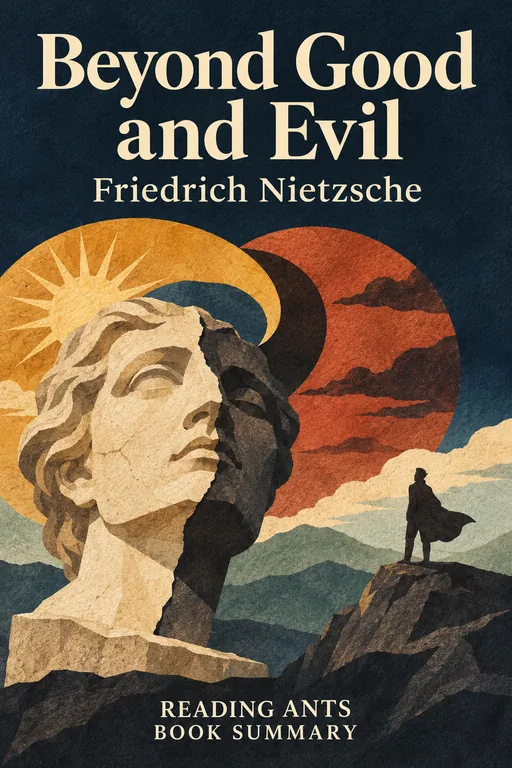
Beyond Good and Evil
Original title: Jenseits von Gut und Böse
Nietzsche challenges the assumptions of earlier philosophers and moralists, argues that our values are shaped by hidden drives and perspectives, and calls for free spirits who dare to question good and evil themselves.
Overview
Beyond Good and Evil: Prelude to a Philosophy of the Future was published in 1886 by Friedrich Nietzsche, a German philosopher who had been a professor of classical languages. It is made up of nearly three hundred short sections, some a line or two, others several pages, arranged in nine parts, along with a poem at the end. The style is provocative, ironic and full of sharp aphorisms. It follows his more poetic Thus Spoke Zarathustra, and gives a more direct statement of his critique of morality and philosophy. It is a difficult book, which has been interpreted in many ways.
Full Summary
1. The prejudices of philosophers
The idea: Nietzsche begins by questioning the supposed love of truth that drives philosophers. He asks why they want truth rather than untruth, and suggests that behind their abstract systems lie personal drives and moral prejudices, which they disguise as pure reason. Philosophy, he says, is often the confession of its author. The belief that good must come from good and that opposites cannot arise from each other is, in his view, a basic prejudice.
In real life: When someone argues very hard for an idea, it can be worth asking what they hope to gain from it.
2. Perspectives and the free spirit
The idea: Nietzsche argues that all knowledge is from some perspective, and that there is no view from nowhere. This does not mean that all views are equal, but that we should be aware of our standpoint, and learn to see from many angles. He calls on “free spirits,” independent thinkers who are willing to doubt and to experiment, and who can live with uncertainty. Such people, he says, are rare, and they are dangerous to established opinion.
In real life: Learning about a conflict from both sides makes your understanding richer.
3. The will to power
The idea: Nietzsche proposes that the basic drive in life is not merely survival or pleasure but a will to power, a tendency to grow, to overcome resistance and to express strength. He tries to explain psychology and morality in terms of this drive. The concept includes self-overcoming and creative force, but also command, appropriation and the domination of others, and scholars disagree about how to read it. He applies it to understanding behavior from science to religion.
In real life: A person who works to master a difficult skill is expressing a kind of drive to grow.
4. Master and slave morality
The idea: One of his best-known ideas is the contrast between two types of morality. Master morality, which arises among the strong and noble, values qualities such as strength, pride and creativity, and calls “good” what is powerful and “bad” what is weak. Slave morality, which arises among the oppressed, values humility, pity and patience, and calls “evil” the strong who threaten them. He suggests that Christian morality grew from the second type, and that modern values come largely from it.
In real life: What one group sees as pride, another may see as arrogance, and the words used reveal their position.
5. The herd and the critique of modern ideas
The idea: Nietzsche criticizes modern democracy, the cult of equality and the “herd” instinct, in which people conform and fear difference. He argues that these tendencies reduce human beings to a mediocre average, and fear great, exceptional individuals. His comments on women, nations and religions are provocative and often offensive to modern readers. He also criticizes utilitarian ideas that happiness is the highest goal, saying that suffering and difficulty can be a source of growth.
In real life: Following the crowd may feel safe, but can keep you from developing your own voice.
6. What is noble?
The idea: In the last part, Nietzsche sketches an ideal of nobility: a person with a sense of distance from the crowd, self-respect, the courage to say yes to life and a commitment to create values of his own. Nietzsche’s idea of nobility is aristocratic: it is tied to rank, breeding and what he calls a pathos of distance, as well as to character, so it is not a modern ideal of equal opportunity. The book ends with a poem about friendship and the longing for new companions on a path to the future. Elsewhere in the book, Nietzsche hopes for future philosophers who would be commanders and legislators of new values.
In real life: Choosing your own goals, instead of those that others expect, is a way of living by your own values.
Why It Matters
Beyond Good and Evil is one of the most influential books of modern philosophy. It shaped existentialism, psychoanalysis, postmodern thought and literature in the twentieth century, and affected thinkers such as Heidegger, Freud, Sartre and Foucault. Nietzsche’s insight that moral beliefs have a history and psychology, and that they can be examined as products of human needs, opened a new way of studying ethics. At the same time, his writings were distorted by others, notably by his sister, and exploited by the Nazis, though many scholars have shown that this was a misreading. The book remains challenging and widely discussed.
Key Takeaways
- Question your assumptions. Even our love of truth has hidden motives.
- Perspective matters. All knowledge is seen from a point of view.
- Values have origins. Moral systems arise from human needs and power.
- Be your own person. Resist conformity and think for yourself.
- Growth requires struggle. Difficulty can build strength.
What We Can Learn
One lesson is to examine your own beliefs and ask where they come from, and whether they are really yours. Practice looking at an issue from several points of view. Notice how fashion and the herd influence your tastes and ideas. Test yourself in tasks that are difficult, and see what you learn. At the same time, read Nietzsche critically, since some of his remarks are harsh or prejudiced, and the ideas of the will to power and the noble individual can be misused. Discuss them with others, and consider opposing views.
Criticism and Counterpoints
Critics have charged that Nietzsche is elitist and contemptuous of ordinary people, and that his praise of strength and his attack on compassion can be used to justify cruelty. Many find his remarks on women, races and nations offensive. Philosophers point out that his arguments are often more rhetorical than systematic, and that his view of perspectivism may undermine itself. The Nazis’ use of his name was based on distortion, but it shows the risks of his rhetoric. Defenders argue that his writing is ironic and meant to provoke thought, not to give simple doctrines.
Who Should Read It
This book is for readers who are curious about philosophy and are ready for a challenging, sometimes disturbing text. It is made of short sections that can be read separately. Beginners may benefit from an introduction, and from reading it alongside commentaries to avoid misunderstanding.
Want the whole book?
A summary is a taste, not the meal. Here is where to find the full book.
You reached the end 🎉
Nicely done. Mark this one as read, and we will suggest what to read next.
Read this next
Thus Spoke Zarathustra
Friedrich Nietzsche
In poetic speeches given by a wandering prophet named Zarathustra, Nietzsche announces the death of the old religious worldview and urges humans to create new values and overcome themselves.
🕊️ Philosophy & Religion
Existentialism Is a Humanism
Jean-Paul Sartre
In a lecture given in Paris in 1945, Jean-Paul Sartre explains and defends existentialism, arguing that humans have no fixed nature, that we create ourselves through our choices, and that this freedom brings full responsibility.
🕊️ Philosophy & Religion
The Problems of Philosophy
Bertrand Russell
Bertrand Russell gives a short, clear introduction to the big questions of philosophy about reality, knowledge and truth, and argues that the value of philosophy lies in widening our minds, not in giving final answers.
🕊️ Philosophy & Religion
Critique of Pure Reason
Immanuel Kant
Immanuel Kant argues that our knowledge is shaped by the structures of our own minds, so that we can know the world only as it appears to us, and that reason goes astray when it tries to answer questions beyond possible experience.
🕊️ Philosophy & Religion
Meditations on First Philosophy
Rene Descartes
Descartes doubts everything that can be doubted, to find a firm foundation for knowledge, and discovers that he exists as a thinking being, from which he tries to rebuild his picture of God, mind and the world.
🕊️ Philosophy & Religion
The Art of War
Sun Tzu
The greatest victory is the one won without fighting, achieved through careful planning, knowing both yourself and your opponent, and using deception, flexibility and timing.
🕊️ Philosophy & ReligionWant something different?
Pick another topic and we will show you three books to start with.