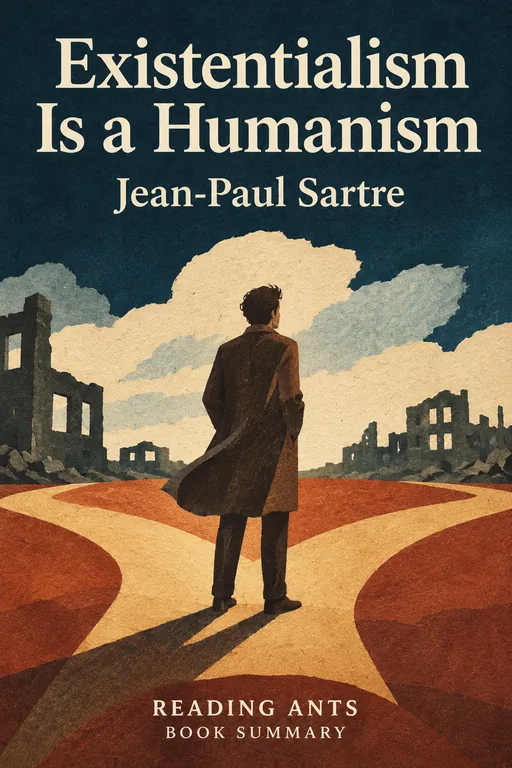
Existentialism Is a Humanism
Original title: L'existentialisme est un humanisme
In a lecture given in Paris in 1945, Jean-Paul Sartre explains and defends existentialism, arguing that humans have no fixed nature, that we create ourselves through our choices, and that this freedom brings full responsibility.
Overview
Existentialism Is a Humanism is a short text based on a public lecture that Sartre gave in October 1945, soon after the end of the Second World War, and published the following year. Sartre was a French philosopher, novelist and playwright, who had become famous. Existentialism was then a fashionable but misunderstood movement, accused by some Christians and Communists of being gloomy, a philosophy of passive despair, or a license to do as one likes. Sartre aimed to explain it in plain terms and to answer these criticisms. Later he came to regret publishing the lecture and distanced himself from parts of it, but it remains one of the easiest ways into his thought.
Full Summary
1. Existence precedes essence
The idea: The key phrase of the lecture is that, for human beings, existence comes before essence. Sartre is speaking of atheistic existentialism, and he acknowledges that Christian existentialists exist too. A paper knife, he says, is made according to an idea in the mind of its maker, so its essence, what it is for, comes before it exists. But there is no such maker for a human being. We first exist, appear in the world, and only afterward define ourselves by what we do. There is no fixed human nature that determines in advance what we are.
In real life: A tool is made for a purpose, but you are not born with a purpose that you have to follow.
2. We are what we make of ourselves
The idea: Because there is no pre-given nature, a person is nothing other than the sum of his actions and choices. Sartre says that people are what they project themselves to be. A coward is not born a coward, but makes himself one by cowardly acts, and he can become otherwise. This view puts the responsibility on the individual, since we cannot blame heredity, environment or fate for how we respond to our situation. Sartre does not say that circumstances or coercion disappear, only that we are responsible for our stance within them.
In real life: Saying “I’m just not a person who does that” can be a way to avoid making a choice.
3. Anguish, abandonment and despair
The idea: Sartre says that existentialism leads to three feelings. Anguish arises from realizing that, in choosing for oneself, one also chooses for all humanity, as if setting an example of what a person should be. Abandonment, or forlornness, is the recognition that there is no God or fixed value to rely on, and we must decide for ourselves. Despair means acting without counting on things beyond our control. He insists that these feelings do not lead to inaction, but to commitment.
In real life: Making a big decision, like a career choice, can feel heavy because no one else can make it for you.
4. The student’s dilemma
The idea: Sartre gives an example. A young man during the war comes to him, torn between staying with his mother, who depends on him, and leaving to join the Free French forces. Neither tradition nor moral theory can resolve it. Sartre says that he could only tell the young man that he was free, and had to choose and invent his own answer. No general rule can decide for the young man, who must decide what to value most, and in doing so, he creates his value.
In real life: Sometimes advice from others does not settle a hard choice, and you must decide for yourself.
5. Responsibility and humanism
The idea: Answering the charge that existentialism is a selfish philosophy, Sartre argues that it leads to responsibility toward all people. When we choose, we choose for everyone, so we must consider what would happen if everyone acted that way. He also says that the existentialist’s humanism does not mean worshipping humanity as a whole, but that human beings are always making themselves and the human future, and that we must work for freedom, ours and that of others.
In real life: Deciding whether to tell the truth also decides what kind of world you are helping to build.
6. Against excuses
The idea: Sartre also attacks what he calls bad faith, the attempt to deny our freedom by pretending that we are determined by circumstances, character or social roles. He claims that people often hide behind excuses, and that existentialism strips these away. He says that it is a philosophy of action and optimism, since it tells us that the future is open, and that we are free to make a life of meaning, even though the world has no built-in purpose.
In real life: Blaming your upbringing or mood for everything denies your power to change.
Why It Matters
This lecture became a manifesto of existentialism, and introduced many readers to its main ideas. It reflects the mood of postwar France, when many were searching for new foundations after the collapse of old certainties, and it shaped the intellectual climate of the twentieth century. Sartre’s notions of freedom, responsibility and authenticity have influenced philosophy, psychology, literature and politics. The text is often used as an introduction to the movement. Even those who disagree with it find that it states clearly what is at stake: whether meaning is given or made.
Key Takeaways
- We are not born with a fixed nature. We define ourselves through actions.
- Freedom brings responsibility. Each choice shapes us and sets an example.
- Circumstances limit us, but do not excuse us. Sartre says that we are responsible for how we respond to our situation, and that blaming circumstances is bad faith.
- No rule can settle every dilemma. Some choices must be made without a guide.
- The future is open. We can act to create meaning.
What We Can Learn
When you are faced with a decision, ask what you value, and what the choice says about the person you want to be. Notice excuses that you use to avoid acting, such as “that’s just how I am.” Think about how your choices affect others, and whether you would be willing for everyone to do the same. Accept that anxiety about big decisions is normal, and does not mean you have done something wrong. And remember that you can begin to change at any time.
Criticism and Counterpoints
Critics say that Sartre’s view of unlimited freedom ignores the real limits set by social conditions, psychology and biology, and that it places an impossible burden on the individual. Some argue that without objective values, the claim that we choose for all humanity has no basis. Marxist critics said that it was too individualistic, and Catholic critics that it was a denial of God and moral law. Sartre himself later modified his views, giving more weight to social conditions. The lecture style is also criticized as an oversimplification of the larger work, Being and Nothingness.
Who Should Read It
This book is for readers who are curious about existentialism, ethics and the question of how to live. It is short and fairly clear, and a good first step before reading Sartre’s novels or his larger philosophical works. Those who want a full and subtle account should read the longer works.
Want the whole book?
A summary is a taste, not the meal. Here is where to find the full book.
You reached the end 🎉
Nicely done. Mark this one as read, and we will suggest what to read next.
Read this next
Nausea
Jean-Paul Sartre
A lonely historian in a French port town is overcome by a sickening awareness that things simply exist, without reason, and he searches for a way to live with this.
🌍 World Literature
Beyond Good and Evil
Friedrich Nietzsche
Nietzsche challenges the assumptions of earlier philosophers and moralists, argues that our values are shaped by hidden drives and perspectives, and calls for free spirits who dare to question good and evil themselves.
🕊️ Philosophy & Religion
The Myth of Sisyphus
Albert Camus
Camus asks whether life is worth living in a universe without clear meaning, and answers that we should accept the absurd, live with full passion and revolt, and imagine Sisyphus as happy.
🕊️ Philosophy & Religion
No Longer Human
Osamu Dazai
A man who feels like an alien among other people hides behind a mask of clowning, and sinks, through drink, drugs and failed relationships, into despair.
🌍 World Literature
The Stranger
Albert Camus
An emotionally detached office worker kills a man on an Algerian beach and discovers that society condemns him as much for refusing its expected feelings as for the murder itself.
🌍 World Literature
The Art of War
Sun Tzu
The greatest victory is the one won without fighting, achieved through careful planning, knowing both yourself and your opponent, and using deception, flexibility and timing.
🕊️ Philosophy & ReligionWant something different?
Pick another topic and we will show you three books to start with.