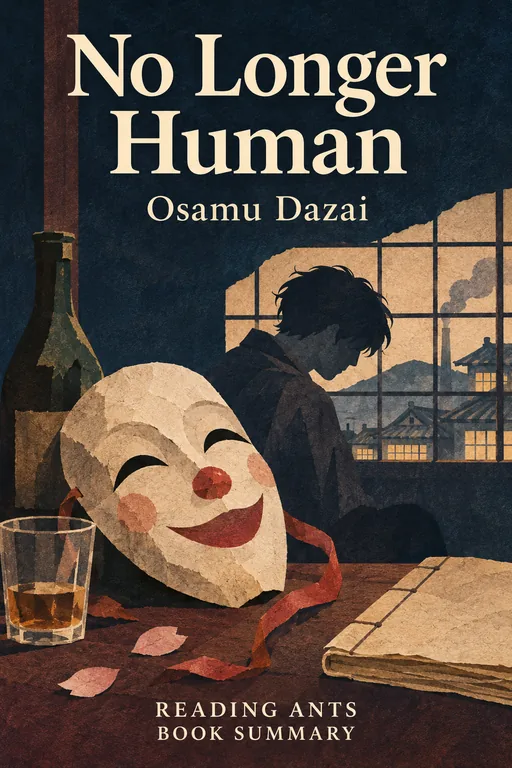
No Longer Human
Original title: 人間失格
A man who feels like an alien among other people hides behind a mask of clowning, and sinks, through drink, drugs and failed relationships, into despair.
Overview
No Longer Human is a novel by the Japanese writer Osamu Dazai, published in 1948, shortly before his death. It is presented as three notebooks written by a man named Oba Yozo, with a preface and an afterword by a framing narrator. The story is set in Japan in the early twentieth century, before and during the Second World War. The book is a confession of deep alienation and self-hatred, and it is one of the best-selling novels in Japan. It deals openly with suicide, addiction and depression, and it can be hard to read. Readers who are struggling should take care and reach out for support.
Main Characters
- Oba Yozo: the main character, who tells his own story.
- Takeichi: a schoolmate, who sees through Yozo’s act.
- Horiki: a drinking companion, a cynical friend who leads him into the city’s low life.
- Tsuneko: a woman, with whom Yozo attempts a double suicide.
- Shizuko: a magazine journalist with a young daughter, who takes him in for a time.
- Yoshiko: a pure-hearted young woman, who becomes his wife.
Full Summary
The First Notebook: The Mask
Yozo begins by saying that he has lived a life full of shame. As a child, he did not understand what other people wanted, or why they were happy. He was afraid of humanity. To protect himself, he developed a habit of clowning, to make others laugh, so that no one would see how afraid he was.
His family is wealthy, but he is miserable, and he feels like a fraud. As a child, he was sexually abused by servants, and was too afraid to tell anyone, which deepens his sense of being cut off from others. The only one who sees through his act is a schoolmate, Takeichi, who tells him that he did it on purpose, which terrifies him.
The Second Notebook: Dissipation
Yozo goes to Tokyo to study, and falls in with Horiki, who introduces him to alcohol, prostitutes and left-wing politics. He finds that the world of the outcasts is more comfortable than that of respectable people. He drinks heavily, and becomes involved in secret political meetings.
He meets Tsuneko, a married woman, who is also deeply unhappy. They decide to die together by drowning themselves in the sea. Tsuneko dies, but Yozo survives. He is questioned by the police, and his family turns away from him.
The Third Notebook: Decline
After this, Yozo is taken in by Shizuko, a woman who works as a journalist. He lives with her and her little girl, but he is a burden. He drinks more, and his work as a cartoonist brings little money.
Later he meets Yoshiko, a young woman who is innocent and trusting, and they move in together. For a moment, Yozo feels that he may find peace. But Yoshiko is sexually assaulted by a man while Yozo watches, unable to act, and the event destroys his fragile trust. The fault is not hers, though Yozo’s damaged mind cannot bear it.
Drugs and the Hospital
Yozo, who is overcome with despair, tries again to end his life, and starts using morphine. He becomes addicted, and begins to sell things to pay for the drug. His family finds him, and he is taken to a mental hospital.
There, he feels that he is “no longer human,” a person who has failed at being a person. He is released and sent to live in the countryside, with an old housekeeper, as a kind of exile.
The Country House
In the countryside, Yozo lives in a small house with an elderly housekeeper, expecting nothing. He is still young, in his late twenties, but he looks much older, and he sees his life as already over.
He says, in the last lines of his notebook, that he does not know anymore what happiness or unhappiness is. Everything, he says, simply passes by.
The Afterword
The framing narrator, who has read the notebooks, meets the woman who ran a bar that Yozo used to visit, and who says that he was a good, gentle man, “like a god.” The reader is left to consider the contrast between how he saw himself, and how others saw him.
The book ends there, without a clear resolution.
Why It Matters
No Longer Human is one of the best-selling novels in Japanese history, and it continues to be read by young people. It is often seen as a mirror of the author, Dazai, who struggled with depression and addiction, and died by suicide in 1948. The book has been adapted for film and manga, and has been translated into many languages. Its depiction of alienation has resonated with readers around the world, and it is a major work of modern Japanese literature. It is often mentioned alongside Natsume Soseki’s Kokoro among the most widely read Japanese novels of the twentieth century, and it is regularly rediscovered by each new generation of young readers, who see their own feelings of not fitting in reflected in it.
Key Takeaways
- Masks isolate. Yozo’s performance keeps people at a distance.
- Shame can be crushing. His self-image ruins his life.
- Others may see us differently. The afterword suggests that Yozo was not what he thought.
- Addiction deepens despair. Drink and drugs worsen his condition.
- Loneliness is a serious illness. The book shows its toll.
What We Can Learn
The book shows how painful it is to feel cut off from others, and how a habit of hiding can make that feeling worse. It reminds us that being open with trusted people can help. If you recognize yourself in Yozo, please talk to a friend, family member or a professional, and seek help.
It also reminds us to be kind to those who seem withdrawn or hard to understand, as they may be suffering. Finally, it shows that how we see ourselves is not always how others see us.
Criticism and Counterpoints
Some readers find the book’s self-pity and passivity frustrating, and they point out that Yozo blames the world for his own choices. Its treatment of women, who are often used and discarded, has been criticized. Some also worry that the book, which is so bleak, may lead vulnerable readers to romanticize despair or suicide. Others say that the book’s honesty is what makes it valuable, and that it gives words to feelings that many people find hard to express. Some also point out that the book’s mix of humor and misery is easy to miss in translation, and that readers should remember it is a work of fiction, not a guide to living.
Who Should Read It
This book is for mature readers who are interested in psychological novels and Japanese literature. It is short but heavy. Those who are in a difficult emotional place should consider reading it with support, or choosing a lighter book.
Want the whole book?
A summary is a taste, not the meal. Here is where to find the full book.
You reached the end 🎉
Nicely done. Mark this one as read, and we will suggest what to read next.
Read this next
Kokoro
Natsume Soseki
A young student befriends a quiet, haunted older man known as "Sensei," and learns, from a long letter, the secret of guilt and betrayal that has shadowed his life.
🌍 World Literature
The Bell Jar
Sylvia Plath
A talented young woman named Esther Greenwood, who seems to be on the path to success in 1950s America, sinks into depression and a suicide attempt, and slowly begins to recover.
📜 ClassicsThe Catcher in the Rye
J. D. Salinger
After being expelled from his boarding school, a lonely, sarcastic sixteen-year-old wanders New York City for three days, struggling with grief, phoniness and the frightening idea of growing up.
📜 Classics
Notes from Underground
Fyodor Dostoevsky
A bitter, lonely former clerk who lives in a squalid underground existence writes an angry confession about his own spite, his contempt for the world and a humiliating episode from his past.
🌍 World Literature
Nausea
Jean-Paul Sartre
A lonely historian in a French port town is overcome by a sickening awareness that things simply exist, without reason, and he searches for a way to live with this.
🌍 World Literature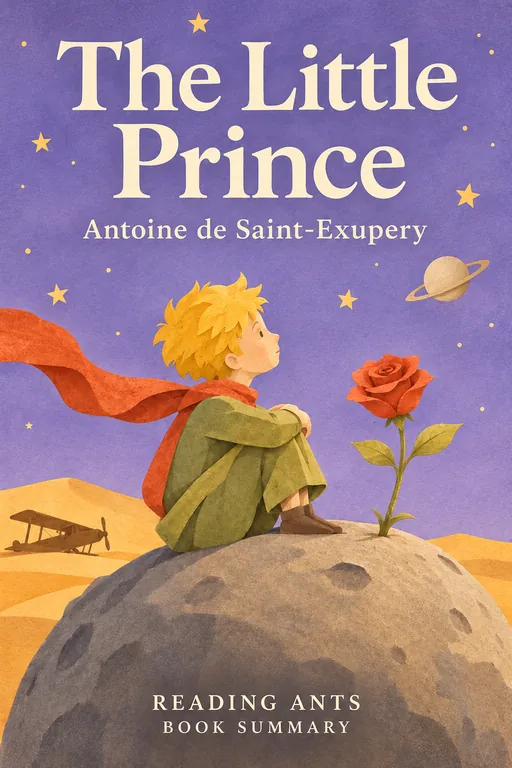
The Little Prince
Antoine de Saint-Exupery
A pilot stranded in the desert meets a small boy from a tiny planet, who teaches him that the most important things in life, like love and friendship, can only be seen with the heart.
🌍 World LiteratureWant something different?
Pick another topic and we will show you three books to start with.