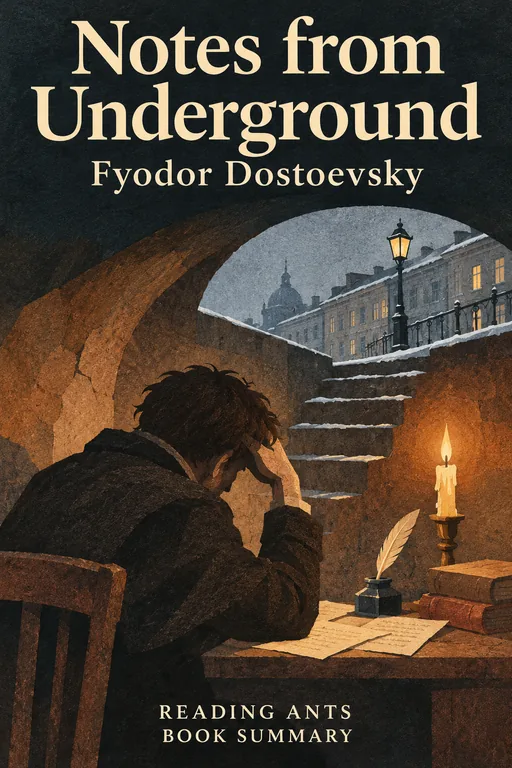
Notes from Underground
Original title: Записки из подполья
A bitter, lonely former clerk who lives in a squalid underground existence writes an angry confession about his own spite, his contempt for the world and a humiliating episode from his past.
Overview
Notes from Underground is a short novel by Fyodor Dostoevsky, published in 1864. It is narrated by a nameless man in his forties, a retired minor official in St. Petersburg, who describes himself as sick, spiteful and unattractive. The book has two parts. In the first, he argues with an imagined audience about free will, reason and why people sometimes act against their own interest. In the second, he describes events from sixteen years earlier, when he humiliated himself and others. It is a work that looks ahead to the great novels that Dostoevsky wrote afterward, and it is often called the first existentialist novel.
Main Characters
- The Underground Man: the narrator, a bitter, self-conscious former civil servant.
- Zverkov: a successful former schoolmate whom the narrator envies and resents.
- Simonov: an acquaintance of the narrator, who organizes a farewell dinner.
- Liza: a young woman who works as a prostitute and whom the narrator meets.
- Apollon: the narrator’s servant, with whom he has a petty war.
Full Summary
The Underground
The book begins with the narrator’s voice, telling readers that he is a sick man, a spiteful man, and an unattractive one. He lives in a small, dingy apartment in St. Petersburg, which he calls his “underground,” and he has quit his job after a distant relative left him some money. He is intelligent and well-read, and he is full of resentment.
In the first part, he argues with an imagined reader about the philosophy of his day. Many thinkers believed that human behavior could be explained by reason, and that people would always choose what is best for them. The narrator says that this is false: people sometimes act against their own interest, just to prove that they are free. He argues that it is more important to be able to choose than to be happy.
The Wet Snow
The second part, called “Apropos of the Wet Snow,” tells of events when the narrator was twenty-four. He was a lonely clerk who felt humiliated by the world, and who longed to be noticed. One day, he stands in the way of an army officer in a tavern, who simply moves him aside, as if he were not even there. The narrator is deeply hurt, and he nurses the grudge for years, until a deliberate shoulder-to-shoulder bump on a fashionable street lets him feel avenged.
He also visits Simonov, an old schoolmate, and finds him with two others planning a farewell dinner for a former classmate named Zverkov. He invites himself, though he is not welcome. He attends, wearing a worn suit, and is treated with polite scorn.
The Dinner
At the dinner, the narrator makes a fool of himself. He insults the guests, argues, and makes a scene. They largely ignore him, and he feels more and more alone. When the others leave for a brothel without him, he is left behind, ashamed and burning for revenge. He borrows some money from Simonov and rushes after them, vowing to slap Zverkov and force him into a duel, but when he arrives the party has already split up and there is no one to confront.
The scene shows his mix of pride and self-loathing. He wants to be respected, but he insists on behaving in ways that make this impossible.
Liza
At the brothel, the narrator meets Liza, a young prostitute. He talks with her and, wanting to feel powerful, he delivers a speech about the misery of her life, and what will happen to her when she is old. She is moved, and she seems to see a chance for escape. He gives her his address, and she says that she will visit him.
When she arrives at his apartment, he is in the middle of a quarrel with his servant, and his furniture is shabby. He is embarrassed and angry, and he says cruel things to her. He breaks down in tears and confesses his misery, and Liza, moved, embraces him with real compassion. He cannot bear her kindness, and he turns on her again, humiliating her by pressing money into her hand. She leaves the money behind, and he is humiliated once more.
The End
The narrator rushes into the street to find her, but she is gone. He realizes that he has missed a chance for human contact. The book ends with a note from an editor, who says that the notes of this “paradoxist” go on, but that it is best to stop here.
The final lines suggest that the narrator is a man who cannot change, who wants love but cannot accept it, and who remains in his underground.
Why It Matters
Notes from Underground is one of the most important works of nineteenth-century literature, and it has had a huge influence on philosophy and fiction. Its narrator, with his mix of self-hatred, pride and intelligence, is among the most memorable characters in the novel, and he was a model for later figures in the work of Kafka, Camus, Sartre and many others. The first part, with its argument about free will and reason, is often cited in debates about human nature.
It also marks a turning point in Dostoevsky’s own career, since it introduces themes of guilt, freedom and spiritual crisis that he explored in Crime and Punishment and The Brothers Karamazov.
Key Takeaways
- People are not only rational. We sometimes act against our own interest.
- Freedom matters to human dignity. The narrator values choice above comfort.
- Self-contempt and pride go together. He is both ashamed and arrogant.
- Isolation can poison. The narrator is ruined by loneliness.
- We can reject kindness. He pushes away Liza’s compassion.
What We Can Learn
The book invites us to look honestly at our own bitterness and pride. The narrator does not like himself, and he lashes out, hoping that others will see how clever or wounded he is. Noticing this impulse in ourselves, and choosing a kinder response, could save us from many a quarrel.
It also warns against a life lived only in the mind. The narrator reads, thinks and argues, but he does not take part in the world, and he becomes more and more alone. Making time for real people and real action is a healthy balance.
Finally, the story shows how much a small act of kindness can matter, and how sad it is when we fail to accept it.
Criticism and Counterpoints
Some readers find the narrator unbearable, since he is petty and cruel, and the first part can be a hard read, with its dense arguments. Others say that the book is an attack on a philosophy of rational self-interest that few people really held, so that its target is partly a straw man. A few criticize the treatment of Liza, who is used as a means for the narrator’s story and who does not have a voice of her own.
Still, it remains a landmark.
Who Should Read It
This book is for mature teenagers and adults who enjoy psychological and philosophical fiction. It is short, but it is demanding and dark. It is a good starting point for readers who want to try Dostoevsky, and for anyone interested in the roots of existentialism.
Want the whole book?
A summary is a taste, not the meal. Here is where to find the full book.
You reached the end 🎉
Nicely done. Mark this one as read, and we will suggest what to read next.
Read this next
Crime and Punishment
Fyodor Dostoevsky
A poor former student in St. Petersburg murders an old pawnbroker to prove he is an extraordinary man above ordinary morality, then is tormented by guilt until love and confession offer him a path to redemption.
🌍 World Literature
The Brothers Karamazov
Fyodor Dostoevsky
When a vulgar, greedy landowner is murdered, his three very different sons, a passionate soldier, a rational intellectual and a gentle novice monk, are drawn into a mystery that is also a debate about faith, doubt, guilt and freedom.
🌍 World Literature
The Stranger
Albert Camus
An emotionally detached office worker kills a man on an Algerian beach and discovers that society condemns him as much for refusing its expected feelings as for the murder itself.
🌍 World Literature
The Metamorphosis
Franz Kafka
A hardworking traveling salesman wakes one morning to find himself transformed into a monstrous insect, and his family's love for him slowly turns to disgust and neglect.
🌍 World Literature
The Myth of Sisyphus
Albert Camus
Camus asks whether life is worth living in a universe without clear meaning, and answers that we should accept the absurd, live with full passion and revolt, and imagine Sisyphus as happy.
🕊️ Philosophy & Religion
The Little Prince
Antoine de Saint-Exupery
A pilot stranded in the desert meets a small boy from a tiny planet, who teaches him that the most important things in life, like love and friendship, can only be seen with the heart.
🌍 World LiteratureWant something different?
Pick another topic and we will show you three books to start with.