 Reading Ants
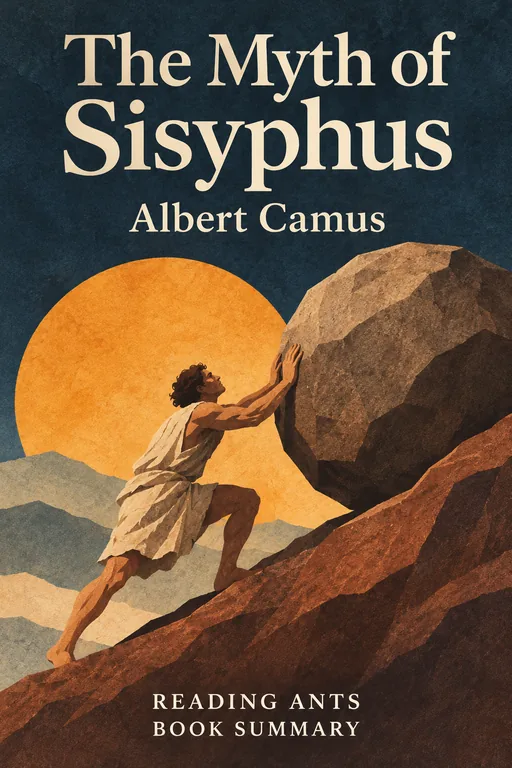
The Myth of Sisyphus
Original title: Le Mythe de Sisyphe
Camus asks whether life is worth living in a universe without clear meaning, and answers that we should accept the absurd, live with full passion and revolt, and imagine Sisyphus as happy.
Overview
The Myth of Sisyphus is a philosophical essay by the French-Algerian writer Albert Camus, published in 1942, during the German occupation of France. Camus was in his late twenties when he wrote it, and it appeared the same year as his novel The Stranger. The two works are often read together as a study of the absurd. The essay opens with a shocking claim: the one truly serious philosophical problem is suicide, since judging whether life is worth living answers the basic question of philosophy. Camus then explores how a person can live with the feeling that the world is meaningless without escaping into false hope. Although he is often associated with existentialism, Camus rejected the label.
Full Summary
1. The question of suicide
The idea: Camus starts by saying that the first question for philosophy is whether life is worth living. Everything else, such as whether the world has three dimensions, is secondary. People take their lives because they judge life not worth living, often because the habits that sustained them lose their meaning, and a feeling of strangeness or emptiness arises. He wants to look for an honest answer, without relying on comforting illusions.
In real life: Many people sometimes feel that routines, like work and school, lose their meaning, and Camus takes that feeling seriously instead of dismissing it.
2. What is the absurd?
The idea: The absurd, Camus explains, is not found in the world alone or in the human mind alone, but arises from the clash between the two: our deep need for meaning, clarity and order, and the silent, indifferent universe that offers none. We ask for reasons and the world answers with silence. The absurd is thus a relationship, and to live with it means to keep both sides in view, without denying either.
In real life: Think of asking “Why did this happen?” after a sudden loss, and finding no satisfying answer.
3. Refusing escapes
The idea: Camus discusses two main ways people try to avoid the absurd. One is suicide, which ends the tension but also ends the awareness that creates it, and which Camus rejects. The other is what he calls “philosophical suicide,” or a leap of faith: the move of thinkers like Kierkegaard, Jaspers and others who respond to the lack of meaning by asserting a hidden meaning or a transcendent God. Camus argues that this leap is dishonest, because it gives up the lucid recognition of the absurd.
In real life: A person who explains every misfortune as “meant to be” may feel comforted but may also stop asking honest questions.
4. Revolt, freedom and passion
The idea: If suicide and false hope are both ruled out, what remains is to live with the absurd, consciously. Camus draws three consequences: revolt, continuing to ask and to resist even though there is no final answer; freedom, since without a fixed purpose, we are free from imposed goals; and passion, living as intensely as possible and valuing the quantity and richness of experience. We do not have to find meaning in the end to find value in what we do.
In real life: Someone who plays music or sport for the sheer love of it does not need a cosmic reason for it to matter.
5. The absurd man
The idea: Camus gives examples of “absurd” lives: the seducer, Don Juan, who lives for variety and the present moment; the actor, who lives many lives in a brief time; and the conqueror, who acts without hope of lasting victory. None is a model to imitate, but they show people who live without appeals to eternity. He also discusses the artist and the absurd creator, who makes things without expecting them to explain the world.
In real life: Doing a task well for its own sake, such as cooking a good meal or making a drawing, is a modest example.
6. The myth of Sisyphus
The idea: In the final section, Camus retells the Greek myth of Sisyphus, who was condemned by the gods to push a boulder up a mountain, only to see it roll back down each time, forever. Camus sees him as the absurd hero. Sisyphus is conscious of his fate, and in the moments when he walks back down to the rock, he is superior to it. Camus concludes that the struggle itself is enough to fill a person’s heart, and that we must imagine Sisyphus happy.
In real life: A person who keeps doing daily tasks with awareness and dignity can find satisfaction in the effort itself.
Why It Matters
The Myth of Sisyphus is one of the best-known philosophical essays of the twentieth century. It gave the idea of the absurd a clear form and influenced literature, theater and philosophy. Camus received the Nobel Prize in Literature in 1957, in part for his work exploring the problems of the human conscience in our time.
The image of Sisyphus has become a common symbol for repetitive struggle and resilience. The essay is widely read by students and by anyone who has asked what the point of it all is, and it continues to inspire discussion.
Key Takeaways
- Face the question honestly. Ask whether life is worth living without illusions.
- The absurd is a clash. Our need for meaning meets a silent world.
- Do not escape. Neither suicide nor false hope solves the problem.
- Live with revolt, freedom and passion. Value the experience of life itself.
- Struggle can be enough. Sisyphus finds meaning in the effort.
What We Can Learn
The essay invites us to treat the question of meaning seriously and without fear. Admitting that we do not have all the answers can be a first step toward living honestly.
It also suggests that meaning does not have to come from a grand plan. We can create value through love, work, curiosity and attention, in the here and now.
Finally, it encourages courage. Camus does not say that life is easy, but that we can face it with dignity and even joy, and that solidarity with others in the same struggle can help.
Criticism and Counterpoints
Critics argue that Camus’s reasoning is not strict. Some say that moving from the feeling of the absurd to the conclusion that suicide is wrong, or that revolt is the right response, is not logically required. Others say that the essay is too brief and poetic to count as a full philosophical argument, and that his treatment of other thinkers, including Kierkegaard, is unfair.
Religious readers often reject his dismissal of faith, while some existentialists criticize his refusal to propose a positive ethic. The essay also barely mentions the practical needs of people in poverty or war. Still, many find the question and the response compelling and relevant.
Who Should Read It
This book suits mature readers and older teenagers with an interest in philosophy. It discusses suicide as an idea, though it argues against it. Anyone in distress should seek support from people they trust or a professional. The essay is short but dense.
Want the whole book?
A summary is a taste, not the meal. Here is where to find the full book.
You reached the end 🎉
Nicely done. Mark this one as read, and we will suggest what to read next.
Read this next

The Stranger
Albert Camus
An emotionally detached office worker kills a man on an Algerian beach and discovers that society condemns him as much for refusing its expected feelings as for the murder itself.
🌍 World Literature
The Plague
Albert Camus
When plague seals an Algerian city off from the world, ordinary people must choose between denial, private escape and the patient shared work of resisting suffering.
🌍 World Literature
Thus Spoke Zarathustra
Friedrich Nietzsche
In poetic speeches given by a wandering prophet named Zarathustra, Nietzsche announces the death of the old religious worldview and urges humans to create new values and overcome themselves.
🕊️ Philosophy & Religion
Nausea
Jean-Paul Sartre
A lonely historian in a French port town is overcome by a sickening awareness that things simply exist, without reason, and he searches for a way to live with this.
🌍 World Literature
The Art of War
Sun Tzu
The greatest victory is the one won without fighting, achieved through careful planning, knowing both yourself and your opponent, and using deception, flexibility and timing.
🕊️ Philosophy & Religion
Meditations
Marcus Aurelius
The private notebook of a Roman emperor, reminding himself daily to accept what he cannot control, to act with justice and kindness, and to remember that life is short.
🕊️ Philosophy & ReligionWant something different?
Pick another topic and we will show you three books to start with.